


This article was automatically translated from the original Turkish version.
+1 More
Bell's Theorem
Short İnformation | The theorem violates Bell inequalities in the manner predicted by quantum mechanics, assuming that measurements between distant particles can be understood through hidden variables while adhering to the principle of locality. | ||||||||
|---|---|---|---|---|---|---|---|---|---|
Bell’s Theorem is a significant scientific result in quantum physics that helps us understand how certain particles are mysteriously connected. These particles are called “entangled,” because the bond between them is so strong that when one changes, the other is instantly affected—even if the particles are separated by vast distances.
In 1964, physicist John S. Bell developed a mathematical theorem showing that these connections cannot be explained by classical physics rules or by any local hidden rules (i.e., rules that only allow influence from nearby surroundings). This work was based on a thought experiment proposed earlier by Einstein and his colleagues. Einstein found the idea of particles influencing each other “instantly” unrealistic. However, Bell proved mathematically that such interactions cannot be explained by classical physics.
Over the years, numerous experiments have confirmed Bell’s idea. These experiments revealed a kind of “spooky” communication between particles that appears faster than the speed of light. Today, thanks to these surprising properties, scientists are developing technologies such as quantum cryptography (secure communication) and random number generation. Bell’s Theorem is a fundamental building block underlying these technologies.
In 1935, renowned scientist Albert Einstein and two colleagues, Podolsky and Rosen, raised an important question about quantum physics. This became known as the “EPR paradox.” They argued that quantum physics was insufficient to fully describe particle behavior. Measurements, they suggested, were not entirely random but must be governed by some kind of hidden order. In other words, outcomes were not purely a matter of chance but determined by unseen rules.
In 1964, physicist John S. Bell challenged this view by proposing a groundbreaking theory. Bell demonstrated that approaches relying on “local hidden variables” to explain particle correlations were inadequate to describe the actual behavior observed in the quantum world. To prove this mathematically, he introduced a set of inequalities. If these inequalities are violated in experiments, quantum physics is validated and classical explanations are invalidated.
In 1972, scientists Stuart Freedman and John Clauser conducted the first experiments testing Bell’s theory. The results showed that Bell was correct and that the predictions of quantum physics were accurate.
In 1982, French physicist Alain Aspect and his team performed even more advanced experiments. In these, measurement settings were randomly chosen at the last moment to prevent any external influence on the results. This further confirmed that quantum mechanics operates far more accurately than classical explanations could account for.
After 2015, highly careful experiments by Hensen and colleagues aimed to eliminate all remaining doubts about quantum physics. These experiments fully addressed issues such as distance effects, detector inefficiencies, and data sampling biases. As a result, it became definitively established that the mysterious connections between quantum particles cannot be explained by classical physics.
In local hidden variable models, each measurement outcome is defined by functions: for experimenter A, A(a,λ) ∈ {−1,+1}, and for experimenter B, B(b,λ) ∈ {−1,+1}. Here, a and b represent the settings of the measurement devices for A and B respectively, while λ denotes hidden parameters that vary from experiment to experiment. The distribution of hidden variables satisfies the condition ∫ρ(λ) dλ=1. The correlation between two distant measurements is defined by
equalities.
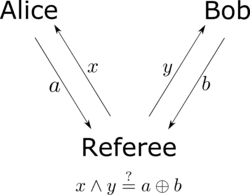
In 1969, Clauser, Horne, Shimony, and Holt derived the CHSH inequality, which defines the following function for four different combinations of measurement directions:
In local hidden variable theories, the absolute value of this quantity is always at most 2 (∣S∣≤2).
In quantum mechanics, particularly when using the most highly entangled two-qubit states (Bell states), the CHSH value can reach
This maximum value is called the Tsirelson bound and quantifies how strongly quantum correlations can exceed those allowed by local models.
Protocols have been developed that guarantee secure key exchange based solely on the violation of Bell’s inequality, independent of the reliability of the hardware. This ensures the confidentiality of communication even in the presence of malicious or faulty devices, as guaranteed by experimental results.
Bits from weak, predictable random sources can be transformed into cryptographically secure genuine random numbers using Bell test protocols. This enables high-quality randomness independent of hardware flaws.
In the coming years, one of the greatest goals for scientists will be to build a global quantum internet. This network will enable secure and robust connections across vast distances via quantum satellites. Thus, quantum-level data exchange will become possible between continents—for example, between Europe and Asia. All communication via air, land, and sea will eventually integrate with this quantum network.
New quantum repeaters, used alongside classical fiber-optic cables, will prevent signal degradation and maintain these connections over thousands of kilometers. Additionally, thanks to nano-satellites and low-cost data transmitters, this network will function not only in major cities but also in small towns and rural areas.
In these new systems, some nodes will both store information and communicate via light signals. This will allow atomic clocks and quantum memories to work together, enabling information to be transmitted rapidly and stored securely for extended periods.
In terms of security, the quantum internet will not only enhance encryption but also protect critical systems. For instance, banking transactions, hospital data, power grids, and water systems will become more secure. Quantum systems will even detect and prevent errors arising from hardware faults. In particular, smart cities will benefit greatly from quantum technologies in traffic and infrastructure management.
Quantum computing will also advance. Systems will be developed capable of simultaneously handling multiple users and processing units. In these systems, computations will be verified using special validation methods based on Bell’s Theorem, ensuring their accuracy. Thus, cloud-based quantum systems will surpass classical computers and solve even highly complex problems without error.
Moreover, quantum sensors will enable us to measure the world with unprecedented precision. These sensors will be used in fields ranging from subsurface exploration to detailed medical imaging. Shared entanglement among sensors will enhance signal clarity, making it easier to detect weak data. Time measurements will become far more precise; while today we measure thousandths of a second, in the future we may achieve precision at the level of a trillionth of a second.
Finally, artificial intelligence will be integrated with quantum networks. Such systems will self-manage, select optimal paths to conserve energy, and correct errors when necessary. These intelligent quantum networks will form the core of future communication systems.
Aspect, Alain. “Bell’s Theorem: The Naive View of an Experimentalist.” *Reviews of Modern Physics* 65, no. 4 (1993): 803–815. Accessed May 3, 2025. https://journals.aps.org/rmp/abstract/10.1103/RevModPhys.65.803
Brunner, Nicolas, Daniel Cavalcanti, Stefano Pironio, Valerio Scarani, and Stephanie Wehner. “Bell Nonlocality.” *Journal of Physics A: Mathematical and Theoretical* 47, no. 42 (2014): 424001. Accessed May 3, 2025. https://iopscience.iop.org/article/10.1088/1751-8113/47/42/424001/meta
Gisin, Nicolas. “Bell Inequalities: Many Questions, a Few Answers.” *eScholarship*, 2007. Accessed May 3, 2025. https://escholarship.org/content/qt7m59f6nz/qt7m59f6nz.pdf
Stairs, Allen. “Bell’s Theorem.” *The Stanford Encyclopedia of Philosophy*. Edited by Edward N. Zalta. Last modified Winter 2022. Accessed May 3, 2025. https://plato.stanford.edu/entries/bell-theorem/
Wiseman, Howard M. “Bell’s Theorem.” *Scholarpedia* 6, no. 10 (2011): 8378. Accessed May 3, 2025. http://www.scholarpedia.org/article/Bell%27s_theorem

Bell's Theorem
Short İnformation | The theorem violates Bell inequalities in the manner predicted by quantum mechanics, assuming that measurements between distant particles can be understood through hidden variables while adhering to the principle of locality. | ||||||||
|---|---|---|---|---|---|---|---|---|---|
History
Mathematical Foundations
Local Hidden Variable Theory and Correlation Function
CHSH Inequality
Tsirelson Bound
Experimental Confirmations
Applications
Device-Independent Quantum Key Distribution (DIQKD)
Randomness Generation and Expansion
Looking Ahead: Quantum Internet and New Possibilities