


+2 More

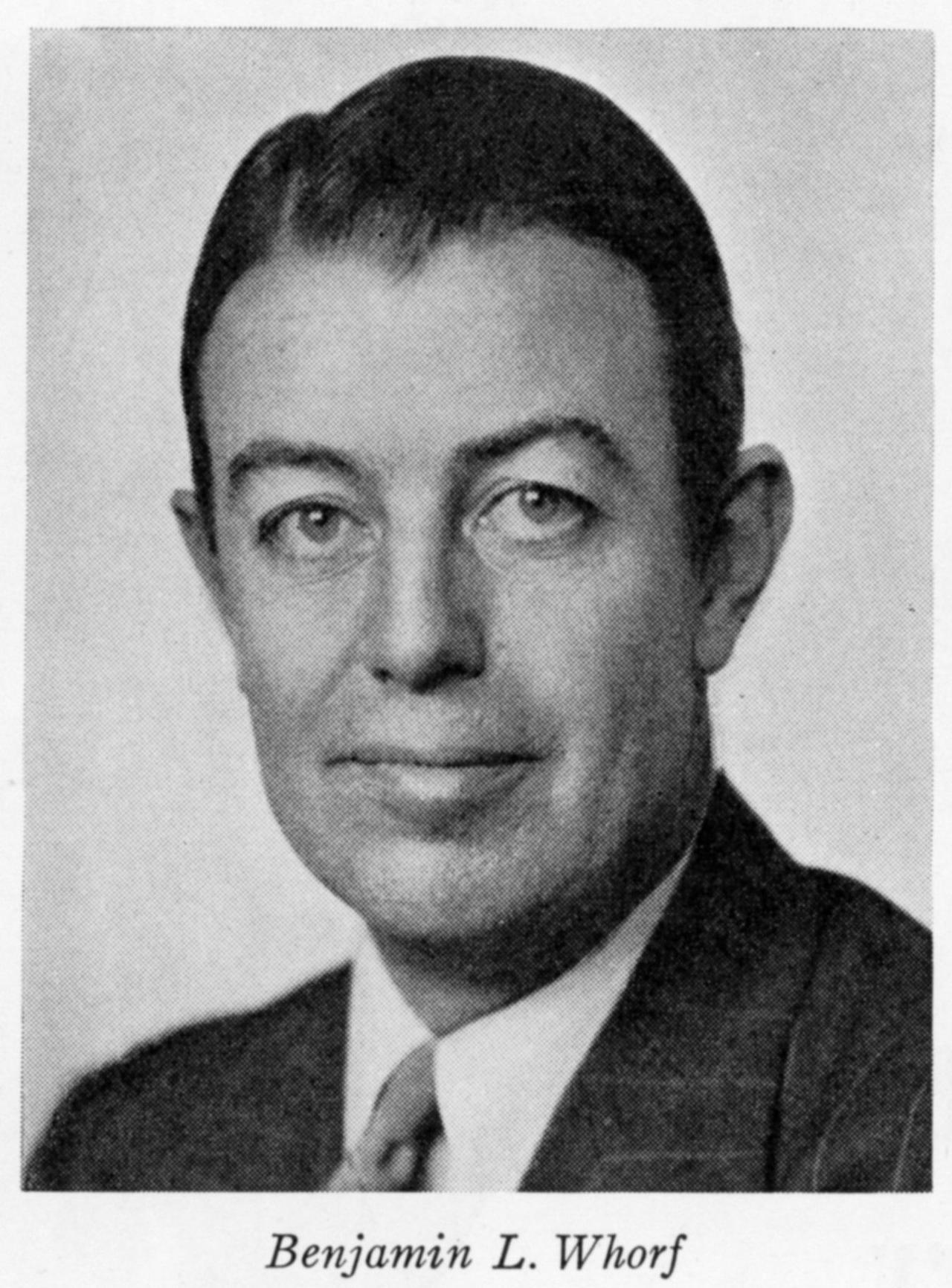
Birth | April 24, 1897 | ||||||||
|---|---|---|---|---|---|---|---|---|---|
Place of Birth | Winthrop, Massachusetts, USA | ||||||||
Death | July 26 1941 | ||||||||
Place of Death | Wethersfield, Connecticut, USA | ||||||||
Profession(s) | Engineer Anthropologist Linguist | ||||||||
Academic Affiliation | student of Edward Sapir Yale University | ||||||||
Areas of Expertise | Culture-language relationship Anthropology Linguistics | ||||||||
Scientific Contribution | Sapir–Whorf Hypothesis | ||||||||
Influenced by | Johann Gottfried von Herder Wilhelm von Humboldt Edward Sapir | ||||||||
Benjamin Lee Whorf (1897–1941) was an American linguist and anthropologist known for his view that language shapes thought processes and perceptions of reality. After receiving training in chemical engineering, he turned to linguistics as a student of Edward Sapir at Yale University; he examined the relationships among language, culture, and thought through studies of languages such as Hopi, Maya, and Aztec. His assumption that each language presents its speakers with a unique worldview formed the foundation of what later became known as the "Sapir–Whorf Hypothesis" theory of linguistic relativity.
Benjamin Lee Whorf was born on 24 April 1897 in Winthrop, Massachusetts, United States.
From an early age, B. Lee Whorf showed interest in drawing, chemistry, and photography; these interests helped develop his technical reasoning and observational skills. After completing secondary school at Winthrop High School, he studied chemical engineering at the Massachusetts Institute of Technology (MIT) and graduated in 1918. He then became an intern at the Hartford Fire Insurance Company, where he rapidly advanced through promotions in the emerging field of fire prevention engineering.
In the early 1920s, Whorf began studying Hebrew to better understand the Bible. This sparked his interest in the ways language influences the cultures that use it, leading him to investigate other languages such as Maya, Aztec, and Hopi.
In 1931, the renowned linguist Edward Sapir accepted a teaching position at Yale University, where B. Whorf enrolled as a graduate student. There, E. Sapir encouraged B. Whorf to learn the Hopi language, which he eventually did. After taking courses from E. Sapir, B. Lee Whorf began writing articles for linguistic and anthropological journals. He sustained his life by continuing his work in insurance while pursuing linguistic research.
While fulfilling his professional obligations in insurance, B. Lee Whorf maintained intense literary productivity throughout his life. He served as a lecturer at Yale University during the 1937–1938 academic year. His ideas in linguistics attracted wide interest. However, the full extent of his intellectual contributions across diverse disciplines became apparent only after his death. Whorf wrote on topics such as gravity, the concept of existence, color perception, tree and plant structure, his rejection of evolutionary theory, and dreams. He also produced an original translation of the Book of Genesis in the Bible.
From the 1930s until his death, Whorf worked to publish his ideas. In his articles on the Hopi, he demonstrated how the grammatical structure of the Hopi language reflects a distinct understanding of the universe. He showed that the Hopi focused primarily on spatial relationships, whereas Indo-European languages emphasized temporal concerns. Observing how such orientations could be detected in the organization of different societies, B. Lee Whorf reached conclusions about how sounds and grammatical structures influence behavior. In his 1944 article titled “The Relation of Habitual Thought and Behavior to Language,” B. Lee Whorf detailed how a language’s syntax, grammar, and characteristic patterns of thought determine how its speakers perceive and conceptualize their world.
Dozens of articles written by B. Lee Whorf were published posthumously in the book Language, Thought and Reality (1956), edited by John B. Carroll. Whorf’s manuscripts are now held in the Yale University Library.
Benjamin Lee Whorf, a student of Edward Sapir at Yale University, remained largely faithful to E. Sapir’s ideas but diverged from him in one key respect: Whorf argued that language does not determine thought but shapes it.
The hypothesis that the structure of a language determines the thinking patterns of its speakers was first proposed in the 18th century by German scholars Johann Gottfried von Herder and Wilhelm von Humboldt. According to this view, the structural differences among languages lead their speakers to perceive the world in different ways. This hypothesis, which later came to be known as the "Sapir–Whorf Hypothesis" equation of culture and language, was largely developed from Sapir’s ideas.
According to Whorf, language plays an active role in shaping thought. Humans perceive reality through language; therefore, each language offers its speakers a unique worldview. Structural differences among languages also lead to differences in how individuals perceive their environments. Whorf argued that culture and language mutually shape each other, and that thought itself exists within language. He maintained that every language is a vast system in which categories and forms—culturally determined and used not only for communication but also for analyzing nature, reasoning, and constructing consciousness—are embedded. He noted that human beings, within this system, divide nature into parts, organize it into concepts, and assign meaning to them.
Research on these reciprocal relationships among language, thought, and culture formed the basis of the theory of linguistic relativity, which came to be known as the "Sapir-Whorf Hypothesis" or "Whorfian Hypothesis." According to this hypothesis, culture shapes language as much as language shapes culture and modes of thinking. Whorf asserted that languages classify the world in different ways and each constructs reality in its own unique manner. Most of his views gained widespread recognition only after his death.
Benjamin Lee Whorf died of cancer on 26 July 1941 at the age of 44 in his home in Wethersfield, Connecticut. His life was too short to fully consolidate his growing reputation. However, after his death, his ideas generated widespread反响; in particular, the 1956 collection Language, Thought and Reality, edited by John B. Carroll, provided the first systematic presentation of Whorf’s views on linguistic relativity.
Whorf’s ideas temporarily lost prominence for a time due to criticisms of Noam Chomsky’s linguistic work, but they were reevaluated toward the end of the 20th century and further developed by contemporary researchers such as George Lakoff, John Lucy, Penny Lee, and Lera Boroditsky in the fields of modern linguistics, cognitive psychology, and cultural studies.
Arısoy, Elif. The Language-Thought Relationship on the Basis of Precedence of Thought over Language. Master's thesis, Middle East Technical University, Graduate School of Social Sciences, Ankara, 2021.
Benjamin Lee Whorf Papers (MS 822). Manuscripts and Archives, Yale University Library. Accessed October 25, 2025. https://archives.yale.edu/repositories/12/resources/4891/digital_materials
Carroll, John B. "Introduction." In Language, Thought, and Reality, by Benjamin Lee Whorf. Cambridge, MA: MIT Press, 1956.
Encyclopaedia. "Benjamin Lee Whorf." Encyclopaedia.com. Accessed October 8, 2025. https://www.encyclopedia.com/people/literature-and-arts/language-and-linguistics-biographies/benjamin-lee-whorf
Kabakcı, Tuğçe. Kutadgu Bilig'de Dil ve Düşünce İlişkisi. Master's thesis, Fatih Sultan Mehmet Vakıf University, Graduate School of Education, Istanbul, 2023.
Schackt, Jon. “Benjamin Lee Whorf.” Store norske leksikon. Accessed October 24, 2025. https://snl.no/Benjamin_Lee_Whorf
Valenti, Peter. “Benjamin Lee Whorf.” *Research Starters EBSCO Research* (2023). Accessed October 19, 2025. https://www.ebsco.com/research-starters/biography/benjamin-lee-whorf
Whorf, Benjamin Lee. "Language, Mind, and Reality." ETC: A Review of General Semantics 9, No. 3 (1952): 167-188.
Whorf, Benjamin Lee. "The Relation of Habitual Thought and Behavior to Language." ETC: A Review of General Semantics 1, no. 4 (Summer 1944): 197–215.
Whorf, Benjamin Lee. Language, Thought, and Reality: Selected Writings of Benjamin Lee Whorf. Ed. John B. Carroll. 4th ed. New York–London: The Technology Press of Massachusetts Institute of Technology and John Wiley & Sons, 1959.

Birth | April 24, 1897 | ||||||||
|---|---|---|---|---|---|---|---|---|---|
Place of Birth | Winthrop, Massachusetts, USA | ||||||||
Death | July 26 1941 | ||||||||
Place of Death | Wethersfield, Connecticut, USA | ||||||||
Profession(s) | Engineer Anthropologist Linguist | ||||||||
Academic Affiliation | student of Edward Sapir Yale University | ||||||||
Areas of Expertise | Culture-language relationship Anthropology Linguistics | ||||||||
Scientific Contribution | Sapir–Whorf Hypothesis | ||||||||
Influenced by | Johann Gottfried von Herder Wilhelm von Humboldt Edward Sapir | ||||||||
Life and Education
Academic Career and Research
Approach to the Relationship Between Language, Culture, and Thought
Death and Legacy