This article was automatically translated from the original Turkish version.
+2 More
Product / Product Group(s) | Bakery and confectionery products sweets dough products | ||||||||
|---|---|---|---|---|---|---|---|---|---|
Origin(s) | Bilecik Türkiye | ||||||||
Registration Type | Mahreç mark | ||||||||
Registration Date | 27 December 2017 | ||||||||
Registration Number | 290 | ||||||||
Material Ratio | 45-48% tahini, 41-45% sugar, 8-12% water | ||||||||
Bilecik Pazaryeri halva, produced in the Pazaryeri district of Bilecik province since 1936, is a distinctive summer halva distinguished by its traditional production method and absence of additives. The product, registered as a geographical indication on 27 December 2017, is prepared using only tahini, sugar and water. This sets it apart from similar products in the halva category. The tahini used in production is obtained by grinding sesame seeds in special stone mills and must comply with the Turkish Food Codex Tahini Notice. The tahini must contain more than 50 percent oil. Bilecik Pazaryeri halva achieves its consistency through prolonged cooking at a temperature of 117–118 °C in copper cauldrons, a process carried out under the supervision of master craftsmen using traditional knowledge.
Bilecik Pazaryeri halva is produced using raw materials in accordance with the Turkish Food Codex Tahini Notice and Sugar Notice. The tahini content ranges between 45–48 percent by mass, sugar between 41–45 percent, and water between 8–12 percent. The tahini must contain at least 50 percent oil. No semolina, flour, flavoring agents or food additives are used in production. The tahini used is derived exclusively from sesame seeds ground in stone mills.
The production of Pazaryeri halva takes place in copper cauldrons at a temperature of 117–118 °C. Unlike other halvas, which are typically cooked at higher temperatures of 140–150 °C, Pazaryeri halva is slowly boiled at a lower temperature to develop its consistency. This method ensures the halva acquires its original texture.
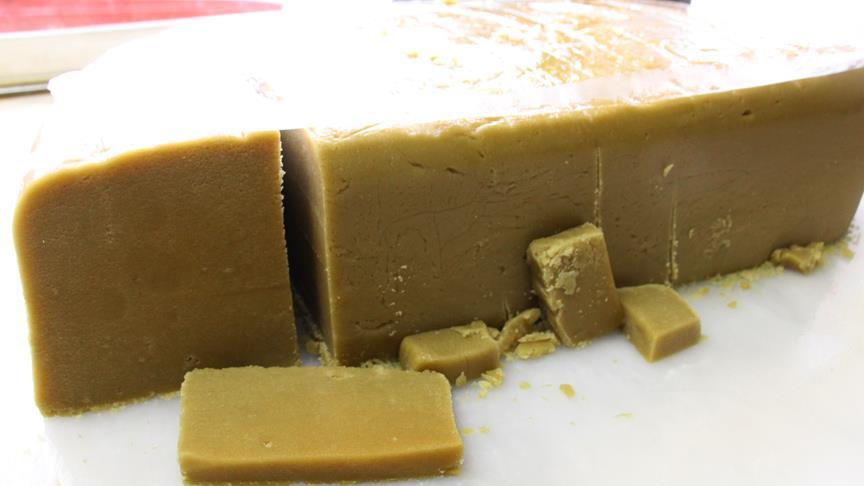
Bilecik Pazaryeri Halva(AA)
Bilecik Pazaryeri halva contains no fillers or taste modifiers such as semolina, flour, flavoring agents or food additives. It is produced using only the following three basic ingredients:
The preparation of Bilecik Pazaryeri halva follows a traditional method requiring high skill and precision. First, sugar and water are combined in the specified proportions. The sugar-water mixture is boiled over a low flame in specially designed small copper cauldrons. The boiling temperature is carefully controlled to reach and maintain 117–118 °C. This temperature is critical for achieving the halva’s structural integrity and consistency. During boiling, the water content of the sugar decreases and the mixture gradually thickens into a lumpy consistency.
During boiling, craftsmen continuously stir the mixture to prevent burning and ensure homogeneity. The duration of boiling and the stirring speed directly affect the flavor and texture of the halva; therefore, the master’s experience is decisive at this stage.
Once boiling is complete, the sugar mixture is removed from the cooking cauldron and pre-prepared tahini is added. The tahini used in Bilecik Pazaryeri halva is made from 100 percent sesame seeds ground in special stone mills and contains at least 50 percent oil. Stirring continues as the tahini is incorporated, ensuring complete integration with the sugar mixture. Careful stirring remains essential at this stage, as achieving a homogeneous, smooth texture is one of the halva’s defining characteristics.
When the mixture reaches the desired consistency, it is immediately transferred to cooling trays while still hot to prevent rapid cooling. The halva is left to cool slowly in the trays for approximately 14–16 hours. This prolonged cooling process allows the structure and consistency of the halva to mature properly.
In the final stage, the rested halva is shaped as desired, packaged and made available for sale. The unique structure of Bilecik Pazaryeri halva is made possible only through this production method, which yields its characteristic consistency and flavor from tahini and beet sugar alone. No flavoring agents, food additives or fillers are used in production; the natural taste and texture of the halva are preserved through this method.
Halva is a highly energy-dense product. Per 100 grams, it contains approximately 620 kcal of energy, 17.8 grams of protein, 39.5 grams of fat and 48.4 grams of carbohydrates. The fat content derived from tahini enhances satiety, while the carbohydrate content provides its characteristic sweetness. The fiber content is low (0.26 g). Levels of elements such as sodium and iron are low. Since no additives are used in the halva, all these components originate solely from natural ingredients. These values underscore the product’s nutritional density alongside its traditional and additive-free composition.
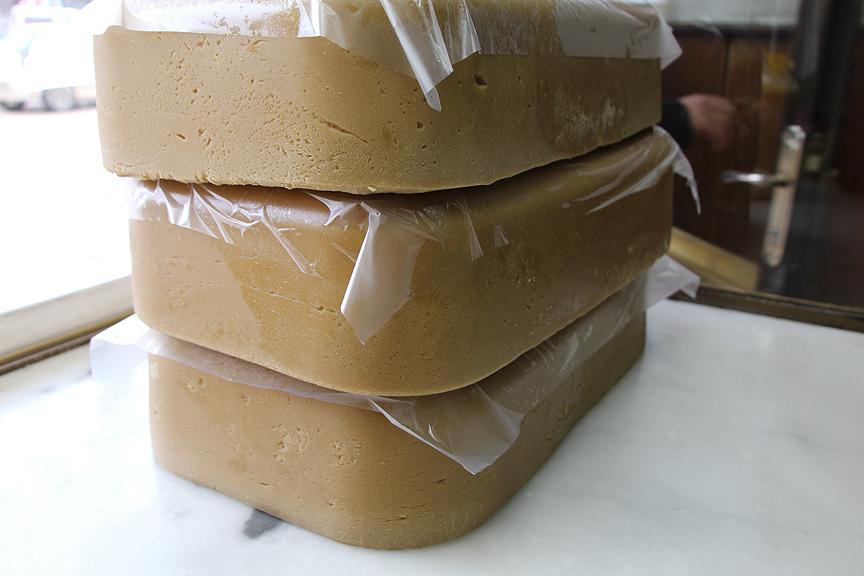
Bilecik Pazaryeri Halva(AA)
Bilecik Pazaryeri halva was registered as a geographical indication on 27 December 2017 by the Turkish Patent and Trademark Office under registration number 290. Production is permitted only within the boundaries of the Pazaryeri district of Bilecik. This restriction reflects the product’s strong connection to the region, the local craftsmanship and the sourcing of its raw materials. Oversight is conducted under the coordination of the Bilecik Chamber of Commerce and Industry, in collaboration with the Bilecik Provincial Directorate of the Ministry of Food, Agriculture and Livestock and the Pazaryeri Municipality. During inspections, production stages, the construction of copper cauldrons, the quality compliance of tahini and sugar, and the structural properties of the final halva are rigorously examined. These inspections are carried out annually or upon complaint, and the results are reported to the Turkish Patent and Trademark Office.
Kaymaz, Harun. “Bilecik Pazaryeri Helvası Artık Tescilli.” Anadolu Ajansı. Accessed July 12, 2025. https://www.aa.com.tr/tr/turkiye/pazaryeri-helvasi-artik-tescilli/1029893
T.C. Ministry of Culture and Tourism. "Bilecik Pazaryeri Helvası." Kültür Portalı. Accessed July 12, 2025. https://www.kulturportali.gov.tr/portal/bilecikpazaryerihelvasi
Turk Patent and Trademark Office. "Bilecik Pazaryeri Helvası." Turk Patent and Trademark Office. Accessed July 12, 2025. https://ci.turkpatent.gov.tr/cografi-isaretler/detay/38361.
Türk Patent ve Marka Kurumu. “Bilecik Pazaryeri Helvası.” Accessed July 12, 2025. https://ci.turkpatent.gov.tr/Files/GeographicalSigns/2b5a23e2-040d-4b6c-9243-06ca3ad4d0c2.pdf.
Çuhadar, Yusuf. “Bilecik Pazaryeri Helvası.” *Türkiye Turizm Ansiklopedisi*. Accessed July 12, 2025. https://turkiyeturizmansiklopedisi.com/bilecik-pazaryeri-helvasi

Product / Product Group(s) | Bakery and confectionery products sweets dough products | ||||||||
|---|---|---|---|---|---|---|---|---|---|
Origin(s) | Bilecik Türkiye | ||||||||
Registration Type | Mahreç mark | ||||||||
Registration Date | 27 December 2017 | ||||||||
Registration Number | 290 | ||||||||
Material Ratio | 45-48% tahini, 41-45% sugar, 8-12% water | ||||||||
No Discussion Added Yet
Start discussion for "Bilecik Market Halva" article
Distinguishing Characteristics
Production Process
Preparation
Nutritional and Chemical Properties
Geographical Indication and Oversight