


This article was automatically translated from the original Turkish version.
+2 More
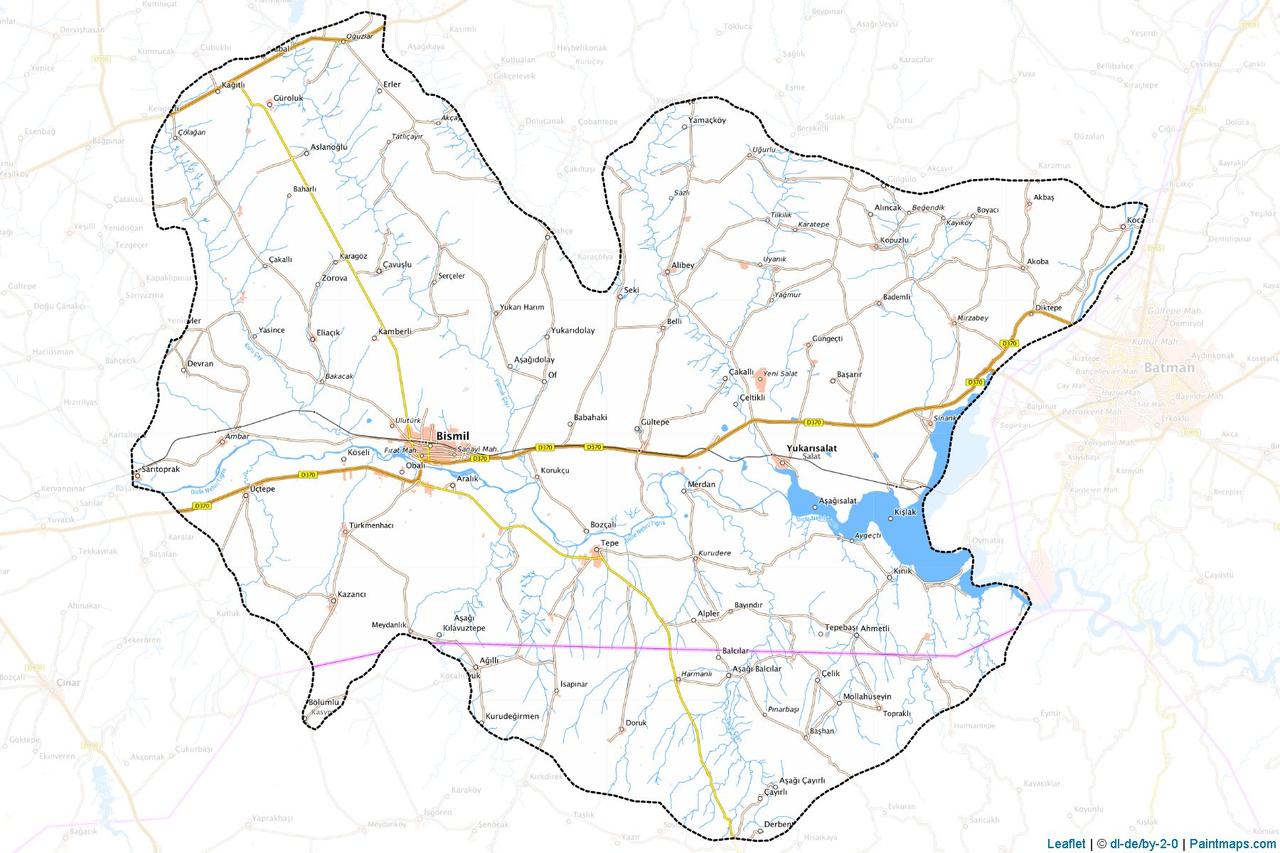
Bismil is a district of Diyarbakır Province. Located 55 km from the provincial center along the Diyarbakır-Batman highway, it covers an area of 1737 km² and is the second largest district in the province. The Tigris River flows through the district and it borders the Diyarbakır districts of Çınar, Sur and Silvan, as well as the provinces of Mardin and Batman.
Although the founding of Bismil is linked to close history, the region’s past extends thousands of years into antiquity. Three legends exist regarding its name.
The first legend relates to wars fought in the 2000s BCE between the Assyrians and Hurrians over the Tigris Plain. The Assyrian palace of Tušpa, discovered at the Üçtepe Höyüğü site, was in use during this period. Cuneiform inscribed stelae found in 1865 by the British traveler Taylor were taken to the British Museum. Excavations in 1989 uncovered remains of the palace along with artifacts from the Assyrian, Hurrian, Roman and Hellenistic periods, which are now exhibited at the Diyarbakır Museum.
The second legend claims that traders from Iran, who stayed near the village of Kurmuşlu, were driven out by a slave uprising and settled in the area under the name “Bistmal,” which later evolved into “Bismil.”
The third legend attributes the name to the Basmil tribe, which settled in the region in the 1700s from Konya or Mosul; during the Republican era, the name was changed to “Bismil.”
Bismil became a subdistrict in 1932 and attained the status of Diyarbakır’s sixth district in 1936. Its first neighborhood was Dicle Neighborhood; over time, Altıok, Bozkurt, Akpınar, Kurtuluş and Fatih neighborhoods were added. Due to flooding of the Tigris River and migration, the number of neighborhood increased, and today the district consists of 122 neighborhoods and 87 mezras.
Bismil lies on the Tigris Plain, with the Tigris River dividing it into two parts. Gentle hills are found to the north and south; the Southeastern Taurus Mountains (known locally as “Kalleş Dağlar” between people) pass to the south. These mountains block warm air currents from the Mediterranean and Middle East. Rivers flowing through the district include Cotton, Tea, Göksu Creek, Kurmuşlu Creek, Kuru Creek, Ambar Creek, Caferi Creek and Salat Creek. The number of lakes is low; only Çöltepe Lake near Çöltepe Village and İkiz Göl in Çakıllı exist.
Bismil has a continental climate with hot, dry summers and cold, wet winters. Dams in the surrounding area have altered the climate, reducing snow precipitation and decreasing frost events. Winter temperatures fall below zero, while summer temperatures exceed 45°C. There is no Plant cover; along the riverbanks, reeds and marshes are common, while poplar, acacia and willow trees grow sporadically. Although the area was once forested, mulberry trees planted in the 1930s and 1940s for sericulture were not preserved and have since disappeared.
In Bismil, Turkmens, Kurds, Zazas and Arabs live together; the majority of the population speaks a broken form of Azerbaijani Turkish also used in Şanlıurfa. The first settlers are said to have been Turkmens. Traces of Alevi-Bektashi culture are present. Traditional dances such as Folk dances (delilo, halay, çepik, Bismil halay, etc.) are frequently performed at weddings. Local dishes include paste, haside, caravan halva, sacda fetir, ashura soup, eşkene, marhuda, meftune, babakanuç and murtığa.
Construction primarily consists of adobe and single-story houses; each home has a garden with fruit and ornamental plants. In recent years, unplanned urbanization has increased, resulting in dead-end streets and the construction of six- to seven-story buildings in Altıok Neighborhood.
Bismil’s economy is based on agriculture and animal husbandry. Cereal crops are cultivated on the Tigris Plain; with the expansion of irrigated farming, cotton and like industry cultivation have become widespread. There is no textile industry. Livestock farming includes both large and small ruminant breeding; modern feeding facilities have multiplied in recent years.
Bismil contains 43 archaeological seating area sites and 4 registered building. Excavations have been conducted at locations such as Körtiktepe (10,400 BCE), Üçtepe Höyüğü, Ziyaret Tepe, Hakemi Use and Salat Tepe. The Tigris River basin is home to migrant birds, particularly storks, which are among the district’s symbols. Historical festivals, such as at competitions and merkep breeding, were held in the past.
Bismil’s population was 889 in 1936; it has grown due to migration and neighborhood formation. Today it comprises 122 neighborhoods and 87 mezras. Different ethnic groups live together; the first settlers are reported to have been of Turkmen origin.
Bismil Belediyesi. "Turistik Yerlerimiz ve Tarihi Geçmişimiz." Accessed April 9, 2025. http://www.bismil.bel.tr/turistik-yerlerimiz-ve-tarihi-gecmisimiz.
Bismil Belediyesi. "Yakın Tarihimiz." Accessed April 9, 2025. http://www.bismil.bel.tr/yakin-tarihimiz.
Bismil Kaymakamlığı Governorship. "Coğrafi Yapı." Accessed April 9, 2025. http://www.bismil.gov.tr/cografi-yapi.
Bismil Kaymakamlığı. "Bismil Tarihçesi." Accessed April 9, 2025. http://www.bismil.gov.tr/bismil-tarihcesi.
Bismil Kaymakamlığı. "Kültür ve Turizm." Accessed April 9, 2025. http://www.bismil.gov.tr/kultur-ve-turizm.
Bismil Kaymakamlığı. "Sosyo-Ekonomik Yapısı." Accessed April 9, 2025. http://www.bismil.gov.tr/sosyo-ekonomik-yapisi1.
Diyarbakır Valiliği. "Bismil." Accessed April 9, 2025. http://www.diyarbakir.gov.tr/bismil.

History
Geographical Structure
Climate and Vegetation
Social Structure
Economic Structure
Tourism Potential
Demographic Structure