


This article was automatically translated from the original Turkish version.
+1 More
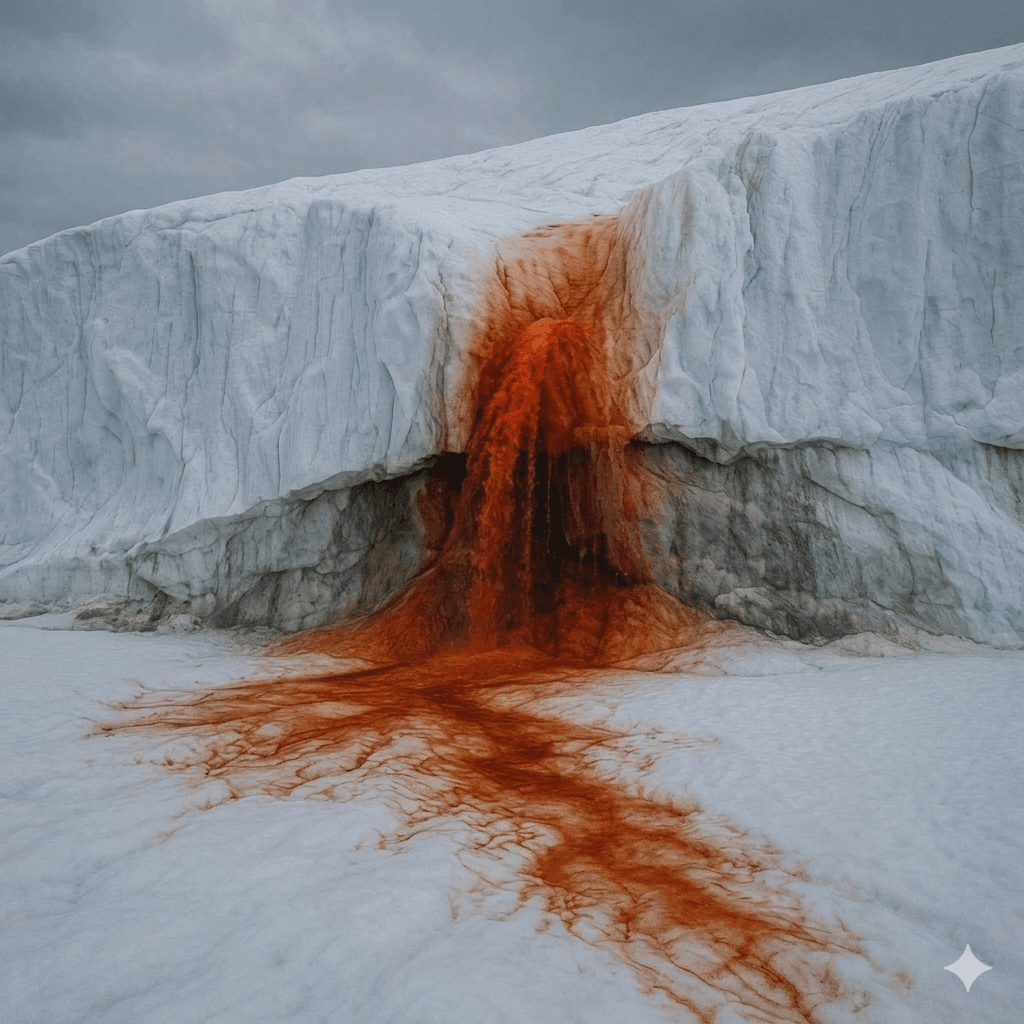
Blood Falls (Antarctica) (generated by artificial intelligence)
Discoverer(s) | Griffith Taylor | ||||||||
|---|---|---|---|---|---|---|---|---|---|
Year of Discovery(ies) | 1911 | ||||||||
Region(s) | Taylor Valley | ||||||||
Ecosystem | Ancient Microorganisms | ||||||||
Cause of Color | Iron Oxidation | ||||||||
Place of Outflow | Bonney Lake | ||||||||
Source | Taylor Buzulu | ||||||||
Blood Falls is a red-colored water flow located in the remote Taylor Valley of Antarctica, flowing from the Taylor Glacier toward Lake Bonney. It is characterized by high concentrations of iron and salt. This geological formation is fed by remnants of an ancient saline lake that formed millions of years ago when sea levels were higher and ocean waters reached deep into the continent’s interior. Due to its striking red color resembling blood, the waterfall has remained an enigma in the scientific community for over a century and has become one of Antarctica’s most intriguing natural features.
Why is this Antarctic Glacier “Bleeding?” | Antarctic Extremes (Youtube)
Blood Falls was discovered in 1911 during a British expedition by Australian geologist Thomas Griffith Taylor. While exploring Taylor Valley, Taylor encountered this crimson flow seeping through vast glaciers over a frozen lake and became the first person to document the waterfall; both the glacier and the valley were subsequently named after him.
In the early years following its discovery, scientists assumed the water’s vivid red color was caused by red algae. Later analyses disproved this algal theory and demonstrated that the primary source of the red hue is iron oxidation.
The source of the waterfall is an isolated subglacial lake trapped beneath the Taylor Glacier, with salinity nearly twice that of seawater. This saline reservoir, dating back approximately five million years, remains liquid despite Antarctica’s freezing temperatures due to the salt’s significant depression of the water’s freezing point. It is estimated that salt deposits extend beneath the entire length of the Taylor Glacier.

Blood Falls (generated by artificial intelligence)
The water turns red when iron-rich water, sealed for millions of years beneath the glaciers in a lightless and oxygen-free environment, emerges to the surface and comes into contact with oxygen, sunlight, and ambient temperatures. This process is a chemical oxidation reaction similar to metal rusting.
Standard tests conducted over many years failed to detect crystalline iron minerals such as hematite, leaving the exact source of the color unexplained. However, recent studies using Transmission Electron Microscopy (TEM) have magnified water samples two million times, revealing microscopic structures termed “nanospheres.” These nanospheres, 100 times smaller than red blood cells, were undetectable by conventional mineral analysis because they lack a crystalline atomic structure. In addition to iron, the nanospheres contain silicon, calcium, aluminum, and sodium. The interaction of this unique composition with oxygen and heat produces the water’s eerie red color.
Beyond its chemical composition, Blood Falls is an exceptionally unique environment due to the isolated life forms it harbors. In this saline lake, completely devoid of light and oxygen, a rare ancient microbial ecosystem has survived for approximately two to five million years.
The microorganisms living in this extreme environment sustain their metabolic processes by using sulfate and iron instead of oxygen. These bacteria, evolved from ancient microbes, convert insoluble ferric iron into soluble ferrous iron to obtain organic matter. This rare metabolic process provides crucial evidence for how life may have persisted during Earth’s harsh “Snowball Earth” periods, when the planet was entirely covered in ice.
Blood Falls and its ecosystem serve as a natural laboratory for studying potential life forms beyond Earth. Scientists searching for signs of life on Mars examine these extremophilic bacteria, which survive in conditions of extreme cold, high salinity, and absence of oxygen, to model the types of life that might exist on other planets and moons in the Solar System.
Moreover, the discovery of iron-rich nanospheres in the waterfall using microscopic techniques has highlighted a significant gap in current space exploration. NASA’s Mars rovers, such as Perseverance, cannot carry electron microscopes due to their size and high energy requirements. This technological limitation underscores the need to return samples directly from Mars or other celestial bodies to Earth for analysis in advanced laboratories to definitively confirm the presence of similar nanoscale biosignatures.
Bressan, David. "Century-Old Mystery of Blood Waterfall in Antarctica May Finally Be Solved." Forbes. Accessed March 6, 2026. https://www.forbes.com/sites/davidbressan/2023/07/10/century-old-mystery-of-blood-waterfall-in-antarctica-may-finally-be-solved/
Grom, J. "Ancient Ecosystem Discovered Beneath Antarctic Glacier." *Science*. Accessed March 6, 2026. https://www.science.org/content/article/ancient-ecosystem-discovered-beneath-antarctic-glacier
Ohio State University. "Explanation Offered For Antarctica's 'Blood Falls'." ScienceDaily. Accessed March 6, 2026. https://news.osu.edu/explanation-offered-for-antarcticas-blood-falls/#:~:text=Lyons%20and%20his%20colleagues%20believe,pushed%20out%20or%20the%20ice.
Yeşil Gazete. "Antarktika'daki 'Kan Şelalesi'nin gizemi sonunda çözüldü." Accessed March 6, 2026. https://yesilgazete.org/antarktikadaki-kan-selalesinin-gizemi-sonunda-cozuldu/
Şahin, Eser. "Dünyanın en sıra dışı yerlerinden biri: Antarktika'daki Kan Şelalesi." Mashable Türkiye. Accessed March 6, 2026. https://tr.mashable.com/life/15788/dunyanin-en-sira-disi-yerlerinden-biri-antarktikadaki-kan-selalesi

Blood Falls (Antarctica) (generated by artificial intelligence)
Discoverer(s) | Griffith Taylor | ||||||||
|---|---|---|---|---|---|---|---|---|---|
Year of Discovery(ies) | 1911 | ||||||||
Region(s) | Taylor Valley | ||||||||
Ecosystem | Ancient Microorganisms | ||||||||
Cause of Color | Iron Oxidation | ||||||||
Place of Outflow | Bonney Lake | ||||||||
Source | Taylor Buzulu | ||||||||
No Discussion Added Yet
Start discussion for "Blood Falls (Antarctica)" article
Discovery and History
Geographical and Chemical Properties
Color Change and Nanospheres
Subglacial Ecosystem
Microbial Life
Contribution to Space Research