


This article was automatically translated from the original Turkish version.
+1 More
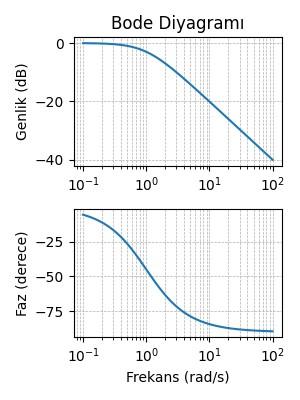
The Bode diagram is a graphical representation used to analyze and evaluate a system’s frequency response. This diagram consists of two separate plots that display the magnitude (gain) and phase characteristics of a transfer function as functions of frequency. It is widely used in stability analysis of control systems and is regarded as a fundamental tool in the design of power electronics systems and control loops.
A Bode diagram comprises two components:
These plots are typically generated using the open-loop transfer function to predict the system’s behavior.
To draw the Bode diagram for the transfer function:

Example Bode Diagram (H(s) = 1 / (s + 1)) (Generated using Matplotlib.)
Bode diagrams are used for purposes such as filter design, stability analysis of systems, controller design, noise analysis, and prediction of system response. They are particularly useful for designing controllers in Single-Input Single-Output (SISO) systems. Stability criteria such as gain margin and phase margin can be derived from the magnitude and phase plots. However, their direct applicability is limited in Multiple-Input Multiple-Output (MIMO) systems. These limitations arise because the classical Bode stability criterion is valid only under specific conditions.
In cases where the classical Bode criterion is insufficient, more general approaches such as the Nyquist stability criterion are employed. However, Nyquist diagrams are graphically more complex, making them less practical for controller design. Therefore, in the literature, methods such as the “Generalized Bode Criterion (GBC)” have been developed to provide universally applicable stability conclusions based on the Bode diagram. This criterion provides information about system stability by analyzing specific phase crossover frequencies and gain values on the Bode plot, thereby extending the applicability of the Nyquist criterion to the Bode framework. Additionally, the “Discrete Generalized Bode Criterion (DGBC)” has been developed for the analysis of discrete-time systems. This method was designed to simplify stability analysis in systems where the controller is implemented digitally, particularly when dynamics near the Nyquist frequency are dominant.
The Bode diagram is both a practical and intuitive tool for analyzing and designing control systems in the frequency domain. However, the stability information it provides may vary depending on the system’s structure and characteristics. Therefore, generalized approaches that go beyond classical Bode analysis enable accurate analysis of more complex systems.
Lumbreras, David, Ernesto L. Barrios, Andoni Urtasun, Alfredo Ursúa, Luis Marroyo, and Pablo Sanchis. On the Stability of Advanced Power Electronic Converters: the Generalized Bode Criterion. IEEE Transactions on Power Electronics, Manuscript ID: TPEL-Reg-2018-07-1420.R1. https://doi.org/10.1109/TPEL.2018.2884892.
Samanes, Javier, Andoni Urtasun, Ernesto Barrios, David Lumbreras, Jesus Lopez, Eugenio Gubia, and Pablo Sanchis. Control Design and Stability Analysis of Power Converters: the MIMO Generalized Bode Criterion. Journal of Emerging and Selected Topics in Power Electronics, IEEE. http://dx.doi.org/10.1109/JESTPE.2019.2941829.
Urtasun, Andoni, Javier Samanes, Ernesto L. Barrios, and Pablo Sanchis. Control Design and Stability Analysis of Power Converters: The Discrete Generalized Bode Criterion. IEEE Access, vol. 9, 2021. https://doi.org/10.1109/ACCESS.2021.3063016.

Basic Structure
Example Application
Applications
Advanced Applications