

This article was automatically translated from the original Turkish version.
+2 More
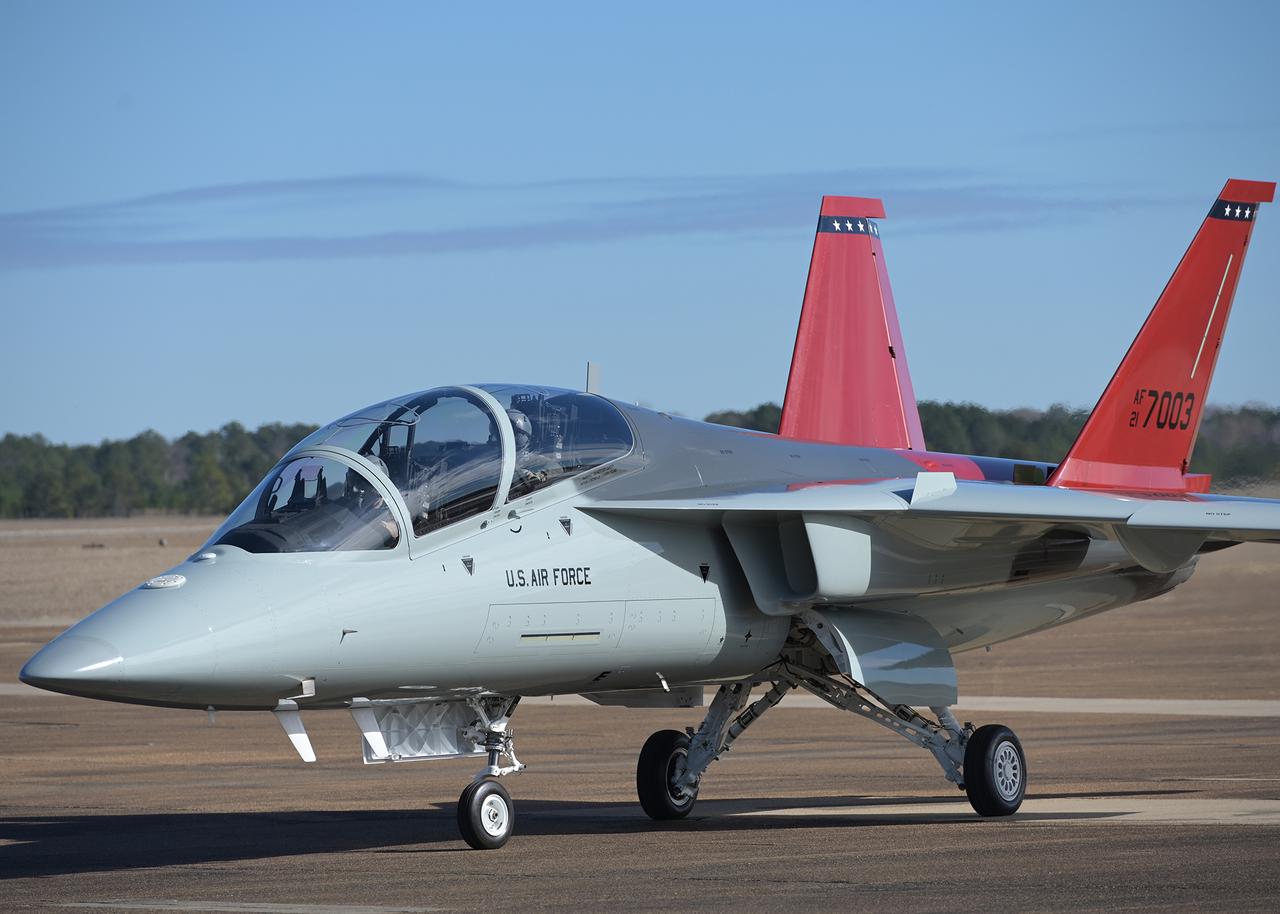
Boeing T-7A Red Hawk is a single-engine, two-seat advanced jet trainer developed jointly by the American company Boeing and the Swedish firm Saab. Designed to replace the aging Northrop T-38 Talon fleet of the United States Air Force (USAF), the aircraft aims to meet the training needs of pilots transitioning to fourth- and fifth-generation fighter aircraft. The T-7A stands out with its modern flight control systems, digital cockpit architecture, open-architecture avionics infrastructure, and modular design that facilitates maintenance.

Boeing T-7A Red Hawk (U.S. Air Force)
The development of the T-7A began with a joint development agreement signed between Boeing and Saab in 2013 under the “T-X” program, whose goal was to replace the USAF’s T-38 training jets with a modern platform. Boeing won the T-X competition in 2018 and signed a fixed-price contract for the production of 350 T-7A aircraft. The first prototype flights were completed in 2023, and the first test aircraft was delivered to the USAF by the end of 2024. Four Production Representative Test Vehicles (PRTVs) are scheduled for delivery within the 2025 fiscal year, with production of Lot 1 aircraft set to begin in 2026.
During development, significant issues arose with the ACES 5 ejection seat system. The U.S. Air Force’s Directorate of Operational Test and Evaluation (DOT&E) reported that the seat could pose serious safety risks, particularly for female pilots, due to potential neck injury from inadequate shock absorption and head support systems under anatomical variations. Environmental testing also revealed problems with various components including the canopy fracture mechanism, the onboard oxygen generation system (OBOGS), and the automatic ground collision avoidance system (AGCAS). Supply chain disruptions, quality issues in component manufacturing, and logistical management failures delayed the overall program timeline. As a result, the USAF postponed the initial operational capability (IOC) date to the 2027 fiscal year.
The USAF expects the T-7A Red Hawk to have a major impact on its pilot training system. Under the program, the T-7A is not merely an aircraft but part of a broader “system family” that includes ground support systems, simulation modules, and updated training curricula. The USAF anticipates training over 1,000 fighter and bomber pilots annually using this system. The Air Education and Training Command (AETC) has adopted a new acquisition model to accelerate the testing and curriculum development process under the program.
Boeing T-7A Red Hawk (Boeing)
The Boeing T-7A Red Hawk is classified as a single-engine, two-seat advanced jet trainer. Its airframe is constructed from composite and aluminum alloy materials and features a tandem seating arrangement known as stadium seating, which provides both instructor and student pilot with an unobstructed field of view. The aircraft is 14.15 meters long, has a wingspan of 9.75 meters, and stands approximately 4 meters tall. Its empty weight is approximately 5,443 kilograms, with a maximum takeoff weight of 8,165 kilograms.
Powered by a single General Electric F404-GE-103 turbofan engine producing 17,700 pounds (approximately 78.7 kN) of thrust, the T-7A is designed to reach speeds up to Mach 1.2. It has a service ceiling of 15,240 meters and a range of approximately 1,850 kilometers. The aircraft is aerodynamically optimized for high angle-of-attack maneuvers and can withstand G-forces ranging from +8 to -2.3 G.
The most serious technical issue with the T-7A program is the ACES 5 ejection seat system. The U.S. Department of Defense’s Office of Test and Evaluation (DOT&E) has reported that the seat may pose unacceptable risks for female pilots. Testing revealed a heightened risk of neck injury among pilots of shorter stature or lower body weight. Shock absorption and head support systems were found to be inadequate during ejection sequences.
Throughout the program, various environmental testing phases encountered difficulties. Tests conducted under high temperature and humidity conditions revealed malfunctions in the canopy fracture mechanism. Additionally, technical inconsistencies and software issues were identified in safety systems such as the onboard oxygen generation system (OBOGS) and the automatic ground collision avoidance system (AGCAS).
The T-7A program has faced challenges related to component quality, supply chain delays, and insufficient production capacity. Poor coordination between Boeing and some of its subcontractors has hindered the timely and consistent delivery of parts to required specifications. These issues have not only delayed the test schedule but also contributed to the postponement of the planned initial operational capability (IOC) date.
The T-7A is primarily designed for training purposes and does not feature permanent weapons carriage capability for combat missions. However, it has the potential to carry a limited number of external stores stations, sensor pods, and training munitions simulation systems for use in training and evaluation scenarios.
As of now, the only known variant is the T-7A Red Hawk. The aircraft was developed exclusively for the United States Air Force. A total of 351 aircraft have been ordered, covering the initial procurement requirement.
Boeing. "T-7A Red Hawk First Flight from the Cockpit." YouTube. Accessed April 29, 2025. https://www.youtube.com/watch?v=r5r5_ej4Shg
Işık, Yunus Emir. "HÜRJET’in rakibi T-7A uçağı sorunlarla boğuşuyor." DefenceTurk. Accessed April 29, 2025. https://www.defenceturk.net/hurjetin-rakibi-t-7a-ucagi-sorunlarla-bogusuyor
Military Factory. "Boeing-Saab T-7 Red Hawk (eT-7A)." MilitaryFactory.com. Accessed April 29, 2025. https://www.militaryfactory.com/aircraft/detail.php?aircraft_id=1647
SAAB. "T-7A." Saab. Accessed April 29, 2025. https://www.saab.com/products/T-7A
Trevithick, Joseph. “New Details About T-7A Red Hawk Jet Trainer Ejection System Woes Emerge.” TWZ. Accessed April 29, 2025. https://www.twz.com/air/new-details-about-t-7a-red-hawk-jet-trainer-ejection-system-woes-emerge
U.S. Air Force Torch. "T-7A Red Hawk stop at CAFB.” U.S. Torch. Accessed April 29, 2025. https://www.torch.aetc.af.mil/News/Photos/igphoto/2003362314/
U.S. Air Force. "Air Force updates T-7A acquisition approach to field operational capability." Accessed April 29, 2025. https://www.af.mil/News/Article-Display/Article/4029147/air-force-updates-t-7a-acquisition-approach-to-field-operational-capability/

No Discussion Added Yet
Start discussion for "Boeing T-7 Red Hawk" article
Development Process and Challenges
Entry into Service and Operational Planning
Technical Specifications
Criticisms and Issues
Ejection Seat and Pilot Safety
Environmental and Systemic Testing Problems
Supply Chain Disruptions and Production Delays
Armament and Payload Capacity
Variants and Operational History