


This article was automatically translated from the original Turkish version.
Serving Temperature | Hot or cold | ||||||||
|---|---|---|---|---|---|---|---|---|---|
Sauce Ingredients | Butter, red pepper flakes | ||||||||
Complementary | Garlic yogurt | ||||||||
Diet Class | Mediterranean diet | ||||||||
Gümüşhane Style | With chard, garlic yogurt | ||||||||
Şanlıurfa Style | With meat, bulgur, chickpea | ||||||||
Main Vegetables | Spinach, chard, broad bean | ||||||||
Name Origin | Buran Hatun (Puran) | ||||||||
Meal Type | Yogurt vegetable dish | ||||||||
Borani is a traditional dish widely recognized across a broad geographical area of Turkish cuisine, prepared by combining vegetables, yogurt, and sometimes meat. Historically rooted in the culinary traditions of the Middle East and Anatolia, this dish exhibits a structure that varies by region according to its primary ingredient. Typically, it is served by pouring garlic-infused yogurt over boiled or sautéed vegetables such as spinach, chard, fresh beans (broad beans), or squash, followed by a drizzle of heated oil-based sauce. From a sociocultural perspective, borani is regarded not merely as a dish but as a reflection of regional identity within the culinary sphere.
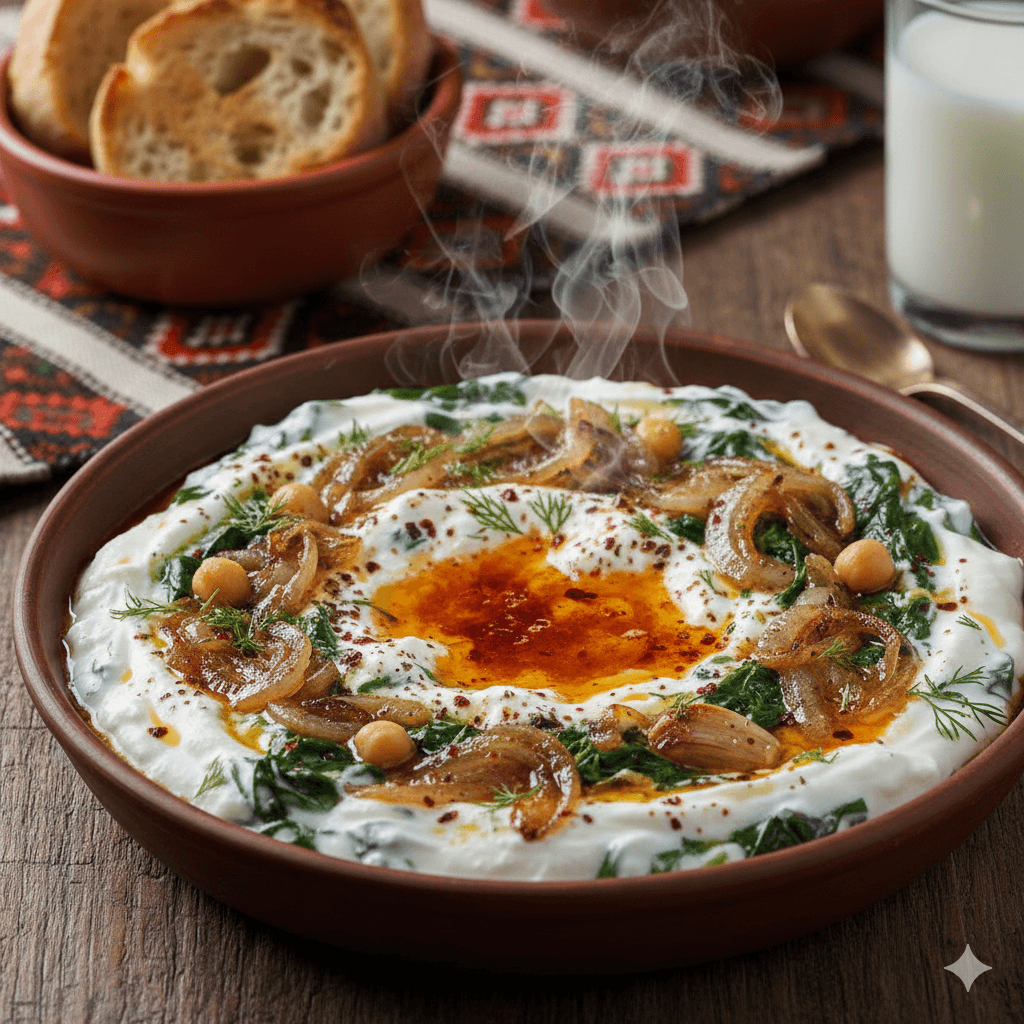
Borani (Generated by Artificial Intelligence)
The most widely accepted historical account of the name borani traces back to the Abbasid era. It is believed that the dish was prepared for the wedding of Buran Hatun (also known as Puran), wife of Caliph al-Ma'mun, and that it derived its name from her. This origin explains why borani is not exclusive to Anatolia but also exists in the cuisines of Iran, the Middle East, and the Caucasus—for example, as Borani-ye Esfenaj in Iran.
Numerous recipes exist across Turkey under the name borani, each differing in ingredients. This diversity is directly linked to regional agricultural production and dietary habits.
In Gümüşhane cuisine, borani is closely associated with winter preparations and local vegetables. The most common presentation involves boiling and draining vegetables—primarily chard or spinach—then mixing them with garlic-infused yogurt and topping with toasted red pepper flakes fried in butter. In some versions, boiled cracked wheat or corn is also added to the mixture.
The Şanlıurfa style of borani differs from vegetable-based yogurt appetizers by functioning as a more complex main dish. In Urfa cuisine, borani is prepared with cubed meat, chickpeas, and “pazı” (in some recipes, spinach roots). Its most distinctive feature is the inclusion of small meatballs known as “yuvarlama.” This dish, in which meat and vegetables are simmered in a yogurt-based broth, exemplifies the region’s rich tradition of stewed dishes.
Spinach borani is the most widely known and prepared variety throughout Turkey. Its base consists of cleaned spinach sautéed with onion or boiled, then cooled and combined with a thick layer of yogurt. Often consumed as a light main course or appetizer, this version is typically garnished with a drizzle of oil-infused paprika or red pepper flakes for both decorative and flavor-enhancing effect.
Across Anatolia, borani exhibits rich diversity not as a single standardized recipe but as a technique of blending available vegetables with yogurt. In Şanlıurfa and Southeastern Anatolian cuisine, borani transcends its appetizer-like form elsewhere and transforms into a hearty main dish containing cubed meat, chickpeas, chard, and small meatballs called “yuvarlama.” In contrast, in Western Anatolia and the Aegean region, lighter and more refreshing versions prevail, made with olive oil, fresh broad beans or squash, enriched with dill and strained yogurt. In Black Sea cities such as Gümüşhane, the dish made by boiling and draining chard or spinach roots is regarded as an inseparable part of local culinary identity.
Borani is a “technique-based” dish adapted across Anatolia according to seasonal conditions. In spring, varieties made with fresh broad beans and chard roots are prominent; during summer, fresh bean and squash borani serve as refreshing options. In winter, versions prepared by boiling and mixing dried vegetables—particularly dried eggplant or beans—reflect the region’s food preservation culture. In some areas, wild foraged ingredients such as mushrooms are also prepared using this technique.
In Turkish cuisine, borani dishes are broadly categorized into two technical approaches based on when the yogurt is added. In the Western and Marmara regions, the “cold borani” technique is common: cooked and cooled vegetables are topped with raw garlic-infused yogurt. In contrast, in certain parts of Central and Eastern Anatolia, the “hot borani” technique prevails. Here, yogurt is stabilized with egg or flour to prevent curdling and added during the cooking process, allowing the dish to be served hot. This distinction enables borani to function as both an appetizer and a stewed main dish.
From a gastronomic perspective, borani is a structure built on the balance of texture, flavor, and presentation. The base vegetables either retain their aroma through sautéing in their own moisture or form a mild foundation through boiling. The combination of this base with garlic-infused yogurt imparts the dish’s characteristic tanginess and freshness, while a drizzle of oil-based paprika or mint sauce adds both visual and sensory depth. In some regions, the yogurt is incorporated during cooking to serve the dish hot; in others, it is presented cold as an appetizer, reflecting borani’s functional versatility and adaptability across different meals in Turkish cuisine.
Anadolu Ajansı. "Et ile Bulgurun Birleştiği Lezzet: Borani." Accessed February 13, 2026. https://www.aa.com.tr/tr/kultur-sanat/et-ile-bulgurun-birlestigi-lezzet-borani/1255903.
Nefis Yemek Tarifleri. "Borani (Urfa Yemeği)." Accessed February 13, 2026. https://www.nefisyemektarifleri.com/borani-urfa-yemegi/.
Nefis Yemek Tarifleri. "Ispanaklı Borani Tarifi." Accessed February 13, 2026. https://www.nefisyemektarifleri.com/ispanakli-borani-tarifi/.
T.C. Ministry of Culture and Tourism. "Borani - Gümüşhane." *Kültür Portalı*. Accessed February 13, 2026. https://www.kulturportali.gov.tr/turkiye/gumushane/neyenir/borani847688.
Yemek.com. "Borani Tarifi." Accessed February 13, 2026. https://yemek.com/tarif/borani/.
Yenişehirlioğlu, Emirhan, and İlke Kalaycı. "Tandır Çorbası, Ispanaklı Bulgurlu Borani, Sirkencubin ve Badem Helvasının Akdeniz Diyeti Kapsamında İncelenmesi." *Nişantaşı Üniversitesi Sosyal Bilimler Dergisi* 9, no. 1 (2021): 56–70. Accessed February 13, 2026. https://dergipark.org.tr/tr/download/article-file/1751980.

Serving Temperature | Hot or cold | ||||||||
|---|---|---|---|---|---|---|---|---|---|
Sauce Ingredients | Butter, red pepper flakes | ||||||||
Complementary | Garlic yogurt | ||||||||
Diet Class | Mediterranean diet | ||||||||
Gümüşhane Style | With chard, garlic yogurt | ||||||||
Şanlıurfa Style | With meat, bulgur, chickpea | ||||||||
Main Vegetables | Spinach, chard, broad bean | ||||||||
Name Origin | Buran Hatun (Puran) | ||||||||
Meal Type | Yogurt vegetable dish | ||||||||
Historical Origins and the Name “Borani”
Regional Varieties and Preparation Methods
Gümüşhane and the Black Sea Region
Şanlıurfa and Southeastern Anatolian Cuisine
Spinach Borani
Regional and Ingredient-Based Variations of Borani
Seasonal Varieties and Ingredient Adaptations
Gastronomic Technique: Hot vs. Cold Preparation
Gastronomic Structure and Presentation Techniques
