

This article was automatically translated from the original Turkish version.
+1 More
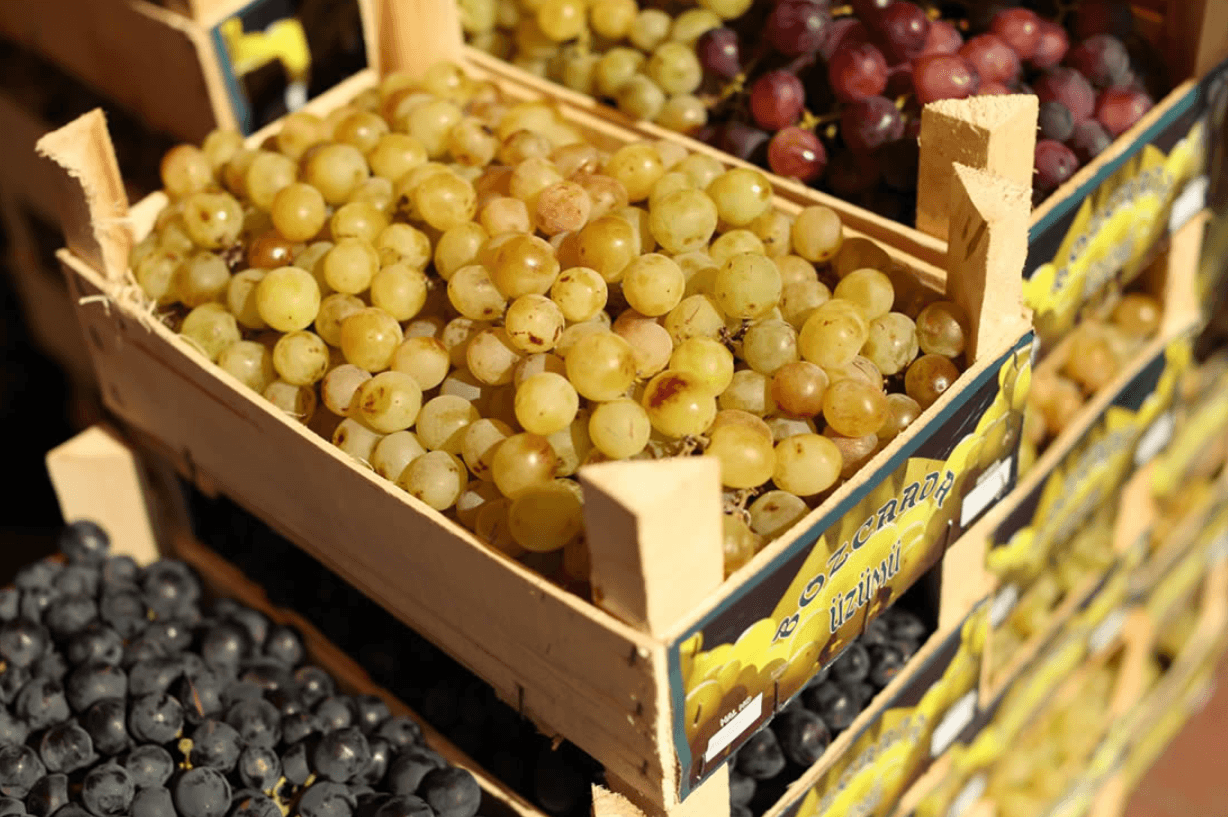
Bozcaada Çavuş grape (Vitis vinifera L.) is a local grape variety cultivated in the Bozcaada district of Çanakkale Province, Türkiye, and registered under its place of origin name. This grape has large, round-oval berries (6–7 g per berry), pale misty yellowish-green in color, with sparse and large clusters. It features a thin skin and transparent venation.
Bozcaada Çavuş grape (Vitis vinifera L.) is a local grape variety cultivated in the Bozcaada district of Çanakkale Province, Türkiye, and registered under its place of origin name. The grape has large, sparse clusters averaging 450 grams in weight, with a winged conical shape. The berries are large, round or oval, averaging 6–7 grams in weight, and contain 1 to 3 seeds. They exhibit a pale misty yellowish-green hue and possess a thin skin with transparent venation. Morphologically, the flower structure appears male, but functionally it is female; the stamens are variably curled and the pollen is sterile. Consequently, it cannot self-pollinate nor pollinate other varieties and absolutely requires companion pollinator varieties for production.
The primary pollinator varieties used for Bozcaada Çavuş grape are Kuntra (Karasakız) and Vasilâki (Anadolu Yapıncağı). These varieties play a significant role in the island’s viticultural culture and directly influence crop productivity. Bozcaada’s unique island ecosystem, characterized by its maritime location, high humidity levels, and soil composition, are decisive factors in developing the grape’s distinctive qualities. Particularly, moist winds coming from the sea, which prevent relative humidity from dropping below 70%, contribute to the thinning of the grape skin and the development of specific aroma profiles.
One of the most notable features of Bozcaada Çavuş grape is its richness in total aroma compounds. It exhibits considerable diversity in terpenes, aldehydes, alcohols, and esters. Notably, the variety is distinguished by its high linalool content and also contains compounds such as E-2-Hexenal, Geraniol, and E-Linalool oxide. These characteristics differentiate Bozcaada Çavuş grape from other Çavuş grape varieties grown in other regions of Türkiye. Biochemically, the weight of 100 berries ranges from 265 to 774 grams, with an average acidity of 4.43 g/L, dry matter content of 17.6%, and a maturity index of 49.
The cultivation of Bozcaada Çavuş grape follows techniques developed to suit the island’s ecosystem. Due to its physiological possession of only female flowers, it is mandatory to plant pollinator varieties at a 25% ratio during planting. Production is typically carried out using grafted vines; cuttings taken after pruning in February–March are grafted onto American rootstocks (particularly 5BB) to establish new plantations. The island-specific goblet training system is employed; vineyards are established with 3–5 arms, low to medium trunk height, and a spacing of 140 cm × 140 cm.
In the annual production cycle, pre-pruning and cleaning operations are conducted in November, followed by winter pruning between January and March. Sulfur applications are carried out before and after flowering, and green pruning is initiated. Harvesting begins at the beginning of August and continues until the end of the month, depending on climatic conditions. The product is primarily consumed fresh, though in recent years it has also been used on a limited scale for wine production.
Harvested Bozcaada Çavuş grapes are typically packed by producers in wooden crates of 5–10 kg. The geographical indication logo and origin name emblem must appear on the product packaging. In cases where these indicators cannot be placed on the packaging, they must be visibly displayed at the production facility.
The production and marketing processes of Bozcaada Çavuş grape are inspected three times annually by a team of at least four experts coordinated by the Bozcaada Agricultural Development Cooperative, in collaboration with the Bozcaada Municipality, the Bozcaada District Directorate of Agriculture and Forestry, and specialists from the Faculty of Agriculture at Çanakkale Onsekiz Mart University. Inspections are conducted during production, harvest, and packaging stages. In cases of complaints, the affected product batch can be traced back through traceability systems. Inspections focus on production methods, the pollinator variety composition of the vineyard, the physical characteristics of the product (cluster structure, berry size, color, maturity, etc.), and the packaging process. Producers are monitored and classified into four risk categories based on risk analysis: non-risk, medium-risk, high-risk, and very high-risk.
Bozcaada Çavuş grape was registered as a geographical indication on 2 June 2020 under number 497 by the Turkish Patent and Trademark Office. Compliance with the use of the geographical indication logo is also included in the inspection scope, and expert services from public and private sector entities may be engaged as needed. The Bozcaada Agricultural Development Cooperative, as the rights holder, is responsible for monitoring the protection of the product’s geographical indication rights.

No Discussion Added Yet
Start discussion for "Bozcaada Çavuş Grape" article
Morphological Characteristics
Pollinator Varieties and Ecological Factors
Aroma Profile and Biochemical Properties
Cultivation Techniques and Production Method
Packaging and Marketing
Inspection and Monitoring Process
Registration and Legal Protection