This article was automatically translated from the original Turkish version.
Type of Geographical İndication | Signaling Mark | ||||||||
|---|---|---|---|---|---|---|---|---|---|
Application Date | 12.07.2018 | ||||||||
Registration Number | 530 | ||||||||
Registration Date | 03.09.2020 | ||||||||
Product / Product Group(s) | Chocolate confectionery and related products | ||||||||
Applicant/Registrant(s) | Textile and Cultural Products Development Association | ||||||||
Place of Production | Bozyazı and Anamur districts, Mersin, Türkiye | ||||||||
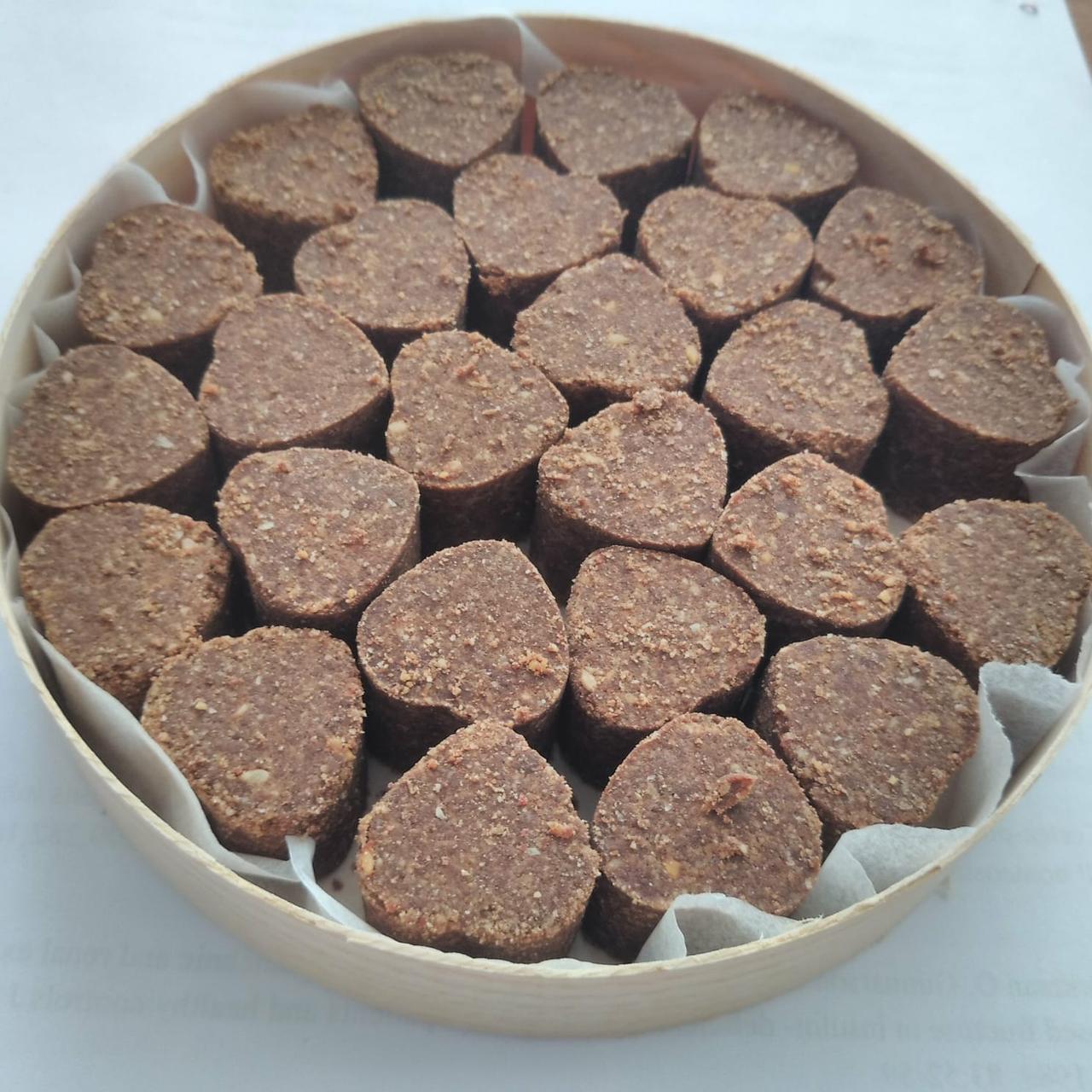
Bozyazı kavutu is a traditional Yörük food prepared by pounding carob (Ceratonia siliqua), peanut (Arachis hypogaea L.), sesame (Sesamum indicum L.), and sorghum (Sorghum bicolor L. Moench) without requiring cooking. It is characterized by its brown color, halva-like texture, and an aroma reminiscent of chocolate tahini. It has a mild sweetness and contains no added sugar; the natural sugars in its ingredients serve as the sole sweetening source.
In the past, it was preferred during long journeys and consumed daily by those engaged in animal husbandry. This usage led to the product being known locally as “çoban helvası” (shepherd’s halva).
Composition The traditional recipe consists of four main ingredients in the following proportions:
Traditional Method: In traditional production, carob, peanut, sesame, and sorghum are sourced locally and pounded inside a hollowed-out hard stone known as a “dibek taşı” until a halva-like consistency is achieved. This process is carried out using mallets called “solgu,” made from resin and cedar wood. First, the carob is pounded until it reaches a paste-like consistency; then peanut and sorghum are added sequentially; finally, sesame is incorporated and the mixture is pounded until it attains the desired halva texture.
In industrial production, the ingredient ratios are maintained. Prior to production, the moisture content of the food components is measured and controlled drying is performed at specified temperatures:
After drying, the ingredients are ground and then transferred to a mixing vessel, where they are refined using a mixer or grinder. The addition of sesame initiates the kneading process, which lasts approximately 45 minutes until the halva consistency is reached. The product is then shaped according to desired forms and presented to consumers.
Bozyazı kavutu was registered as a geographical indication on 03.09.2020 under the Industrial Property Law No. 6769. The entire production and processing process must take place within the boundaries of the Bozyazı and Anamur districts of Mersin Province. The product’s reputation is rooted in its long-standing traditional production method within this geographical boundary.
Monitoring of production and the use of the geographical indication is coordinated by the Textile and Cultural Products Development Association (DOKUDER). The monitoring body consists of one representative from each of the following institutions:
Inspections are conducted at least once annually, verifying compliance with production techniques, ingredient ratios, adherence to the geographical boundary, and proper use of sorghum. Expert support from public or private sector entities may be sought when necessary. The registering entity is also responsible for initiating legal proceedings to protect these rights within this framework.
Turk Patent and Trademark Office. "Coğrafi İşaret Detayı: Bozyazı Kavutu." Coğrafi İşaretler Portalı. Accessed July 2, 2025. https://ci.turkpatent.gov.tr/cografi-isaretler/detay/38600.

Type of Geographical İndication | Signaling Mark | ||||||||
|---|---|---|---|---|---|---|---|---|---|
Application Date | 12.07.2018 | ||||||||
Registration Number | 530 | ||||||||
Registration Date | 03.09.2020 | ||||||||
Product / Product Group(s) | Chocolate confectionery and related products | ||||||||
Applicant/Registrant(s) | Textile and Cultural Products Development Association | ||||||||
Place of Production | Bozyazı and Anamur districts, Mersin, Türkiye | ||||||||
Production Methods
Industrial Method
Storage Conditions
Geographical Indication and Registration Information
Monitoring Mechanism