This article was automatically translated from the original Turkish version.
+1 More
Name(s) | Metropolitan Cathedral of Our Lady of Aparecida | ||||||||
|---|---|---|---|---|---|---|---|---|---|
Known Name | Brasília Cathedral | ||||||||
Location | Brasília / Brazil | ||||||||
Architect(s) | Oscar Niemeyer | ||||||||
Opening Date | 1970-05-31 | ||||||||
Architectural Style(s) | Modernism | ||||||||
Construction Material | Concrete, Glass | ||||||||
Capacity | 4000 | ||||||||
The Brasília Cathedral (Portuguese: Catedral Metropolitana Nossa Senhora Aparecida) is a cathedral located in Brasília, the capital of Brazil, and is regarded as one of the most important examples of modernist architecture. It is situated along the city’s primary planning axis, the Monumental Axis. The cathedral is dedicated to Nossa Senhora Aparecida, the patron saint of Brazil. The cathedral’s structural framework is part of the public buildings designated by Brazil’s state authorities as “symbols of a new nation.”
When Brasília was constructed as the new capital in 1960, it was intended to be adorned with architectural symbols. The city’s master plan was designed by urban planner Lúcio Costa, while the cathedral’s design was entrusted to architect Oscar Niemeyer. Construction began on 12 September 1958, and the structural framework was completed in 1960. Interior architectural and artistic elements were added later, and the cathedral was opened to the public on 31 May 1970. The cathedral is located on the Monumental Axis (Eixo Monumental) at the center of Brasília.
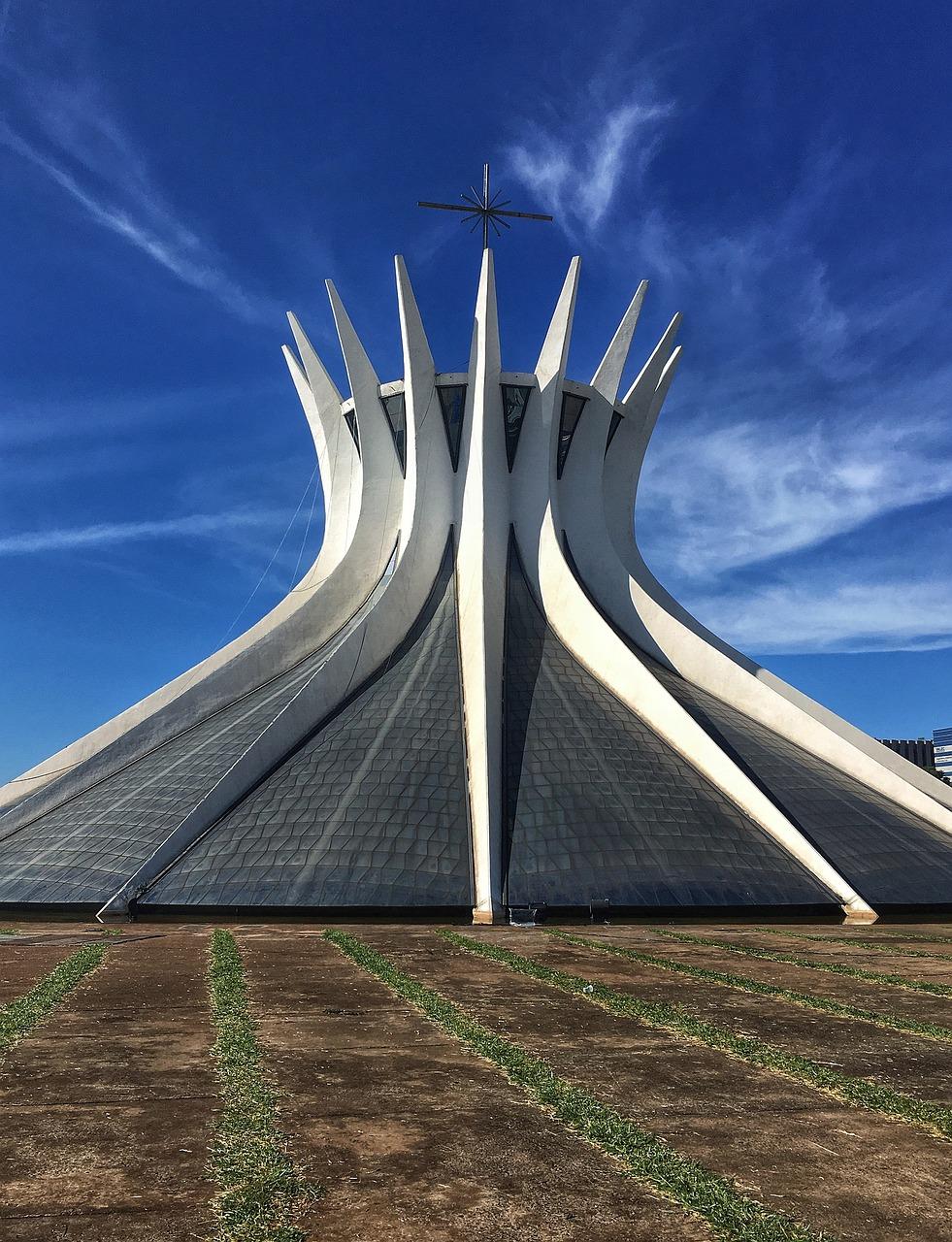
The architectural design of the building is by Oscar Niemeyer. The cathedral’s most striking feature is its hyperbolic structure composed of 16 boomerang-shaped columns that rise upward from below ground level, forming a crown-like silhouette. These columns are 30 meters high and weigh 90 tons each. The entire structure is placed on a circular platform accessible via an open plaza.
The cathedral has a capacity of approximately 4,000 people. Visitors enter the interior space through a glass-enclosed tunnel from the exterior area. A 12-meter-tall metal cross at the top serves as a visually prominent element. The glass panels on the exterior facade, combined with a surrounding water mirror, facilitate the entry of humid air into the interior, aiding natural cooling in the hot climate of Brazil’s Cerrado region. Inside the space, three bronze angel sculptures hang from the ceiling suspended by steel cables.

Interior of the Brasília Cathedral (Pixabay)
The building is constructed using modernist architectural materials such as concrete and glass. The stained glass windows, designed by French-Brazilian artist Marianne Peretti, allow light to filter softly into the space and are harmonized with the reinforced concrete structure. The glass panels consist of three primary colors: blue, green, and white.
The baptistry attached to the cathedral features ceramic panels by Brazilian artist Athos Bulcão. Bulcão’s geometric patterns exemplify the integration of modern art into religious architecture. This section also includes a small cross-shaped opening that allows light to enter.

Brasília Cathedral (Pixabay)
The water mirror surrounding the building is not merely an aesthetic feature but also serves a climatic function. This reflective surface enhances the building’s architectural presence while helping to reduce internal temperatures. It also amplifies the light effects reflected on the glass facades, strengthening the overall architectural perception.
The Brasília Cathedral is among the most prominent architectural and cultural landmarks in the city of Brasília. It is recognized as a representative of modernist architecture through the combined use of concrete and glass. The building is situated within the planned architectural fabric of Brasília, which is inscribed on the UNESCO World Heritage List.
20th Century ARCHITECTURE. "Brazil." *Architecture history.* Accessed July 15, 2025. https://architecture-history.org/schools/BRAZIL.html.
Funari, Pedro Paulo. “Cultural Heritage and Urban Identity in Brasília.” *Latin American Perspectives* 29, no. 6 (2002): 38–47. Accessed July 15, 2025. https://doi.org/10.1177/0094582X0202900604
Google Arts & Culture. "The Cathedral of Brasília." Google Arts & Culture. Accessed July 15, 2025. https://artsandculture.google.com/story/the-cathedral-of-bras%C3%ADlia/MgVRXcLqDHwkfg?hl=en
Pixabay. “Brasilia - Brezilya, Katedral, Kilise JPG.” Pixabay. Accessed July 22, 2025. https://pixabay.com/tr/photos/brasilia-brezilya-katedral-kilise-83557/
Pixabay. “Brasilia, Metropol Katedrali, Katolik JPG.” Pixabay. Accessed July 22, 2025. https://pixabay.com/tr/photos/brasilia-metropol-katedrali-katolik-1205602/
Pixabay. “Cathedral, The Cathedral of Brasilia JPG.” Accessed July 22, 2025.
UNESCO World Heritage Centre. “Brasilia.” UNESCO. Accessed July 22, 2025. https://whc.unesco.org/en/list/445

Name(s) | Metropolitan Cathedral of Our Lady of Aparecida | ||||||||
|---|---|---|---|---|---|---|---|---|---|
Known Name | Brasília Cathedral | ||||||||
Location | Brasília / Brazil | ||||||||
Architect(s) | Oscar Niemeyer | ||||||||
Opening Date | 1970-05-31 | ||||||||
Architectural Style(s) | Modernism | ||||||||
Construction Material | Concrete, Glass | ||||||||
Capacity | 4000 | ||||||||
Historical Background
Design and Architectural Features
Structural and Functional Features
Baptistry
Environmental Elements
Cultural and Heritage Value