


This article was automatically translated from the original Turkish version.
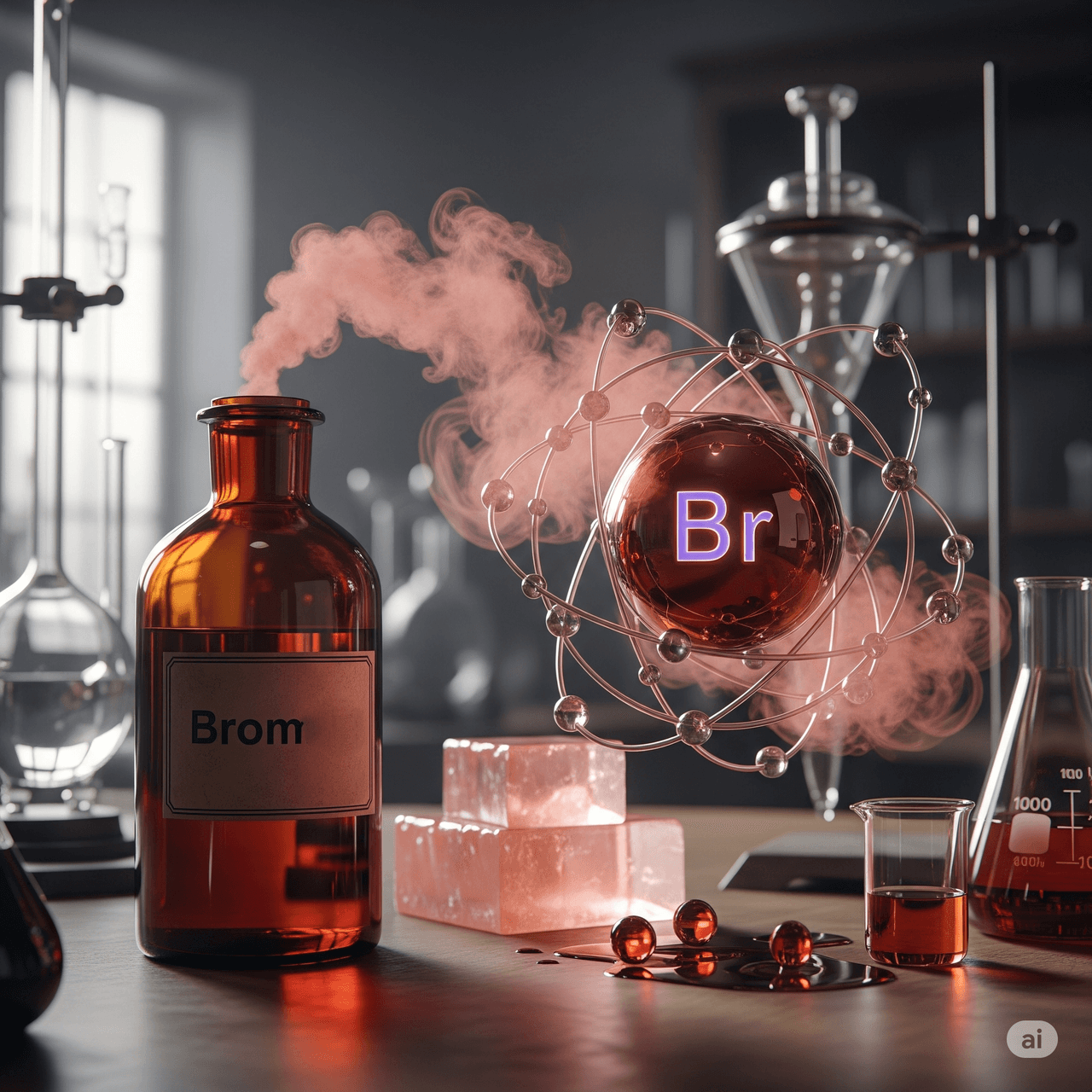
Brom (Br) (Generated by Artificial Intelligence.)
Group / Period / Block | 17 / 4 / p-Blok | ||||||||
|---|---|---|---|---|---|---|---|---|---|
Electronegativity | 2.96 (Pauling Scale) | ||||||||
Atomic Mass | ~79.904 u | ||||||||
Standard State | Liquid | ||||||||
Odor | Sharp, Irritating | ||||||||
Natural Isotopes | ⁸¹Br ⁷⁹Br | ||||||||
Year of Discovery / Discoverer | 1826 / Antoine J. Balard | ||||||||
Discovery(ies) | Seawater Saline Groundwaters | ||||||||
Melting Point | 265.95 K (-7.2°C or 19.0°F) | ||||||||
Boiling Point | 331.95 K (58.8°C or 137.8°F) | ||||||||
Applications | Photography Disinfection Agriculture Drug Flame Retardant | ||||||||
Brom is a halogen element located in group 17 of the periodic table and is one of the rare elements that exists as a liquid at room temperature. With an atomic number of 35, bromine is a reddish-brown liquid with a sharp, irritating odor.
Bromine does not occur freely in nature; it is typically found in seawater and saline groundwater as bromide ions (Br⁻). Due to its high chemical reactivity, bromine plays important roles in both industrial applications and environmental processes. It is also an element that requires careful monitoring due to its toxicological properties.
The element bromine was discovered in 1826 by the French chemist Antoine Jérôme Balard. While examining saltwater samples derived from seaweed near Montpellier, Balard identified a new substance exhibiting chemical properties intermediate between chlorine and iodine. He named this substance “bromine,” derived from the Greek word bromos, meaning “bad smell.”【1】 Balard’s discovery contributed to a better understanding of the halogen family and paved the way for bromine’s industrial applications.
Bromine is a p-block element in the periodic table and belongs to the halogen group. Its atomic number is 35 and its atomic mass is approximately 79.904 atomic mass units. Its electron configuration is [Ar] 3d¹⁰ 4s² 4p⁵. Bromine is the only halogen that exists as a liquid at room temperature and is commonly found in nature as a diatomic molecule (Br₂). These characteristics make bromine unique both chemically and physically.
Bromine is a reddish-brown, volatile liquid with a sharp odor. Its vapors are highly irritating and toxic. It has limited solubility in water but dissolves more readily in organic solvents. Chemically highly reactive, bromine undergoes electrophilic addition reactions with alkenes and aromatic compounds. This reactivity enables its widespread use in organic synthesis. Additionally, bromine reacts directly with many metals to form metal bromide compounds.
The electronegativity of bromine is 2.96, indicating its tendency to attract electrons. Among the halogens, it ranks third after chlorine and fluorine in terms of electronegativity. Bromine can act as a strong oxidizing agent and shows a strong tendency to react with organic compounds. These properties make bromine widely used in bromination reactions. Although highly reactive, it exhibits less aggressive behavior compared to fluorine and chlorine.
Naturally occurring bromine has two stable isotopes: ⁷⁹Br and ⁸¹Br. These isotopes occur in approximately equal proportions, and the atomic mass of natural bromine is based on their average. Both isotopes are used in nuclear analyses and isotopic tracing studies. Radioactive isotopes of bromine have limited applications and are generally produced in laboratory settings.
Bromine does not occur in its free state in nature; it is primarily found in seawater as bromide ions (Br⁻). Bromine compounds are also present in evaporite deposits and saline groundwater. Common compounds include hydrogen bromide (HBr), methyl bromide (CH₃Br), ethylene dibromide (C₂H₄Br₂), and sodium bromide (NaBr). These compounds play significant roles in both industrial and environmental processes. Methyl bromide, in particular, was historically widely used as a fumigant in agriculture.
Bromine is not an essential element for the human body; however, it can be part of organic compounds naturally synthesized by certain marine organisms. Bromine compounds may affect the nervous system, and some brominated compounds were previously used as sedatives. Nevertheless, certain brominated organic compounds are classified as toxic and persistent pollutants. Brominated flame retardants, for example, can accumulate in the environment and cause adverse effects on ecosystems. Therefore, the biological impacts of bromine must be carefully monitored.

Applications of Bromine Element (Generated by Artificial Intelligence.)
Bromine and its compounds are used in various industrial fields. Brominated compounds serve as flame retardants in electronics and textile products. In the pharmaceutical industry, some brominated compounds possess sedative and anticonvulsant properties. Methyl bromide was historically widely used as a fumigant in agriculture, but its use has been restricted due to environmental concerns. Bromine compounds are also used as disinfectants in water treatment systems. Additionally, silver bromide is used in photography as a light-sensitive material.
Brominated organic compounds are persistent and bioactive substances from an environmental perspective. Particularly compounds such as brominated flame retardants and methyl bromide can remain in the atmosphere and water sources for extended periods. These substances can damage the ozone layer and exert toxic effects on living organisms. The environmental impact of bromine must be carefully evaluated in terms of both human health and ecosystem integrity. Consequently, the production and use of bromine-containing compounds are subject to international regulations.
Faina Gelman and Agnieszka Dybala-Defratyka. “Bromine isotope effects: Predictions and measurements.” *Chemosphere* 246 (2020): 125746. Accessed August 21, 2025. https://www.sciencedirect.com/science/article/pii/S004565351932987X.
National Center for Biotechnology Information. “Bromine.” *PubChem Compound Summary*. Accessed August 21, 2025. https://pubchem.ncbi.nlm.nih.gov/element/Bromine.
TÜBİTAK Bilim Genç. "Brom." *Bilim Genç*. Accessed August 21, 2025. https://bilimgenc.tubitak.gov.tr/periyodik-tablo/brom.
[1]
TÜBİTAK Bilim Genç, “Brom,” Bilim Genç, Erişim 21 Ağustos 2025, https://bilimgenc.tubitak.gov.tr/periyodik-tablo/brom.

Brom (Br) (Generated by Artificial Intelligence.)
Group / Period / Block | 17 / 4 / p-Blok | ||||||||
|---|---|---|---|---|---|---|---|---|---|
Electronegativity | 2.96 (Pauling Scale) | ||||||||
Atomic Mass | ~79.904 u | ||||||||
Standard State | Liquid | ||||||||
Odor | Sharp, Irritating | ||||||||
Natural Isotopes | ⁸¹Br ⁷⁹Br | ||||||||
Year of Discovery / Discoverer | 1826 / Antoine J. Balard | ||||||||
Discovery(ies) | Seawater Saline Groundwaters | ||||||||
Melting Point | 265.95 K (-7.2°C or 19.0°F) | ||||||||
Boiling Point | 331.95 K (58.8°C or 137.8°F) | ||||||||
Applications | Photography Disinfection Agriculture Drug Flame Retardant | ||||||||
Discovery
Classification and Fundamental Properties
Physical and Chemical Properties
Electronegativity and Reactivity
Isotopes
Occurrence in Nature and Compounds
Biological Role and Importance to Living Organisms
Applications
Environmental Impact and Toxicity