


This article was automatically translated from the original Turkish version.
+2 More
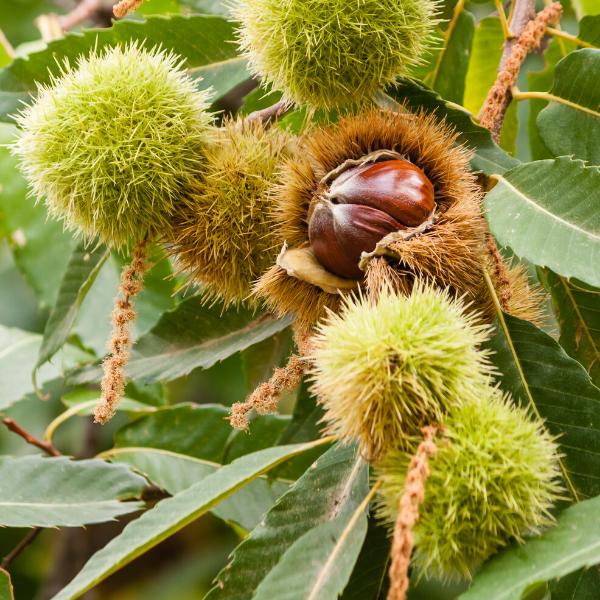
Bursa Chestnut is the fruit of Castanea sativa trees native to the province of Bursa in Türkiye’s Marmara Region. This product is cultivated in villages at specific elevations on the slopes of Uludağ and is protected under geographical indication. Its production, from cultivation to storage, follows specific technical and traditional methods. Distinguished by its morphological and chemical characteristics from other chestnut varieties, Bursa Chestnut is defined by the grafting techniques applied in its production and the unique climate and soil structure of its growing region.

Bursa Chestnut, (Information Processing Directorate, Bursa Metropolitan Municipality)
Bursa Chestnut is cultivated in the villages of Fidyekızık, Hamamlıkızık, and Cumalıkızık under the district of Yıldırım; Derekızık under the district of Kestel; and İnkaya and Yiğitali (Çongara) under the district of Osmangazi, all located on the slopes of Uludağ in Bursa Province. This geographical boundary lies between 400 and 600 meters elevation and features volcanic-origin soils with high potassium content.
Bursa Chestnut belongs to the family Fagaceae and develops on trees of the species Castanea sativa. The trees exhibit a tall crown structure and grow in a semi-upright form. They display sympodial branching, halting apical growth and transferring development to lateral branches. Young branches are reddish-brown and contain numerous white lenticels. Leaves are alternate, long, broad, and serrated. The average leaf length is 19.64 ± 6.25 cm, width is 6.25 ± 0.71 cm, and petiole length is 2.77 ± 0.75 cm.
In terms of fruit morphology, Bursa Chestnut is large and broadly flattened, with 53 to 55 fruits per kilogram. On average, three fruits develop per bur. The average fruit dimensions are 40.71 ± 2.29 mm in length, 31.66 ± 1.56 mm in width, and 23.84 ± 2.54 mm in height. The shell thickness is 0.368 ± 0.049 mm, placing it in the thin-shell category. The shell color is typical chestnut brown with a slightly striated surface. The hilum (seed stalk) is wavy, measuring 26.07 ± 2.71 mm in length and accounting for 13.25 ± 2.20% of the fruit’s surface. There is no umbilical cavity, and the kernel is light cream-colored.
When evaluated on a dry matter basis, Bursa Chestnut is notable for its high starch and protein content. Chemical analyses are as follows:

Bursa Chestnut, (Directorship of Information Processing, Bursa Metropolitan Municipality)
Bursa Chestnut is primarily produced by grafting wild chestnut trees found in forested areas adjacent to villages. The establishment of new chestnut orchards and associated plantings in these areas is very limited. The product is monoecious and dichogamous; therefore, pollination predominantly occurs through cross-pollination. Due to the high genetic variation resulting from seed propagation, this method is used only for obtaining rootstock.
In grafting wild chestnut trees with cultivated varieties, cleft and bark grafting techniques are preferred. Trees selected for grafting must be healthy and not diseased or excessively old. One of the most common methods is bark grafting, performed during the period when sap flow begins and the bark separates easily from the wood. Grafting scions are taken from healthy branches free of chestnut blight and stored at +2 °C. For grafting, the trunk is pruned to a height of approximately 90–100 cm. Thick branches of older trees are also prepared for grafting. After grafting, the graft surfaces are sealed with grafting wax. Depending on branch diameter, two or three scions can be grafted per branch. Successful graft union typically occurs within 30 days, and well-rooted rootstocks exhibit rapid shoot development.
In the production of seedlings for new orchards, bud grafting methods are widely used due to their practicality and efficient utilization of scion material. Techniques employed include T-budding, inverted T-budding, and chip budding. Timing of grafting is critical to success. Bud grafting performed in spring (late April to early May), after the rootstock has leafed out, generally yields high success rates. After grafting, all shoots except one or two above the graft are pruned. Dormant bud grafting can be performed in August; scions for this method are taken from the same year’s shoots and used immediately without storage. Grafts performed this way develop during the following growing season.
The cultivation area lies on the slopes of Uludağ at elevations between 400 and 600 meters. Annual average rainfall in this region ranges from 600 to 700 mm. Precipitation levels directly influence fruit development. High daytime temperatures and low nighttime temperatures during the vegetative period are key factors determining the internal structure and composition of the fruit. Chestnut trees in their natural habitat thrive in shaded environments; however, in north-facing areas, light requirements increase.
As the chestnut tree possesses a deep taproot system, the soil must be loose, well-drained, and deep. An ideal soil pH range is 5.0 to 6.5. The volcanic origin and high potassium content of soils within the geographical boundary significantly influence the structural and chemical properties of the fruit. This soil composition contributes to increased starch and protein levels.
Chestnut trees may be adversely affected by drought periods during summer. This can lead to leaf drop and reduced fruit size. Therefore, irrigation is essential, particularly during dry summer months.
The harvest time is determined by the opening of the spiny fruit capsules (burs) and the browning of the chestnuts inside. Harvesting is carried out when at least half of the capsules have matured. During harvesting, fruits are collected by striking branches with long poles, ensuring no damage to the tree structure.
The harvested product can be stored in two ways:
The monitoring process is conducted at least once annually under the coordination of the Bursa Province Livestock Development Union, in collaboration with experts from the Bursa Metropolitan Municipality, the Bursa Provincial Directorate of Agriculture and Forestry, and the Osmangazi Chamber of Agriculture. Monitoring includes verification of production methods and conformity to the morphological and chemical characteristics unique to Bursa Chestnut. Additional inspections may be carried out as needed. The use of the geographical indication and origin designation is also evaluated within this framework.

Bursa Chestnut, (Information Processing Directorate, Bursa Metropolitan Municipality)
Bursa Metropolitan Municipality. "Bursa Kestanesi de Artık Tescilli." Bursa Büyükşehir Belediyesi Resmî Web Sitesi, December 25, 2023. Accessed May 22, 2025. https://www.bursa.bel.tr/haber/bursa-kestanesi-de-artik-tescilli-34087.
Turkish Patent and Trademark Office. "Bursa Kestanesi Coğrafi İşaret Başvuru Dosyası (PDF)." Coğrafi İşaretler ve Geleneksel Ürün Adları. Accessed May 22, 2025. https://ci.turkpatent.gov.tr/Files/GeographicalSigns/04111992-7662-4bdf-b3bd-4a2ad5782e10.pdf.
Turkish Patent and Trademark Office. "Bursa Kestanesi – C2022/000186." *Geographical Indications Database*. Accessed May 22, 2025. https://ci.turkpatent.gov.tr/cografi-isaretler/detay/6964.

Geographical Boundary and Distribution
Botanical and Morphological Characteristics
Chemical Properties
Production
Grafting of Wild Trees
Production of Grafted Seedlings
Climatic Conditions
Soil Characteristics
Irrigation Practices
Harvesting Process
Storage Methods
Monitoring Mechanism