This article was automatically translated from the original Turkish version.
+1 More
Type of Geographical İndication | Traffic Sign | ||||||||
|---|---|---|---|---|---|---|---|---|---|
Application Date | 14.03.2019 | ||||||||
Registration Number | 603 | ||||||||
Registration Date | 23.11.2020 | ||||||||
Product / Product Group(s) | Textiles | ||||||||
Province(s) | Denizli | ||||||||
Applicant/Registrant(s) | Çameli Municipality | ||||||||
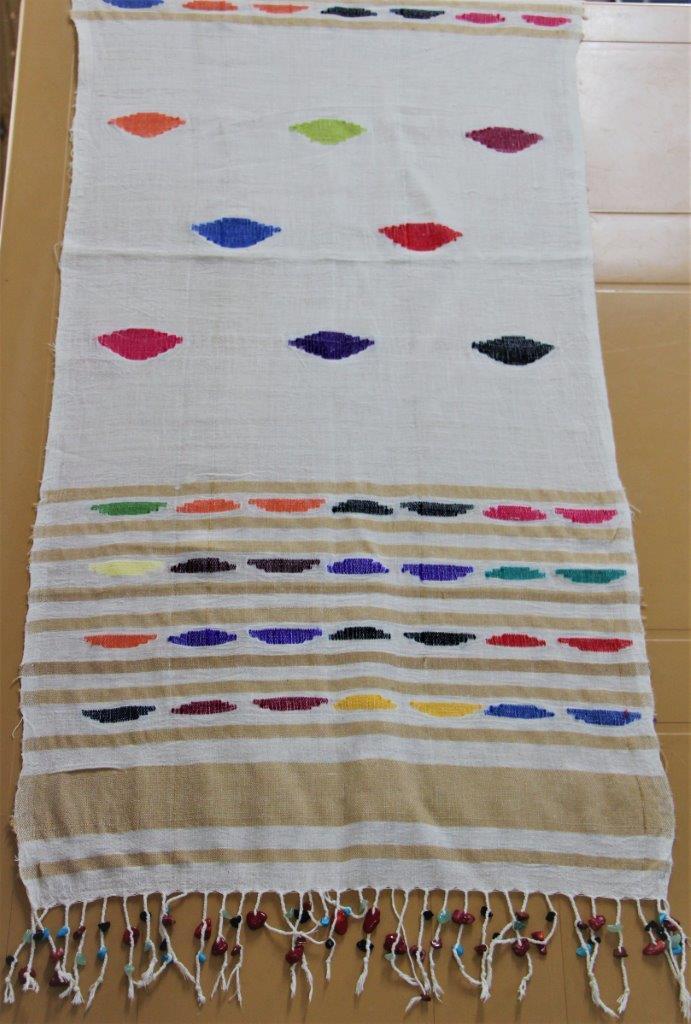
Çameli Elmalı Bezi is a traditional woven textile produced in the village of Elmalı, within the Çameli district of Denizli Province. Registered as a geographical indication under Law No. 6769 on Industrial Property, this fabric is woven from extremely fine yarns and possesses high absorbency. The product has a long history dating back to the early 20th century and is strongly associated with its region of origin. After weaving, the fabric is washed in warm soapy water, causing it to shrink crosswise and acquire its characteristic wrinkled texture.
The beginning and end sections of the fabric feature vibrant colors derived from natural sources such as pomegranate, saffron, and other plant-based dyes in shades of yellow, red, green, blue, purple, and their intermediate tones. The fabric is adorned with geometric patterns and regional kilim motifs, and its fringes represent a distinct example of handcraftsmanship.
Çameli Elmalı Bezi is woven on portable, whip-loom systems known as “düven.” The whip mechanism allows the shuttle to be propelled by a pedal-driven system rather than by hand. A six-harness loom system is typically used, and yarn passages follow specific rules. To maintain a consistent width during weaving, an iron device called “çımbar” is employed.
For both weft and warp, extremely fine 20/1 count 100% cotton yarns are preferred. The warp yarns are highly twisted and referred to as “kıvrak iplik.” The fabric is commonly used for headscarves, aprons, and tablecloths.
First, the yarns are sized: they are immersed for 24 hours in a mixture prepared by dissolving corn or wheat flour in boiling water. After this treatment, the yarns are wound onto spindles without drying and transferred to wooden reels called “çağ” to prepare them for the warp.
In warp preparation, the ends of the yarns are hung on a “çözek” frame, aligned using a reed, and passed through the heddles. Each warp thread is threaded through eyes called “gücü,” and weaving is carried out manually by opening the shed, inserting the weft, and beating it into place on the loom.
To prevent distortion of the fabric width during weaving, an iron belt called “çumbar” is used, and the woven fabric is wound around a wooden beam known as “saymin” at the front of the loom. The fabric is woven to a width of 60 cm; after completion, a 15–20 cm gap is left before starting the next piece. The fabric is then cut, fringed, and the weaving process concludes.
Colorful pattern weaving begins once the fabric reaches 35 cm in length. While using shuttles to open the shed, colored yarns are manually inserted into selected threads. These steps are repeated according to the shapes of geometric or regional motifs. The ground is typically left in the natural color of the unbleached yarn, while the patterns are designed using vibrant dyes. The colors are derived from natural sources—for example, walnut husks yield brown, onion skins produce orange, and the bark of the dye tree gives yellow.
Çameli Elmalı Bezi can be produced only in the village of Elmalı. The production process, which requires specialized craftsmanship, is made possible only through the transmission of cultural knowledge and technical skills within this geographical boundary. Due to its geographical indication status, all stages of production must occur in this region.
Annual and complaint-based inspections are coordinated by the Çameli Municipality. During inspection, the fabric’s weaving characteristics, patterns, colors, and its registered logo and geographical indication emblem are examined. Authorized institutions or qualified experts may participate in the inspection process.
Turk Patent and Trademark Office. "Coğrafi İşaretler Portalı: Çameli Elmalı Bezi." Turk Patent and Trademark Office. Accessed July 9, 2025. https://ci.turkpatent.gov.tr/cografi-isaretler/detay/162.

Type of Geographical İndication | Traffic Sign | ||||||||
|---|---|---|---|---|---|---|---|---|---|
Application Date | 14.03.2019 | ||||||||
Registration Number | 603 | ||||||||
Registration Date | 23.11.2020 | ||||||||
Product / Product Group(s) | Textiles | ||||||||
Province(s) | Denizli | ||||||||
Applicant/Registrant(s) | Çameli Municipality | ||||||||
Production Process and Technical Details
Yarn Preparation and Pre-Weaving Processes
Coloring and Pattern Application Techniques
Geographical Link and Production Boundary
Monitoring Mechanism