This article was automatically translated from the original Turkish version.
+1 More
Registration Number | 19 | ||||||||
|---|---|---|---|---|---|---|---|---|---|
Registration Date | 14.11.1997 | ||||||||
Application Number | C1996/024 | ||||||||
Application Date | 21.06.1996 | ||||||||
Name of the Geographical Indication | Çanakkale El Halısı | ||||||||
Product / Product Group(s) | Halı / Halılar ve kilimler | ||||||||
Type of Geographical Indication | Mahreç işareti | ||||||||
Applicant/Registrant(s) | Çanakkale Belediyesi | ||||||||
Address of the Registrant | İsmetpaşa Mah. Demircioğlu Cad. No: 132 17100 ÇANAKKALE | ||||||||
Geographical Boundary | Çanakkale ili | ||||||||
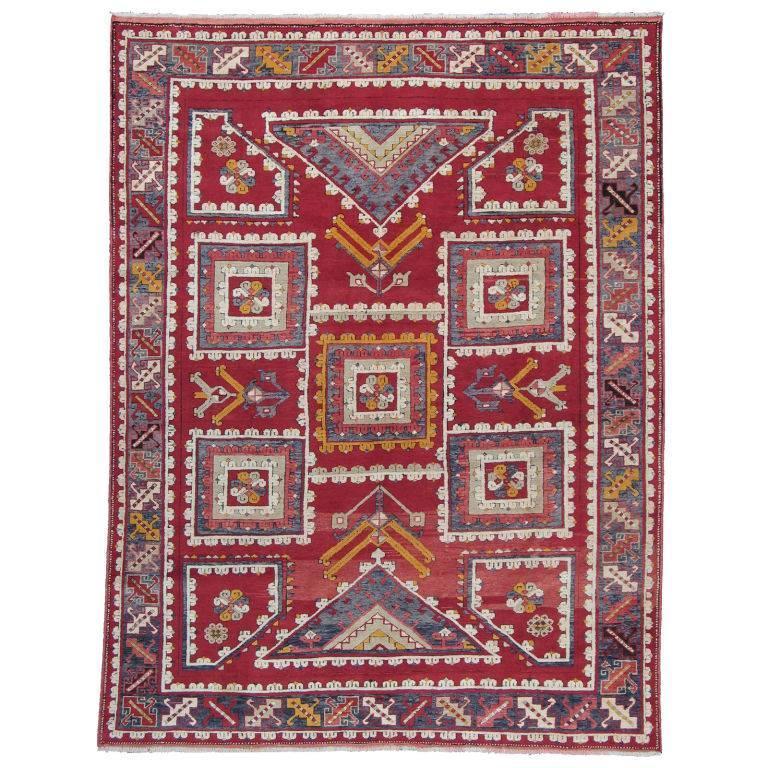
Çanakkale hand-knotted carpet is a type of carpet unique to Çanakkale province in Türkiye, produced using traditional techniques and entirely hand-woven. Its origins trace back to the Yörük communities who migrated to the region from Central Asia and the Caucasus. This carpet is characterized by geometric patterns and local motifs. Common motifs include star plate, crane belly, baklava slice, plane leaf, and poplar leaf.
Carpet weaving activities in Çanakkale historically stem from Yörük communities who migrated from Central Asia and the Caucasus to Anatolia and led a semi-nomadic lifestyle in mountain villages. This traditional production method evolved over time into region-specific techniques and motifs, developing into a distinct local craft identity.
Çanakkale hand-knotted carpets may only be produced within the boundaries of Çanakkale province. This restriction is imposed because the product has become historically identified with Çanakkale and its production knowledge has been passed down locally from generation to generation. Production outside these geographical boundaries renders the use of the term “Çanakkale Hand-Knotted Carpet” and its official emblem unlawful.
Çanakkale hand-knotted carpets feature a structure composed entirely of geometric patterns. Common elements in the designs include octagons, hexagons, baklava shapes, broken horizontal lines, hooks, crochets, triangles, and star forms. The motif repertoire includes star plate (an eight-pointed star enclosed within a circle), gold plate, turna (crane belly), enli sular, baklava slice, clustered star, plane leaf, vine leaf (Turkmen rose), topak, yağlık, and poplar leaf. These motifs are arranged in a specific pattern across the carpet surface to create a distinctive appearance.
The carpet typically features three borders: one wide and two narrow. The borders incorporate motifs such as carnation, scissors, and plane leaf. In particular, examples woven in the Çan district are characterized by a water motif in the main border. Additionally, border arrangements composed of oak leaf and cup motifs are frequently used. The form and arrangement of the edge borders are distinguishing features of the Çanakkale hand-knotted carpet.
Natural dyes are predominantly used in the production of these carpets. The color palette is dominated by blue, green, brown, black, and white. In the districts of Ayvacık and Yenice, yellow is used more intensively.
The primary tools and equipment used in the production of Çanakkale hand-knotted carpets include a vertical loom, kirkit, scissors, knife, and comb. The knotting technique employed is the Turkish knot (Gördes knot), known for its symmetrical structure. This technique involves a single loop tied around two independent warp threads. This knotting method enhances the carpet’s durability and lifespan.
The technical specifications of the carpet are as follows:
The total material consumption is 4,250 g/m², distributed as follows:
All stages of production must occur within the defined geographical boundaries. Production outside these boundaries is considered detrimental to the product’s authenticity and quality, as it is intrinsically linked to the region’s cultural heritage and artisanal expertise.
The production of Çanakkale hand-knotted carpets and the use of the geographical indication are monitored through inspections conducted twice annually—in January and April—and as needed. These inspections are carried out by a five-member inspection body coordinated by the Çanakkale Municipality. The body includes representatives from the Çanakkale Municipality, the Çanakkale Provincial Center for Public Education, the Çanakkale Evening Art School Directorate, and the Çanakkale City Council Cultural Values Working Group.
Inspection criteria include:
Expert individuals or institutions may be included in the inspection process. Inspection reports are submitted annually to the Turkish Patent and Trademark Office to ensure ongoing quality control and the protection of the geographical indication rights.
Turkish Patent and Trademark Office. "Çanakkale El Halısı Coğrafi İşaret Tescil Belgesi." Accessed July 18, 2025. https://ci.turkpatent.gov.tr/Files/GeographicalSigns/a9c5575f-b6ae-4448-84f2-8f919883d2af.pdf.
Turkish Patent and Trademark Office. "Çanakkale El Halısı." Accessed July 18, 2025. https://ci.turkpatent.gov.tr/cografi-isaretler/detay/37882.

Registration Number | 19 | ||||||||
|---|---|---|---|---|---|---|---|---|---|
Registration Date | 14.11.1997 | ||||||||
Application Number | C1996/024 | ||||||||
Application Date | 21.06.1996 | ||||||||
Name of the Geographical Indication | Çanakkale El Halısı | ||||||||
Product / Product Group(s) | Halı / Halılar ve kilimler | ||||||||
Type of Geographical Indication | Mahreç işareti | ||||||||
Applicant/Registrant(s) | Çanakkale Belediyesi | ||||||||
Address of the Registrant | İsmetpaşa Mah. Demircioğlu Cad. No: 132 17100 ÇANAKKALE | ||||||||
Geographical Boundary | Çanakkale ili | ||||||||
No Discussion Added Yet
Start discussion for "Çanakkale El Halısı" article
Historical Background and Cultural Context
Geographical Boundaries and Appellation
Technical and Physical Characteristics
Production Techniques and Material Properties
Production Conditions
Inspection Process