


This article was automatically translated from the original Turkish version.
+1 More
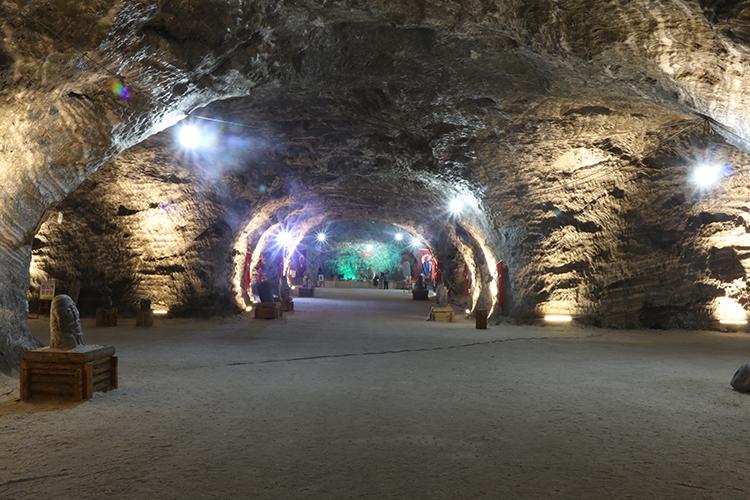
Çankırı Salt Cave
Location | Alıbağı Village Türkiye Çankırı Merkez District | ||||||||
|---|---|---|---|---|---|---|---|---|---|
Elevation(s) | Approximately 900 m | ||||||||
Depth(s) | Approximately 150 metres underground | ||||||||
Reserve | According to MTA data, approximately 808 million tons of apparent and probable rock salt reserve | ||||||||
The Çankırı Salt Cave is a natural salt formation located approximately 18 kilometers east of the city center of Çankırı, within the boundaries of Balıbağı Village, in Türkiye’s Central Anatolia Region. The cave is recognized as one of the oldest and largest rock salt mines in the world, with salt production having taken place there for about 5,000 years.
For many years, salt was extracted within the cave, and the voids created during this process gradually evolved into an extensive underground network. Efforts to develop these galleries for tourism began following a letter dated 8 November 2013 from the General Directorate of Mining Affairs and with the consent of the operating company. Under this initiative, the area was transferred to the Çankırı Provincial Special Administration; however, the contract was later terminated due to issues with the company awarded the tender. Subsequently, in accordance with Decision No. 69 of the Provincial General Assembly dated 26 April 2017, the right to use the cave for tourism purposes was transferred to the Çankırı Municipality.

Çankırı Salt Cave(Anadolu Agency)
Under the initiatives led by the Çankırı Municipality, cleaning and lighting works have been carried out in the cave, and it has been temporarily opened to visitors in response to public demand. Access to the cave is provided via a 13-kilometer village group road, followed by a 5-kilometer connecting road designated as the “Tourism Road.” The Salt Cave currently accommodates over 10,000 visitors per month.
As part of events held in the cave, salt sculptures produced during the Orhun Monuments Salt Workshop—attended by artists from Turkic Republics and several European countries—are exhibited. Additionally, sculptures made from salt by students of the Sculpture Department of Marmara University Faculty of Fine Arts and the exhibition “Weaving Çankırı” by the Textile Department of Çankırı Faculty of Fine Arts are presented to visitors. Artworks crafted from natural materials such as goat horn and sunflower seeds are also displayed within the cave.
Scientific observations indicate that the Çankırı Salt Cave has beneficial effects on respiratory diseases such as asthma and bronchitis. In line with this, the Çankırı Municipality has implemented a health tourism project titled “A Stronger Breath.” Under this project, patients with COPD receive supportive treatment in groups of 15, under the supervision of doctors and medical staff, within the cave.
An administrative building has been constructed at the entrance of the facility, housing service areas including an information office, restrooms, a cafeteria, a mosque, and a parking lot. Interior design and arrangement works within the underground galleries are ongoing.
Çankırı occupies an advantageous location in terms of road and rail transport. It is 120 kilometers from Ankara, 90 kilometers from Esenboğa Airport, 450 kilometers from Istanbul, and 199 kilometers from İnebolu Port. Its location along the Ankara-Zonguldak railway line enhances its accessibility. Once the planned high-speed train projects are completed, travel time to the region will be further reduced.
Yıldız, Halil İbrahim. “Hititlerden Kalan Tuz Mağarası Çankırı’nın Turizminde Öncü Rol Oynuyor.” Anadolu Ajansı. https://www.aa.com.tr/tr/dosya-haber/hititlerden-kalan-tuz-magarasi-cankirinin-turizminde-oncu-rol-oynuyor/3065098. Accessed May 10, 2025.
Çankırı Belediyesi. "Yer Altı Tuz Şehri." *cankiri.bel.tr*. https://cankiri.bel.tr/proje/yer-alti-tuz-sehri/76. Accessed May 10, 2025.
Çankırı Valiliği. “Tuz Mağarası Çankırı.” *cankiri.gov.tr*. http://www.cankiri.gov.tr/tuz-magarasi-cankiri. Accessed May 10, 2025.

Çankırı Salt Cave
Location | Alıbağı Village Türkiye Çankırı Merkez District | ||||||||
|---|---|---|---|---|---|---|---|---|---|
Elevation(s) | Approximately 900 m | ||||||||
Depth(s) | Approximately 150 metres underground | ||||||||
Reserve | According to MTA data, approximately 808 million tons of apparent and probable rock salt reserve | ||||||||
Current Use and Tourism Activities
Health Tourism Potential
Infrastructure and Access