


This article was automatically translated from the original Turkish version.
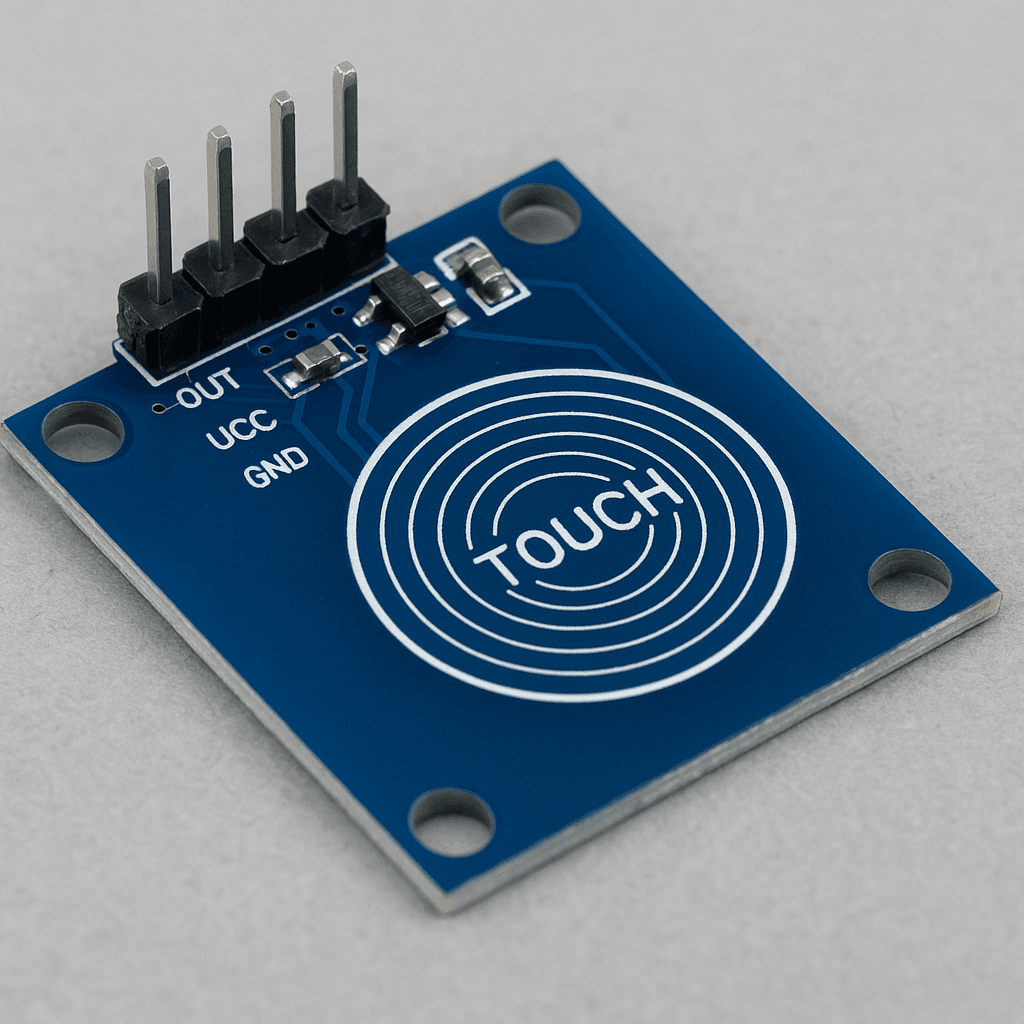
Capacitive Sensor
Usage Area | Consumer Electronics | ||||||||
|---|---|---|---|---|---|---|---|---|---|
Supply Voltage | 2.0V – 5.5V DC | ||||||||
Output Type | Digital | ||||||||
A capacitive touch sensor is an electronic sensor that detects only finger contact or proximity without requiring physical pressure. These sensors are widely used, ranging from modern smartphone screens to household appliances. Replacing mechanical buttons, these sensors offer advantages such as design integrity, long lifespan, and high sensitivity.
Capacitive sensors have a fundamental capacitance value between a conductive surface (sensor pad) and circuit ground. This creates a stable electric field over the sensor surface. The human body is naturally conductive. When a conductive object such as a finger approaches or touches the sensor’s electric field, it effectively adds a second capacitor to the system. This new capacitor forms between the finger (first plate) and the sensor pad (second plate), creating a path to ground through the human body. This additional capacitance, connected in parallel to the circuit, increases the system’s total capacitance. The sensor’s control circuit continuously measures this sudden increase in capacitance. When the change exceeds a predefined threshold, it is interpreted as a touch event and triggers a corresponding digital output signal. The fundamental mathematical expression determining a capacitor’s capacitance is:
Where:
This formula illustrates the factors affecting the capacitance formed between the finger and the sensor. This additional capacitance generated upon touch forms the foundation of the sensor’s operational principle.

Capacitive Touch Sensor (Generated by Artificial Intelligence)
Capacitive sensors are preferred in many fields due to their ease of use and aesthetic advantages:
Li, Xiujun, and Gerard C. M. Meijer. "An Accurate Interface for Capacitive Sensors." *IEEE Transactions on Instrumentation and Measurement* 51, no. 5 (October 2002): 935–39. Accessed June 17, 2025. https://repository.tudelft.nl/file/File_f706620b-9490-41ff-bcbf-b6914ac46f20.
Nam, Hyoungsik, Ki-Hyuk Seol, Junhee Lee, Hyeonseong Cho, and Sang Won Jung. "Review of Capacitive Touchscreen Technologies: Overview, Research Trends, and Machine Learning Approaches." *Sensors* 21, no. 14 (2021): 4776. Accessed June 17, 2025. https://pmc.ncbi.nlm.nih.gov/articles/PMC8309784/.

Capacitive Sensor
Usage Area | Consumer Electronics | ||||||||
|---|---|---|---|---|---|---|---|---|---|
Supply Voltage | 2.0V – 5.5V DC | ||||||||
Output Type | Digital | ||||||||
No Discussion Added Yet
Start discussion for "Capacitive Touch Sensor" article
Working Principle
Characteristics
Applications