


This article was automatically translated from the original Turkish version.
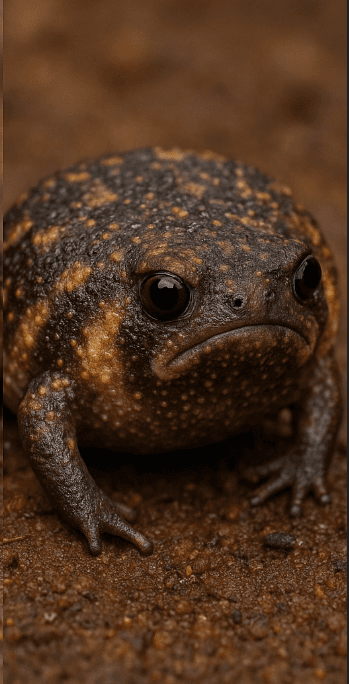
Cape Rain Frog
Latin Name | Breviceps gibbosus | ||||||||
|---|---|---|---|---|---|---|---|---|---|
Family | Microhylidae | ||||||||
Habitat | Türkiye | ||||||||
Physical Characteristics | Swollen body | ||||||||
The Cape Rain Frog (Breviceps gibbosus) is an endemic amphibian found in western South Africa, particularly around Cape Town and its surrounding areas. It is distinguished by its short legs, rounded body, and inconspicuous head structure. This species emerges from underground during or before rainfall or under humid weather conditions, a behavior that has earned it the name “rain frog.” It lives by digging in the soil and plays an important role in its ecosystem through this activity.
The Cape Rain Frog is a species that can reach a length of approximately 45 mm, with short legs and a rounded body. Its skin color is typically shades of brown, and the underside features a speckled pattern. These frogs lack swimming ability and can drown if placed in water. They are adapted to a subterranean lifestyle and use their thick, powerful legs to dig burrows in the soil for shelter.

Cape Rain Frog (Generated by Artificial Intelligence)
This species is found in western South Africa, particularly between Cape Town and Citrusdal, at elevations up to 1,000 meters above sea level. It inhabits Mediterranean-type shrublands such as fynbos and renosterveld, as well as agricultural lands and urban gardens. Its habitat is threatened by urban expansion and agricultural activities. However, some individuals have adapted to survive in urban gardens.
The Cape Rain Frog is a solitary species. It typically remains underground and only surfaces during or before rainfall or under humid conditions. When threatened, it inflates its body to appear larger than it is, thereby deterring predators. This behavior is known locally as “blaasoppie.”
This frog feeds on small invertebrates such as earthworms, insects, and termites. Due to its subterranean lifestyle, it searches for prey within the soil or near the surface. Its feeding habits vary depending on the abundance of available prey in its region. For example, in some areas termites form the primary food source, while in others earthworms are the main dietary component.
Unlike many other frog species, the Cape Rain Frog reproduces without requiring water. The female lays her eggs in a burrow she digs underground, and the eggs hatch directly into small frogs, bypassing the larval or tadpole stage entirely. This adaptation allows the frogs to breed even in arid regions. Males emit calls from underground to attract females and secrete a sticky substance during mating to adhere to the female’s body.
The Cape Rain Frog is classified as “Near Threatened” by the International Union for Conservation of Nature (IUCN). Factors such as habitat loss, urban expansion, agricultural activities, and pesticide use negatively impact its population. Domestic pets also pose a threat to these frogs. Conservation efforts include protecting natural habitats, reducing pesticide use, and raising public awareness.
The Cape Rain Frog is regarded by local communities as a harbinger of rain and holds cultural significance in certain beliefs. Additionally, by digging in the soil, it contributes to soil aeration, which supports plant growth. However, its habitat is shrinking due to urban expansion and agricultural activities. Therefore, raising public awareness and preserving natural habitats are crucial for the conservation of this species.
Amphibians of the World. "Breviceps gibbosus (Linnaeus, 1758)." Accessed May 12, 2025. https://amphibiansoftheworld.amnh.org/Amphibia/Anura/Brevicipitidae/Breviceps/Breviceps-gibbosus.
Earth Touch News. “May We All Be as Fierce as This Tiny, Screaming Rain Frog.” Accessed May 12, 2025. https://www.earthtouchnews.com/cute-and-cool/cute/may-we-all-be-as-fierce-as-this-tiny-screaming-rain-frog.
Kakehashi, Ryosuke, Keitaro Hemmi, Willem Landman, Nobuaki Furuno, Louis Du Preez, Leslie Minter, and Atsushi Kurabayashi. “Better than Mere Attraction – Adhesive Properties of Skin Secretion in the Common Rain Frog, Breviceps adspersus.” *Salamandra* 58, no. 1 (2022): 43–51. https://www.researchgate.net/publication/358633526_Better_than_mere_attraction_-_adhesive_properties_of_skin_secretion_in_the_Common_Rain_Frog_Breviceps_adspersus. Accessed May 12, 2025.
SANBI. "Cape Rain Frog." Accessed May 12, 2025. https://www.sanbi.org/animal-of-the-week/cape-rain-frog/.
iNaturalist. "Rainfrogs of Cape Town's Journal." Accessed May 12, 2025. https://www.inaturalist.org/projects/rainfrogs-of-cape-town/journal.

Cape Rain Frog
Latin Name | Breviceps gibbosus | ||||||||
|---|---|---|---|---|---|---|---|---|---|
Family | Microhylidae | ||||||||
Habitat | Türkiye | ||||||||
Physical Characteristics | Swollen body | ||||||||
No Discussion Added Yet
Start discussion for "Cape Rain Frog (Breviceps gibbosus)" article
Physical Characteristics
Habitat and Distribution
Behavior and Social Structure
Diet and Feeding Habits
Reproduction and Offspring
Threats and Conservation Efforts
Relationships with Humans