


This article was automatically translated from the original Turkish version.
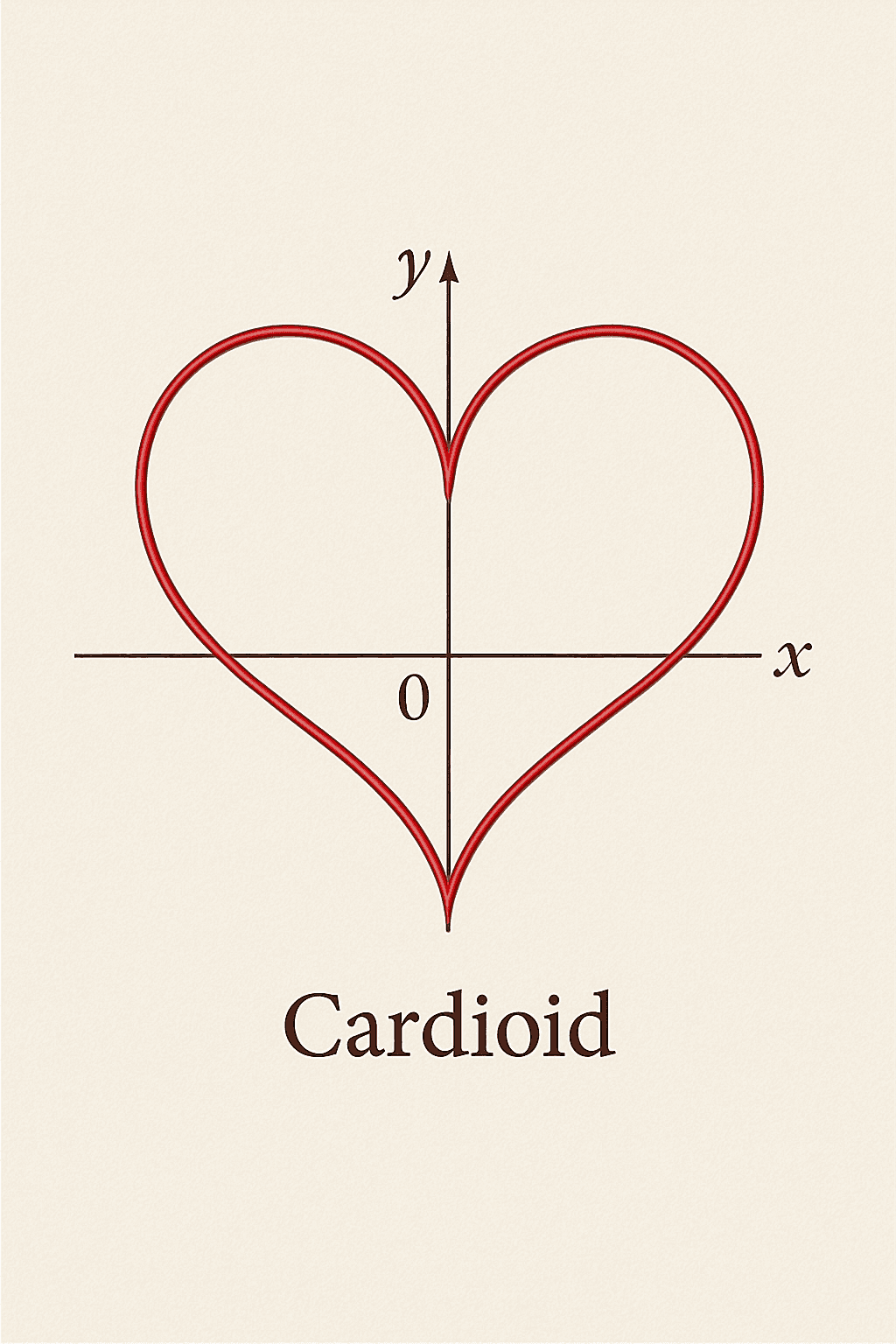
Cardioid is derived from the Greek word kardia (heart) and refers to a special curve that appears in mathematics and physical systems, resembling the shape of a heart. This curve is defined as the path traced by a point on a circle of radius r rolling without slipping around another fixed circle of the same radius r. This definition also coincides with the trajectory of any point on a circle of equal radius rolling along a fixed circle. The cardioid is particularly expressed by a specific formula in polar coordinates and has various applications in fields such as mathematics acoustics and optics.
The cardioid curve is expressed in polar coordinates by the following equation:
r=2a(1+cosθ)
Where:
In Cartesian coordinates the cardioid equation is written as:
(x2 + y2 – 2ax)2 = 4a2(x2 + y2)
Consider one of the heart-shaped curves defined by the equation (x2 + y2 – 1) 3 – x2y3 = 0. This equation produces a heart shape. However if we replace the value on the right-hand side of this equation from zero to a parameter α we can obtain different curves.
Let our new equation be (x2 + y2 – 1) 3 – x2y3 = α. As α increases positively the graph moves away from the heart shape and gradually takes on a more circular appearance resembling a circle. This indicates that the curve becomes flatter and more symmetric.
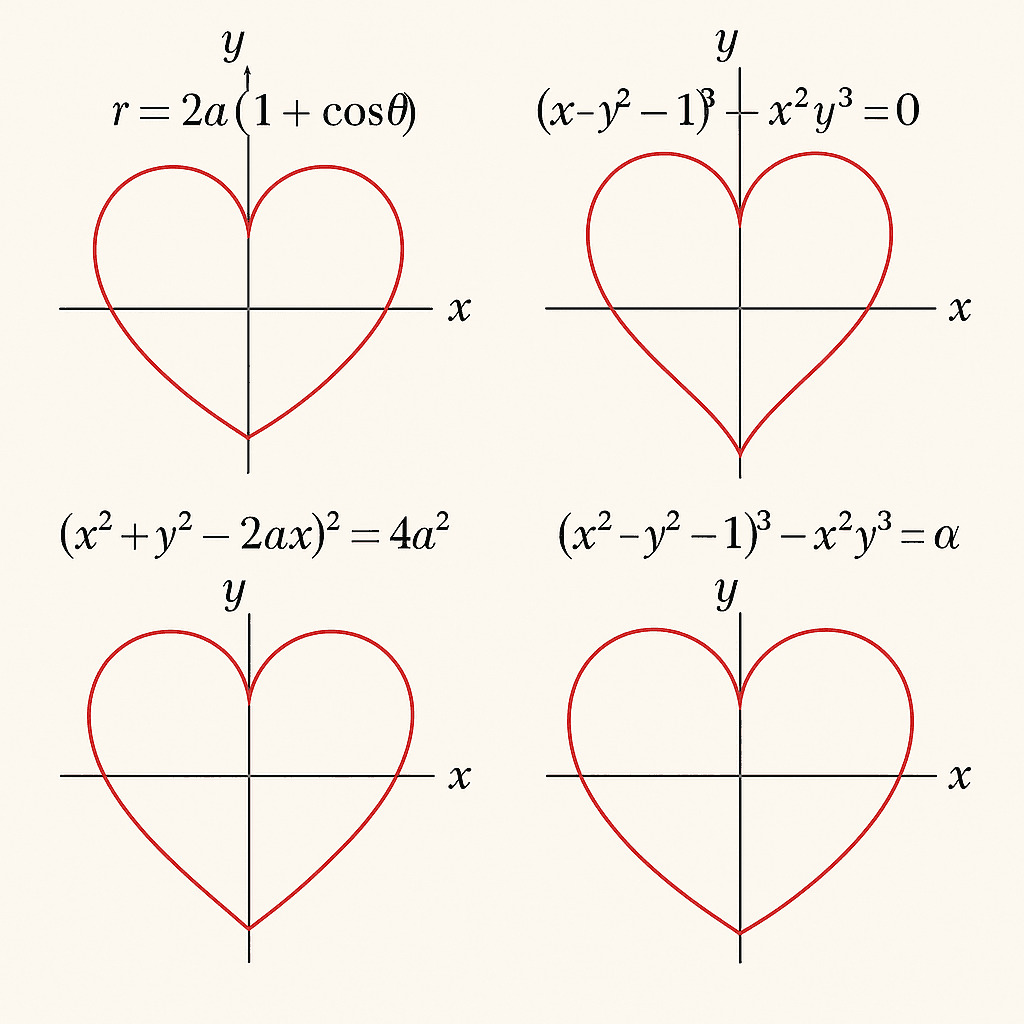
Cardioids generated using different formulas (created with the aid of artificial intelligence).
1. Symmetry: The cardioid is symmetric about the horizontal axis.
2. Tangent Points: The cusp of the curve is at the origin and its widest point is at (2a, 0).
3. Area and Perimeter: The area enclosed by the cardioid is calculated as 6πa2 and its perimeter as 16a.
First a circle with a diameter of 17 cm is drawn. Then 52 points are marked at equal intervals along this circle and numbered from 0 to 51. Next each point numbered n is connected by straight lines to the point numbered 2n. Beyond point number 26 the value of 2n exceeds the total number of points on the circle. Therefore for n ≥ 26 the points are connected to those obtained by subtracting 2n from 52.

Diagram illustrating the formation of the cardioid. (TÜBİTAK)
1. Acoustics and Sound Technology: The cardioid pattern is frequently used in microphone directivity patterns. Cardioid microphones capture sound from the front while minimizing sound from the rear making them effective at reducing unwanted background noise.
2. Antennas and Radio Wave Propagation: Cardioid patterns are used in the design of radio antennas to enhance signal strength in specific directions. This allows for more powerful signal transmission to desired areas.
3. Optical Systems and Lighting: The cardioid shape can be employed in optical systems to control light distribution. It is particularly useful for illuminating specific areas or directing light precisely.
4. Mathematical and Geometrical Applications: The cardioid is studied as a representative curve in mathematical analysis and geometry courses. Its properties provide practical examples for applications in differential and integral calculus.
Kaya, E. E. *Meşhur Eğri Kardiyoit*. Accessed May 4, 2025. https://bilimgenc.tubitak.gov.tr/meshur-egri-kardiyoit.
MMMT. "#Pergamon 003: Kardiyoit." Accessed May 4, 2025. https://medium.com/mmmt-pergamon/pergamon-003-kardiyoit-742ddb7e985b.
Richeson, David. *Cardioid: G4G13 Gift Exchange Contribution*. Accessed May 4, 2025. https://www.gathering4gardner.org/g4g13gift/art/RichesonDavid-GiftExchange-Cardioid-G4G13.pdf.
Çağlar, S. *Eğriler İle Eğlenebilirsiniz: Kardiyoit Yani Kalp Eğrileri*. 2025. Accessed May 4, 2025. https://www.matematiksel.org/egriler-ile-eglenebilirsiniz-kalp-egrileri-ve-digerleri/.

Mathematical Definition and Equation of the Cardioid
Properties and Construction of the Cardioid Curve
Applications of the Cardioid