


This article was automatically translated from the original Turkish version.
+1 More
Carob
Family | Fabaceae | ||||||||
|---|---|---|---|---|---|---|---|---|---|
Scientific Name(s) | Ceratonia siliqua L. | ||||||||
Climate(s) | Mediterranean | ||||||||
Conservation Status | Concern | ||||||||
Carob (Ceratonia siliqua L.) is an evergreen, drought-tolerant plant belonging to the Fabaceae (legume) family and is native to the Mediterranean climate. It typically grows as a shrub or a tree reaching heights of 6 to 10 meters. It is characterized by a broad crown, thick branches, and hard, hairless, evergreen leaves. The leaves are 3–5 cm long and composed of 3–5 pairs of leaflets. The upper surface is glossy dark green, while the lower surface is light green with a reddish-brown tint. The flowers are small, green, and lack petals; they are arranged in racemes, with approximately 50 flowers per raceme.
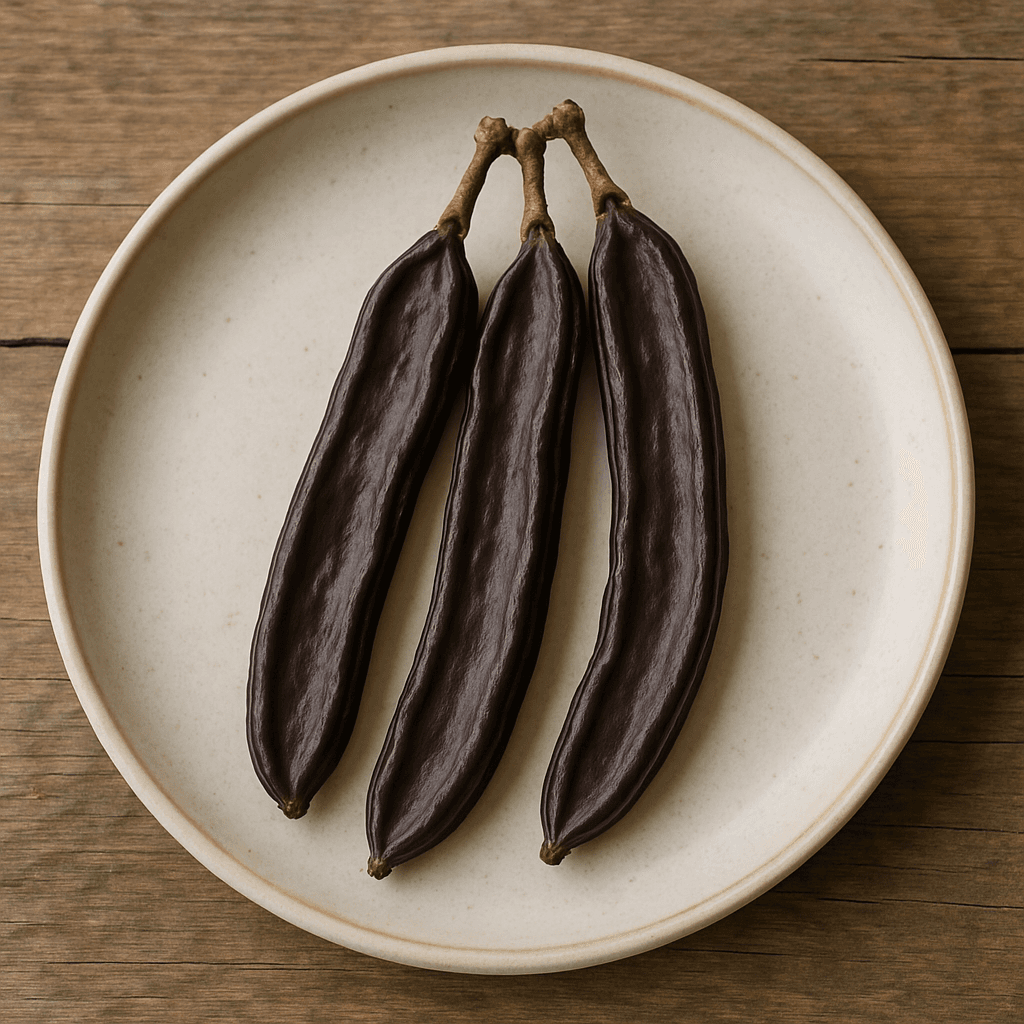
The carob fruit is 7–20 cm long, flat, hard-shelled, and brownish-purple in color, highly seeded, and usually curved. This distinctive appearance gives the fruit its common name, "carob." Natural forms have a matte, thin skin, while cultivated forms are typically glossy blackish-brown. The mesocarp (fleshy part) is soft when fresh but hardens over time; it is characteristically sweet.
The fruit is chemically rich, containing 60–70% carbohydrates, including sugars such as sucrose (12.0–28.5%), fructose (5.6–9.3%), and glucose (2.2–6.2%), as well as cellulose, nitrogenous compounds, tannins, and fixed oils. These components confer high nutritional and energy value to the carob fruit. It has been reported that 1000 g of fruit contains approximately 258 g of dietary fiber and 3944.7 mg of total phenolic compounds. The fruit is also rich in minerals, particularly potassium (843–1215 mg/kg), calcium (251–361 mg/kg), phosphorus (85–681 mg/kg), and magnesium (63–326 mg/kg).

Generated using artificial intelligence.
Major products derived from carob fruit include carob molasses, carob flour, carob gum (locust bean gum, LBG), dietary fiber, and D-pinitol. Carob gum is primarily isolated from the seed endosperm and is widely used as a thickener and emulsifier in the food, cosmetic, paper, and textile industries. D-pinitol is a bioactive compound obtained from natural sources and known for its hypoglycemic effects. The richness of carob in these compounds makes it an important raw material for functional food production.
Carob is also gluten-free and thus provides an alternative food ingredient for individuals with celiac disease. Carob flour is used as a cocoa substitute in cake and biscuit production, while seed flour and fibers are evaluated to improve rheological and textural properties in gluten-free bread, plant-based milk products, and meat products.
Ecologically, carob is a species with high temperature and light requirements, drought-tolerant but sensitive to frost. It thrives in regions where the annual average temperature exceeds 17 °C, the coldest month average does not fall below 7 °C, and annual rainfall exceeds 600 mm. In Türkiye, its natural distribution is limited to the coastal areas of the Aegean and Mediterranean regions. It shows the highest density of distribution along the Mediterranean coast from İzmir to Antalya and Mersin. It typically grows on red Mediterranean soils, red-brown Mediterranean soils, and rendzina soils.
Floristically, carob occurs within the maquis formation alongside species such as wild olive (Olea europaea var. sylvestris), mastic (Pistacia lentiscus), myrtle (Myrtus communis), bay laurel (Laurus nobilis), Phillyrea (Phillyrea latifolia), and kermes oak (Quercus coccifera). On coastal dunes and poor soils, it may adopt a prostrate form and form shrub communities together with mastic.
Carob cultivation in Türkiye is primarily carried out around Mersin and Antalya. As of 1996, 93.6% of the 354,600 carob trees were located in the Mediterranean Region, with 54% in Mersin and 35.8% in Antalya. Mersin contributes 62.7% of the annual production. In recent years, increased interest in carob has been driven by growing product diversity and its potential as a functional food ingredient.

Generated using artificial intelligence.
Günal, Nurten. Keçi Boynuzu (Ceratonia siliqua L.)’nun Türkiye’deki Coğrafi Yayılışı, Ekolojik ve Floristik Özellikleri. İstanbul: Marmara Üniversitesi, Atatürk Eğitim Fakültesi, Coğrafya Eğitimi Anabilim Dalı, 2022. Accessed: PDF dosyası.
Pazır, Figen, and Yıldız Alper. "Keçiboynuzu Meyvesi Ceratonia siliqua L. ve Sağlık." Akademik Gıda 14, no. 3 (2016): 302–306.
Şener, Özlem, and Büşra Hakgüder Taze. “Fonksiyonel Bir Gıda Bileşeni Olarak Keçiboynuzu: Özellikleri ve Gıda Uygulamaları.” *Uşak Üniversitesi Fen ve Doğa Bilimleri Dergisi* 6, no. 1 (2022): 45–66. https://doi.org/10.47137/usufedbid.1130043.

Carob
Family | Fabaceae | ||||||||
|---|---|---|---|---|---|---|---|---|---|
Scientific Name(s) | Ceratonia siliqua L. | ||||||||
Climate(s) | Mediterranean | ||||||||
Conservation Status | Concern | ||||||||
No Discussion Added Yet
Start discussion for "Carob (Ceratonia siliqua L.)" article