


This article was automatically translated from the original Turkish version.
+1 More
Mastic Tree (Pistacia lentiscus L.)
Scientific Name(s) | Pistacia lentiscus L. | ||||||||
|---|---|---|---|---|---|---|---|---|---|
Family | Anacardiaceae (Sumac family) | ||||||||
Species Characteristic | Dioecious (male and female individuals separate); evergreen | ||||||||
Height(s) | 2–6 metres | ||||||||
Distribution Area | Mediterranean Basin (Türkiye: İzmir, Muğla, Mersin, Hatay; Greece: Chios Island) | ||||||||
Flowering Period | April March | ||||||||
Fruit Type | Drupe; black when ripe | ||||||||
Propagation Methods | Grafting Cutting propagation Seed (low yield) | ||||||||
Chemical Composition | Essential oils Phenolics Monoterpenes Triterpenes | ||||||||
Applications | Perfumery Cosmetics Modern pharmacology Traditional medicine Food | ||||||||
EU Geographical Indication | Chios Mastic Gum – 1997, Chios Island | ||||||||
Conservation Projects | Chios Clonal Park (2012–2015) Chios Action Plan (2014–2019) | ||||||||
Mastic Tree (Pistacia lentiscus L.), a member of the Anacardiaceae (Sumac) family, is an evergreen species that grows as a shrub or small tree and is dioecious. It is primarily found in coastal areas with a Mediterranean climate and is known for its economically valuable resin, known as mastic.
Mastic Tree Introduction Video (Ministry of Agriculture and Forestry of the Republic of Türkiye YouTube Channel)
The mastic tree is a densely branched, compound-leaved species reaching 2–6 metres in height. Male and female individuals are found on separate trees. Flowering occurs in March and April. The fruit, a drupe, turns black as it ripens. Seeds exhibit epigeal germination but have low germination rates and show significant genetic variation; therefore, propagation by seed is not preferred in production. Vegetative methods such as cutting and grafting are used to improve production quality.
The natural distribution of the mastic tree is the Mediterranean Basin. In Türkiye, it grows in coastal provinces such as İzmir (Çeşme, Karaburun), Muğla, Antalya, Mersin, and Hatay. The most productive variety is found on the Greek island of Chios. It is believed that underwater volcanoes surrounding the island contribute to the high quality of resin produced there.

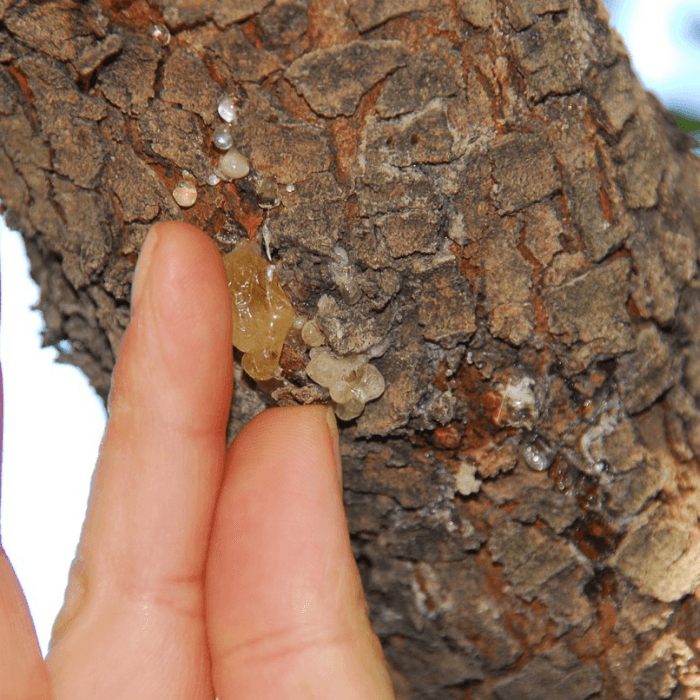
Mastic Resin Flowing from Cuts Made on the Trunk and Solidifying Upon Exposure to Air AA)
During the summer months, resin exudes from horizontal incisions made on the trunk and branches. Upon exposure to air, it dries and hardens into what is known as mastic. This resin contains numerous bioactive compounds, including triterpenes (especially masticin), monoterpenes, volatile oils, resin acids, phenolic compounds, and phytosterols. High-quality mastic is clear and glassy in appearance; oxidized yellowish varieties are not preferred.
Archaeological findings have uncovered mastic tree leaf fossils on the island of Chios dating back 6,000 years. In ancient Greek, Roman, and Ottoman periods, mastic resin was used in health, culinary, and cosmetic applications. During the Ottoman era, the highest quality resin from Chios was sent to the imperial court, while the remainder was traded commercially. In 1997, Chios mastic was officially registered by the European Union as a geographical indication under the name “Chios Mastic Gum”.
In Turkish cuisine, mastic is used as a flavoring and preservative in a variety of products including dairy desserts (rice pudding, muhallebi), baked goods (bread, cake, biscuits), confectionery ( Turkish delight, halva), and beverages (Turkish coffee, salep, soda). Mastic oil is also commonly used as a flavoring agent in drinks.
Since ancient times, mastic resin has been used by physicians such as Hippocrates and Ibn Sina to treat stomach, liver, dental, and respiratory ailments. Modern studies have confirmed its anti-inflammatory, antimicrobial, and antioxidant properties. It is effective against pathogens such as Helicobacter pylori. The European Medicines Agency classifies it as a traditional herbal medicinal product.
Mastic is used in cosmetics such as soap, perfume, toothpaste, and cream. Additionally, the wood of the mastic tree has traditionally been used for making firewood and kindling.
In collaboration with TEMA Foundation, İzmir Institute of Technology, and the General Directorate of Forestry, projects such as the “Degraded Mastic Tree Rehabilitation Project” and the “Mastic Tree Clonal Park” have been implemented. Between 2012 and 2015, a total of 124 clones and 935 individual trees were placed under conservation. Additionally, the “Mastic Action Plan” (2014–2019) aimed to protect natural populations and increase production. Mastic production holds strategic importance for both rural development and the conservation of biological diversity.
Akdemir, Ömer Faruk, Engin Tilkat, Ahmet Onay, Fatih Mehmet Kılınç, Veysel Süzerer, and Yelda Özden Çiftçi. “Geçmişten Günümüze Sakız Ağacı (Pistacia lentiscus L.).” Batman Üniversitesi Yaşam Bilimleri Dergisi 3, no. 2 (2013): 1–28. Accessed May 31, 2025. https://dergipark.org.tr/tr/download/article-file/313422.
Anadolu Ajansı. “Urla’da 10 Yıl Önce Dikilen Sakız Ağaçlarında İlk Hasat Yapıldı.” Photograph. Date Published September 20, 2023. Accessed May 31, 2025. https://www.aa.com.tr/tr/ekonomi/urlada-10-yil-once-dikilen-sakiz-agaclarinda-ilk-hasat-yapildi/2978956.
Kılıç, Mazlum Umut. *Farklı Sakız Ağacı (Pistacia lentiscus L.) Genotiplerine Ait Sürgün Ucu Eksplantlarında İn Vitro Kültürlerin Başlatılması ve Mikroçoğaltım Olanaklarının Araştırılması.* Master's thesis, Aydın AdnanMenderes Üniversitesi Institute of Natural Sciences, Agricultural Biotechnology Program, Advisor: Dr. Öğr. Üyesi Hüseyin Uysal, 2021. Accessed May 31, 2025. http://adudspace.adu.edu.tr:8080/jspui/bitstream/11607/4527/1/3136.pdf.
Onay, Ahmet, Hakan Yıldırım, and Mehmet Ali Yavuz. “Sakız Ağacı (Pistacia lentiscus L.) Yetiştiriciliği ve Reçinesi.” Batman Üniversitesi Yaşam Bilimleri Dergisi 3, no. 2 (2013): 29–47. Accessed May 31, 2025. https://dergipark.org.tr/tr/download/article-file/313672.
Sakız Üreticileri Birliği. *Mastiha Harvesting Process in Chios.* YouTube video, 3:28. January 21, 2017. Accessed May 31, 2025. https://www.youtube.com/watch?v=JtOqOLuibR0.
TEMA Vakfı. "Sakız Ağacı Güvenli Ellerde." Visual material. Accessed May 31, 2025. https://www.tema.org.tr/basin-odasi/basin-bultenleri/sakiz-agaci-guvenli-ellerde_1.
TEMA Vakfı. "Sakız Ağacı Klon Parkı Tesisi Projesi." Visual material. Accessed May 31, 2025. https://www.tema.org.tr/agaclandirma-projeleri/tamamlanan-projeler/sakiz-agaci-klon-parki-tesisi-projesi.

Mastic Tree (Pistacia lentiscus L.)
Scientific Name(s) | Pistacia lentiscus L. | ||||||||
|---|---|---|---|---|---|---|---|---|---|
Family | Anacardiaceae (Sumac family) | ||||||||
Species Characteristic | Dioecious (male and female individuals separate); evergreen | ||||||||
Height(s) | 2–6 metres | ||||||||
Distribution Area | Mediterranean Basin (Türkiye: İzmir, Muğla, Mersin, Hatay; Greece: Chios Island) | ||||||||
Flowering Period | April March | ||||||||
Fruit Type | Drupe; black when ripe | ||||||||
Propagation Methods | Grafting Cutting propagation Seed (low yield) | ||||||||
Chemical Composition | Essential oils Phenolics Monoterpenes Triterpenes | ||||||||
Applications | Perfumery Cosmetics Modern pharmacology Traditional medicine Food | ||||||||
EU Geographical Indication | Chios Mastic Gum – 1997, Chios Island | ||||||||
Conservation Projects | Chios Clonal Park (2012–2015) Chios Action Plan (2014–2019) | ||||||||
No Discussion Added Yet
Start discussion for "Mastic Tree (Pistacia lentiscus)" article
Morphological and Biological Characteristics
Natural Distribution and Ecological Adaptation
Production and Chemistry of Mastic
History and Cultural Significance
Applications
Food Industry
Medicine and Health
cosmetics and Other Uses
Production and Conservation Efforts in Türkiye