


This article was automatically translated from the original Turkish version.
+2 More
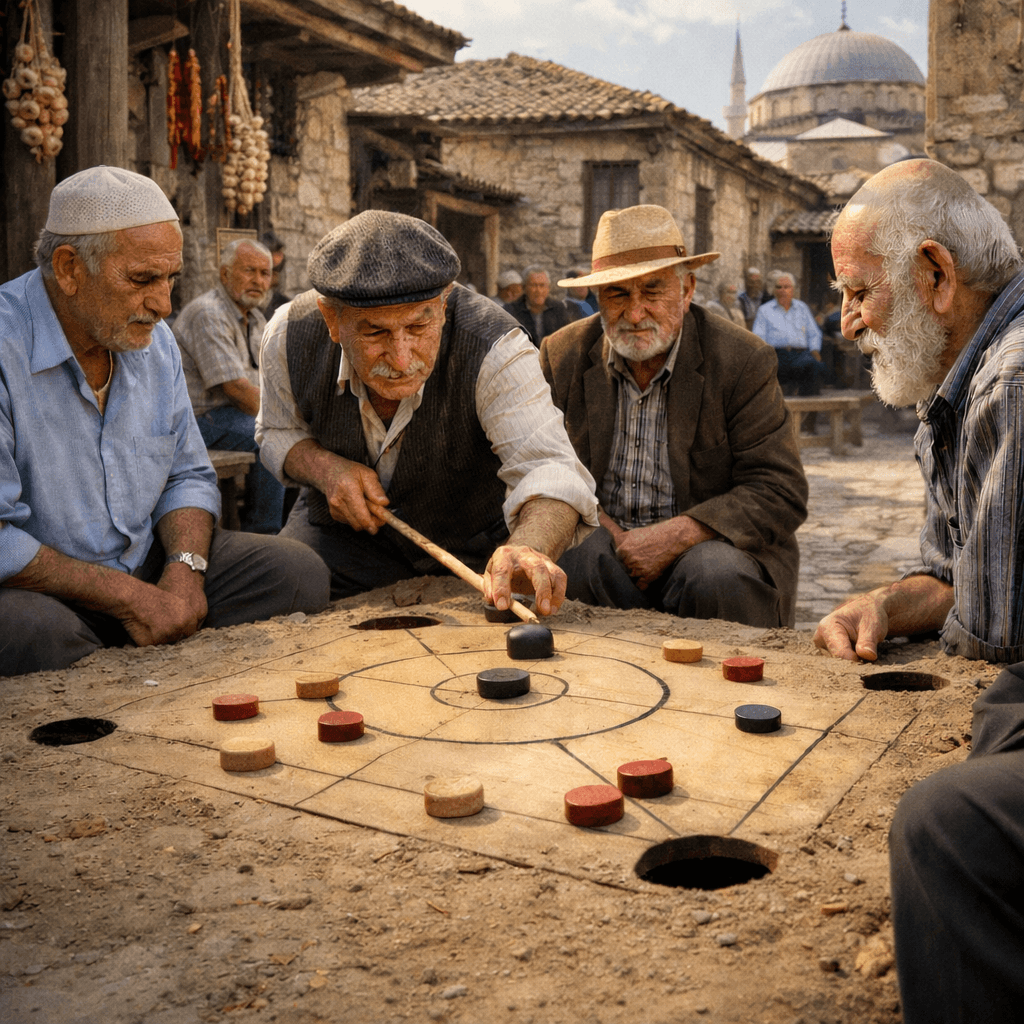
(Yapay Zeka ile Oluşturulmuştur)
Karambol game is a traditional game played in the Aegean Region, particularly around İzmir and Tire. It is believed to have been brought to Anatolia by Sephardic Jews expelled from Spain and Portugal in the late 15th century. Initially played only by Jewish communities, the game was gradually adopted by the local population of the region and passed down through generations until the present day. Today, Karambol is a local game played in only a few limited areas in Tire and faces the threat of extinction.
Karambol Game (Nathalie Ritzmann)
The introduction of Karambol to Anatolia is associated with the migration of Jewish communities expelled from Spain and Portugal between 1491 and 1497. Some of these communities dispersed by sea and others by land to North Africa, Europe and the Ottoman territories, settling particularly in the Aegean Region of Anatolia. During this process, Karambol is said to have been introduced as a cultural element to the region.
During periods when Jewish populations were concentrated in İzmir and its surroundings, the game was played in neighborhoods such as Karabağlar, Mezarlıkbaşı, Altındağ, Kestanepazarı, Gürçeşme and Tilkilik. However, from the mid-20th century onward, as the Jewish population declined, the game was forgotten in these areas but continued to be played in Tire after being adopted by the local community.
The Karambol game is played on a flat, smooth concrete surface measuring approximately 4 × 12 meters. The playing area consists of a rectangular court enclosed by wooden frames along its edges. These wooden frames serve a functional purpose by directing the movement of the balls during play.
The essential equipment used in the game includes: meşe, lek, a scoring board, and a piece of velvet. The meşe are wooden balls, typically made from boxwood, with a diameter of 3–4 cm. The lek are wooden figures approximately 4.5–5 cm in length, used as auxiliary targets. Players use the scoring board placed along the edge of the court to keep track of their points.
The Karambol game is played over eight sets. Each set is won by hitting either the opponent’s meşe or all four lek on the playing field, and this action earns the player one point. The player or team that reaches eight points wins the game. In the event of a tie, an extension known as Kayım is applied.
Players typically make their shots while kneeling and launching the meşe with their fingers. In addition to straight shots, experienced players employ specialized techniques known as dik vuruş (vertical shot). Shots that rebound off the wooden borders of the playing field are called karambol.
Today, the Karambol game is played in only a few limited courts in Tire. Most of the playing areas that were once common in café gardens have disappeared. The courts established by the Tire Municipality in Alay Park and one located in a schoolyard are among the rare surviving examples of Karambol. However, the game is not sufficiently known or popular among younger generations. This situation highlights the need to preserve Karambol as intangible cultural heritage and ensure its transmission to future generations.
Kent Yaşam. "Bir Kültür Mirası: Karambol Oyunu." Accessed January 12, 2026. https://www.kentyasam.com.tr/2022/12/19/bir-kultur-mirasi-karambol-oyunu/115830
Nathalie Ritzmann. "Karambol game in Tire (Turkey)." YouTube. Accessed January 12, 2026. https://www.youtube.com/watch?v=ge2mG8iAHJY
Tatar, Ergin. “Ege Bölgesinde Oynanan Karambol Oyunu.” *İzmir Araştırmaları Dergisi*, no. 19 (2023). Accessed January 12, 2026. https://dergipark.org.tr/tr/download/article-file/3554867
Yeni Asya. "Sadece İspanya ve Tire’de Oynanan Oyun: Karambol." Accessed January 12, 2026. https://www.yeniasya.com.tr/hafta-sonu/sadece-ispanya-ve-tire-de-oynanan-oyun-karambol_131390
(Yapay Zeka ile Oluşturulmuştur)
History
Playing Field and Equipment
Rules and Gameplay
Karambol Game Today