This article was automatically translated from the original Turkish version.
+1 More
Product Type | Sweet / Dough product / Baking and pastry product | ||||||||
|---|---|---|---|---|---|---|---|---|---|
Geographical Boundary | Samsun Province Çarşamba District | ||||||||
Registration Type | Mahreç mark | ||||||||
Registration Date | 10 May 2021 | ||||||||
Registration Number | 751 | ||||||||
Applicant/Registrant(s) | Çarşamba Chamber of Commerce and Industry | ||||||||
Distinctive Feature(s) | Phyllo dough rolled and shrunk around a rolling pin served without syrup square shape | ||||||||
Main Materials | Butter Powdered sugar Hazelnut kernel Walnut kernel Starch Wheat flour Carbonate Egg Water Liquid oil Yogurt | ||||||||
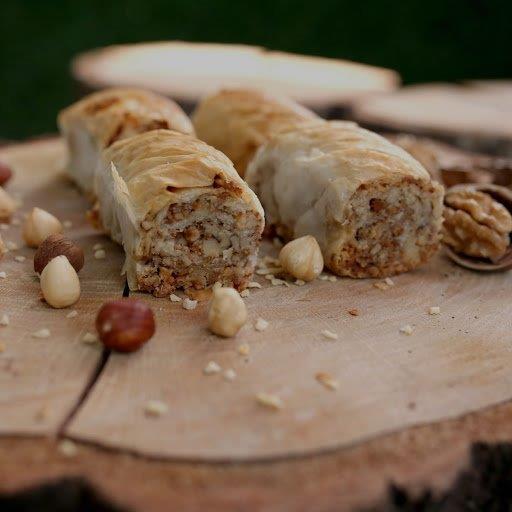
Çarşamba Kıvratması is a traditional sweet pastry registered with a geographical indication, unique to the Çarşamba district of Samsun Province. It is prepared using a dough made from yogurt, liquid oil, water, eggs, baking soda, and wheat flour. The filling consists of crushed walnut and hazelnut kernels mixed with powdered sugar. The prepared sheets of dough are wrapped around a rolling pin to create pleats and then cut into square shapes to achieve its distinctive form. Melted butter is poured over the pastry before baking, and it is served without syrup.
This product attracts attention not only for its flavor but also for its shaping method and the skilled production process it requires. Particularly, the twisted structure formed by wrapping the dough around the rolling pin is a defining feature that distinguishes it from similar pastries.

Çarşamba Kıvratması (Türkiye Culture Portal)
According to traditional knowledge passed down by the local population, the origins of Çarşamba Kıvratması are very old. It is commonly prepared during special occasions such as holidays, weddings, and guest receptions in the region. In this way, it has become not merely a food product but also an integral part of local culture and social cohesion. The manual rolling of dough sheets and the skilled techniques involved in shaping them are preserved through generations as traditional knowledge.
The ingredients used in the production of Çarşamba Kıvratması are: 200 g yogurt, 200 ml liquid oil, 200 ml water, 3 eggs, 2.5 g baking soda, 1 kg wheat flour, 0.5 kg starch (for rolling out the dough), 750 g walnut kernels, 250 g hazelnut kernels, 0.5 kg powdered sugar, and 750 g butter.
The dough is prepared by mixing yogurt, liquid oil, water, eggs, baking soda, and wheat flour, and is kneaded until it reaches the softness of an earlobe. After resting for one hour, the dough is divided into pieces the size of an egg and allowed to rest for another 10 minutes. Using starch, each piece is rolled into sheets approximately 0.5 mm thick and 80 cm in diameter. A filling made from walnut kernels, hazelnut kernels, and powdered sugar is spread over the sheets. The sheets are then loosely wrapped around a rolling pin, with the end folded inward and peeled off the pin to create a pleated form. These rolls are cut into square pieces and placed on a baking tray. Melted butter is poured over them and baked at 180 °C for approximately 45 minutes. The product is served without syrup.
Çarşamba Kıvratması was registered as a geographical indication on 10 May 2021 under Law No. 6769 on Industrial Property. The application was submitted on 17 March 2020 and recorded by the Turkish Patent and Trademark Office under registration number 751. The holder of the registration is the Çarşamba Chamber of Commerce and Industry. The indication “Çarşamba Kıvratması” must be visibly displayed along with the geographical indication emblem on the product itself, its packaging, or at the production site.
All stages of production of Çarşamba Kıvratması must be carried out within the boundaries of the Çarşamba district of Samsun Province. This requirement stems from the fact that the product is prepared using specific local techniques for shaping and baking, which demand a high level of craftsmanship.
The production of Çarşamba Kıvratması and compliance with geographical indication regulations are monitored by a four-member oversight body composed of representatives from the Çarşamba Municipality, Çarşamba District Governorate, and Çarşamba Chamber of Commerce, under the coordination of the Çarşamba Chamber of Commerce and Industry. Inspections are conducted at least once a year but may also be carried out upon request or complaint. These inspections focus on the suitability of ingredients, adherence to production methods and presentation standards, and the correct use of the registered emblem.
T.C. Ministry of Culture and Tourism. “Çarşamba Kıvratması.” *Turkey Culture Portal.* Accessed July 12, 2025. https://www.kulturportali.gov.tr/turkiye/samsun/neyenir/carsamba-kivratmasi
Turk Patent and Trademark Office. "Çarşamba Kıvratması – Tescil Belgesi." *Geographical Indications Portal.* Accessed July 12, 2025. https://ci.turkpatent.gov.tr/Files/GeographicalSigns/0f9a7ab4-ff18-4310-8dd3-f4ac2f71b2c5.pdf
Turk Patent and Trademark Office. "Çarşamba Kıvratması." *Geographical Indications Portal.* Accessed July 12, 2025. https://ci.turkpatent.gov.tr/cografi-isaretler/detay/1826

Product Type | Sweet / Dough product / Baking and pastry product | ||||||||
|---|---|---|---|---|---|---|---|---|---|
Geographical Boundary | Samsun Province Çarşamba District | ||||||||
Registration Type | Mahreç mark | ||||||||
Registration Date | 10 May 2021 | ||||||||
Registration Number | 751 | ||||||||
Applicant/Registrant(s) | Çarşamba Chamber of Commerce and Industry | ||||||||
Distinctive Feature(s) | Phyllo dough rolled and shrunk around a rolling pin served without syrup square shape | ||||||||
Main Materials | Butter Powdered sugar Hazelnut kernel Walnut kernel Starch Wheat flour Carbonate Egg Water Liquid oil Yogurt | ||||||||
No Discussion Added Yet
Start discussion for "Çarşamba Kıvratması" article
History and Cultural Context
Production Process
Geographical Indication and Protection
Monitoring and Implementation