

This article was automatically translated from the original Turkish version.
Family | Euphorbiaceae | ||||||||
|---|---|---|---|---|---|---|---|---|---|
Type(s) | Ricinus communis L. | ||||||||
Body | Spotted, Green-Red Colored, Waxy Layer | ||||||||
Leaf | Large, Hand-Shaped, 5–11 Lobed | ||||||||
Fruit | Three-Loculed Capsule, Spiny/Spineless | ||||||||
Poisoning Routes | Oral, Intravenous, Inhalation | ||||||||
Production | India, Brazil, China, Paraguay, Philippines | ||||||||
Castor oil plant (Ricinus communis L.) is a plant belonging to the Euphorbiaceae family, valued in industrial and medical fields for the oil obtained from its seeds and its constituent compounds. Historically identified in early periods, it was mentioned in the 16th century BCE Ebers Papyrus from ancient Egypt under the name “Palma Christi”. Its use for various purposes has been documented in ancient Greek, Egyptian and African societies.

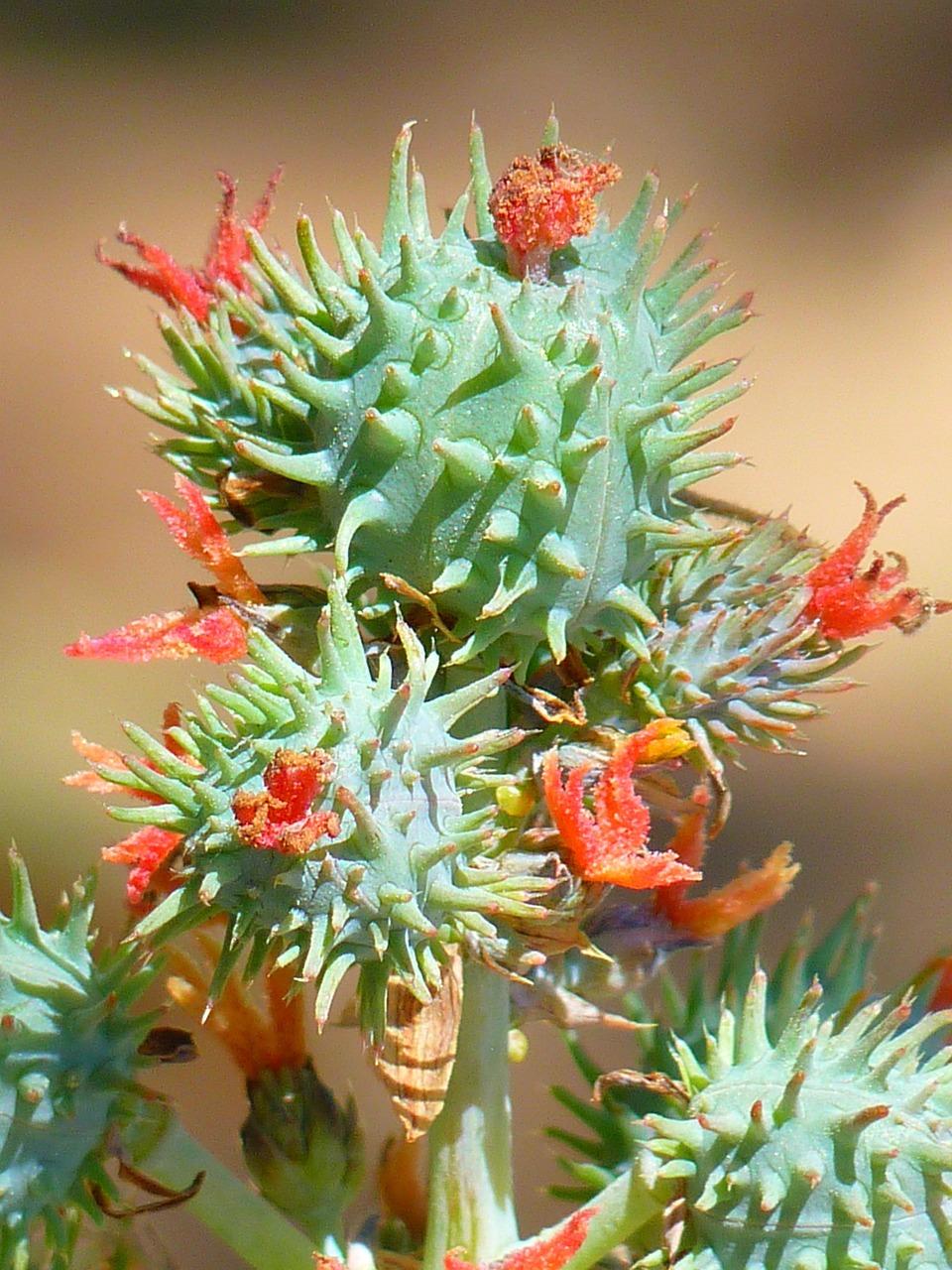
Castor oil plant (Pixabay)
The plant grows naturally in tropical and subtropical regions. India, Brazil, China and the United States are the main producing countries. In Türkiye, limited cultivation is carried out in certain areas, primarily the Mediterranean and Southeastern Anatolia regions.
The plant may be annual or perennial. Its roots extend deep into the soil, and its stem is branched, varying in color from green to red. The leaves are large, palmate and glossy. Male and female flowers occur on the same plant. The fruit is a three-lobed capsule, and the seeds are rich in oil and toxic.
The seeds contain a high proportion of oil, with ricinoleic acid being the most prominent fatty acid. Additionally, the seeds and other parts of the plant contain the alkaloids ricin and ricinine. These compounds have potent toxic effects; it has been reported that ingestion of even a small number of seeds can be fatal.
The castor oil plant thrives in well-drained loamy soils. It requires high temperatures and humidity. Sowing is typically done in spring, and germination occurs slowly. Yield can be increased through regular weeding, irrigation and fertilization. Harvesting is carried out when the capsules dry, and the seeds remain viable for long periods when stored under appropriate conditions.

Castor oil plant (Pixabay)
The castor oil plant and the oil extracted from its seeds have wide-ranging applications across various sectors. Industrially, the oil is used in the production of varnishes, paints, plastics, nylon types, electrical insulating materials and lubricants. It is also an important raw material in biodiesel production. Due to its rapid drying property, it is preferred in the paint and varnish industries. In the nylon industry, it serves as a feedstock for sebacic acid production, allowing high yields of nylon from a given quantity of oil. Additionally, it functions as an anti-mold agent in the sugar, chocolate and packaging industries.
In medicine, its use for various purposes has continued for many years. Its laxative effect is particularly preferred for bowel evacuation prior to radiological examinations. It has also been used as an analgesic, antipyretic, antidote, expectorant and anti-inflammatory agent. Components derived from the seeds and oil have been reported to be applied in the treatment of abscesses, arthritis, asthma, influenza, tumors, rheumatism, headaches, labor pains and various skin disorders. Due to its ricinoleic acid content, it is noted to have labor-pain-reducing effects and has been evaluated for use in contraceptive medications. Furthermore, due to its antimicrobial and antifungal properties, it is used in the formulation of drugs to combat harmful insects and fungi.
The plant is also functional in military and technical applications. Historically, it has been recorded as being used for lubricating aircraft engines, in the production of explosives and as a fuel additive. It has also been preferred for lubricating motorcycle and bicycle engines. The cellulose obtained from its stem has been utilized in the production of cardboard, paper and wallpaper.
These diverse applications have conferred significant value on the plant as an important resource in both industry and medicine.
Poisoning occurs when parts of the plant containing ricin are ingested orally, inhaled or administered intravenously. Symptoms may include nausea, vomiting, diarrhea, abdominal pain, dehydration and organ damage. Treatment is not based on a specific antidote but rather on supportive care and administration of activated charcoal. Poisoning manifestations can range from mild symptoms to fatal outcomes.

Castor oil plant (Pixabay)
The largest producers are India and Brazil. Cultivation also takes place in parts of Europe and the Americas. Although Türkiye has suitable conditions for cultivation, production remains limited and the plant is generally regarded as an ornamental species.
Başalma, Dilek, and Maryam Pashazadeh. “Hintyağının (Ricinus communis L.) Önemi, Bitkisel Özellikleri ve Tarımı.” Uludağ Üniversitesi Ziraat Fakültesi Dergisi 25, no. 2 (2011): 57–67. Accessed August 23, 2025. https://dergipark.org.tr/tr/download/article-file/154146
Korkmaz, Sevim Büşra, Ahmet Osman Kılıç, Fatih Akın, and Abdullah Yazar. “Nadir Bir Zehirlenme Vakası: Ricinus Communis Zehirlenmesi / A Rare Case of Poisoning: Ricinus Communis Poisoning.” Mevlana Medical Sciences 3, no. 1 (2023): 35–37. Accessed August 23, 2025. https://app.mevlanamedsci.org/uploads/makale-pdf/nadir-bir-zehirlenme-vakasi-ricinus-communis-zehirlenmesi-a-rare-case-of-poisoning-ri61797916.pdf
Pixabay. "Hint Yağı Bitkisi, Hint Yağı, Keneotu." Accessed August 23, 2025. https://pixabay.com/tr/photos/hint-ya%C4%9F%C4%B1-bitkisi-hint-ya%C4%9F%C4%B1-keneotu-5276704/
Pixabay. "Hint Yağı Bitkisi, Meyveler, Bitki." Accessed August 23, 2025. https://pixabay.com/tr/photos/hint-ya%C4%9F%C4%B1-bitkisi-meyveler-bitki-6648514/
Pixabay. "Hint Yağı, Hint Meyvesi, Çiçek, Bitki." Accessed August 23, 2025. https://pixabay.com/tr/photos/hint-ya%C4%9F%C4%B1-hint-meyvesi-%C3%A7i%C3%A7ek-bitki-43221/
Pixabay. “Çiçek, Hint Yağı, Tohumlar, Zehirli.” Accessed August 23, 2025. https://pixabay.com/tr/photos/%C3%A7i%C3%A7ek-hint-ya%C4%9F%C4%B1-tohumlar-zehirli-3776831/

Family | Euphorbiaceae | ||||||||
|---|---|---|---|---|---|---|---|---|---|
Type(s) | Ricinus communis L. | ||||||||
Body | Spotted, Green-Red Colored, Waxy Layer | ||||||||
Leaf | Large, Hand-Shaped, 5–11 Lobed | ||||||||
Fruit | Three-Loculed Capsule, Spiny/Spineless | ||||||||
Poisoning Routes | Oral, Intravenous, Inhalation | ||||||||
Production | India, Brazil, China, Paraguay, Philippines | ||||||||
No Discussion Added Yet
Start discussion for "Castor oil plant (Ricinus communis L.)" article
Distribution
Botanical Characteristics
Chemical Components and Toxicity
Agricultural Cultivation
Applications
Poisoning and Treatment Approaches
Production Status in Türkiye and Worldwide