


This article was automatically translated from the original Turkish version.
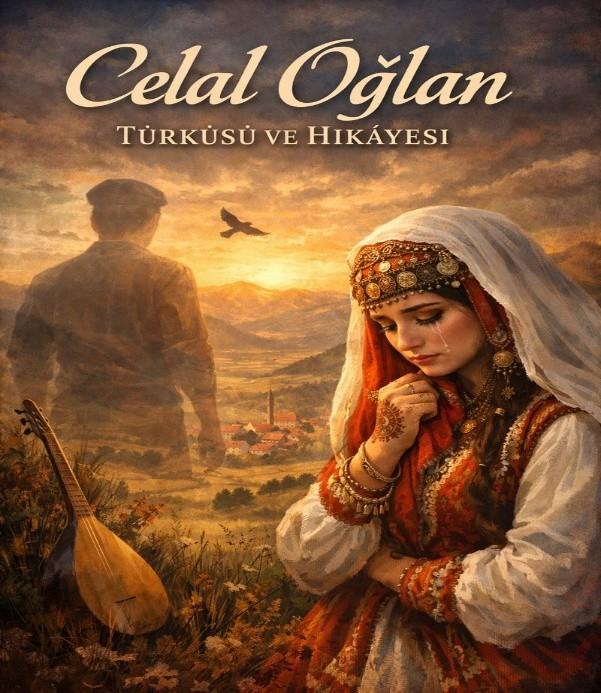
Celal Oğlan Türküsü (Generated by Artificial Intelligence.)
Celal Oğlan Türküsü
Type(s) | Folk Song – Folk Tale | ||||||||
|---|---|---|---|---|---|---|---|---|---|
Region(s) | Yozgat | ||||||||
Subject(s) | Love separation and death | ||||||||
Narrative Style | Oral culture product | ||||||||
Main Figures | Celal Oğlan, Elif | ||||||||
Celal Oğlan Türküsü is a folk song originating from the Yozgat region. Classified within the lament tradition of folk literature, it expresses the grief and emotional void left by the death of a young man named Celal. Its lyrics serve as an example of how personal loss is preserved in collective memory through the folk song form.
Celal Oğlan Türküsü has the character of a lament sung after the death of a beloved young person. In the song, the sorrow and helplessness experienced by those left behind are conveyed through imagery drawn from everyday life. Particularly through the motif of “yonca,” the absence of Celal and the void it creates in daily existence are emphasized. Over time, the song spread through oral tradition and became anonymous.
In folk poetry, a lament is regarded as a form of koşma and is typically sung following the death of a young or beloved individual. Works in this genre elevate the deceased’s qualities and their place in society through an honorific narrative. Deaths caused by illness, murder, or martyrdom have historically been catalysts for the emergence of laments. Characterized by a sorrowful and heart-wrenching language, laments prompt listeners to reflect on the nature of death and the transience of life. Celal Oğlan Türküsü is a representative example of folk poetry possessing these characteristics.
In pre-Islamic Turkish societies, poetic compositions known as “sagu” were recited during funeral rites held after a person’s death. Sagus expressed the grief felt for the deceased, as well as their virtues and heroic deeds. Composed in syllabic meter and structured in quatrains, these works resemble koşmas in form and follow a rhyme scheme of aaab / cccb / dddb. Folk laments and divan poetry mersiyeler are considered continuations of this tradition. Celal Oğlan Türküsü can be understood as a reflection of the sagu tradition within folk literature.
Elements such as “yonca” and “sarmaşık” in the song are used both to depict the environment and to express longing. Yonca, literally a part of daily life, becomes a symbol that makes Celal’s absence visible. The lines “Who will cut this yonca / When Celal Oğlan is no more” describe the emptiness following death through a concrete domestic task. Sarmaşık, in folk poetry, is associated with the beloved’s hair and reinforces feelings of longing and devotion.
Although Celal Oğlan Türküsü was originally composed in memory of a specific individual, it gradually became a folk song and acquired an anonymous character. In folk literature, many laments, even if initially sung by a particular person, became anonymous through the process of oral transmission. This enabled the song to transcend regional boundaries and become part of the cultural memory.
Kültür Portalı. "Celal Oğlan Türküsü ve Hikâyesi." Accessed February 6, 2026.
Turk Dili ve Edebiyatı Ders Kitabı. PDF document. E-Ucebnici.mon.gov.mk. Accessed February 6, 2026. https://www.e-ucebnici.mon.gov.mk/pdf/T%C3%9CRK%20D%C4%B0L%C4%B0%20VE%20EDEB%C4%B0YATI%20DERS%20K%C4%B0TABI-SON.pdf
“Arguvan Türkülerinde Geçen Simgeler Üzerine Bir Değerlendirme.” Academia.edu. PDF document. Accessed February 6, 2026. https://www.academia.edu/90274695/ARGUVAN_T%C3%9CRK%C3%9CLER%C4%B0NDE_GE%C3%87EN_S%C4%B0MGELER_%C3%9CZER%C4%B0NE_B%C4%B0R_DE%C4%9EERLEND%C4%B0RME

Celal Oğlan Türküsü (Generated by Artificial Intelligence.)
Celal Oğlan Türküsü
Type(s) | Folk Song – Folk Tale | ||||||||
|---|---|---|---|---|---|---|---|---|---|
Region(s) | Yozgat | ||||||||
Subject(s) | Love separation and death | ||||||||
Narrative Style | Oral culture product | ||||||||
Main Figures | Celal Oğlan, Elif | ||||||||
No Discussion Added Yet
Start discussion for "Celal Oğlan Türküsü" article
Subject and Story of the Song
Its Place Within the Lament Tradition
Historical Background: The Sagu Tradition
Symbolic Elements and Language
The Process of Anonymization
Lyrics of the Song