

This article was automatically translated from the original Turkish version.
The cell membrane (also known as the plasma membrane, cell membrane, or cytoplasmic membrane) is a biological structure that separates the cytoplasm of all living cells from the external environment and maintains cellular integrity. By surrounding the cell, it isolates the cytoplasm and organelles from the external milieu and regulates the exchange of materials between the inside and outside of the cell. This property enables the maintenance of intracellular balance (homeostasis).
The cell membrane is present in both prokaryotic and eukaryotic cells, defining the cell’s boundaries and enabling interaction with environmental changes. Additionally, the membrane serves as an interface that facilitates the detection and transmission of chemical and biological signals between the cell and its external environment.
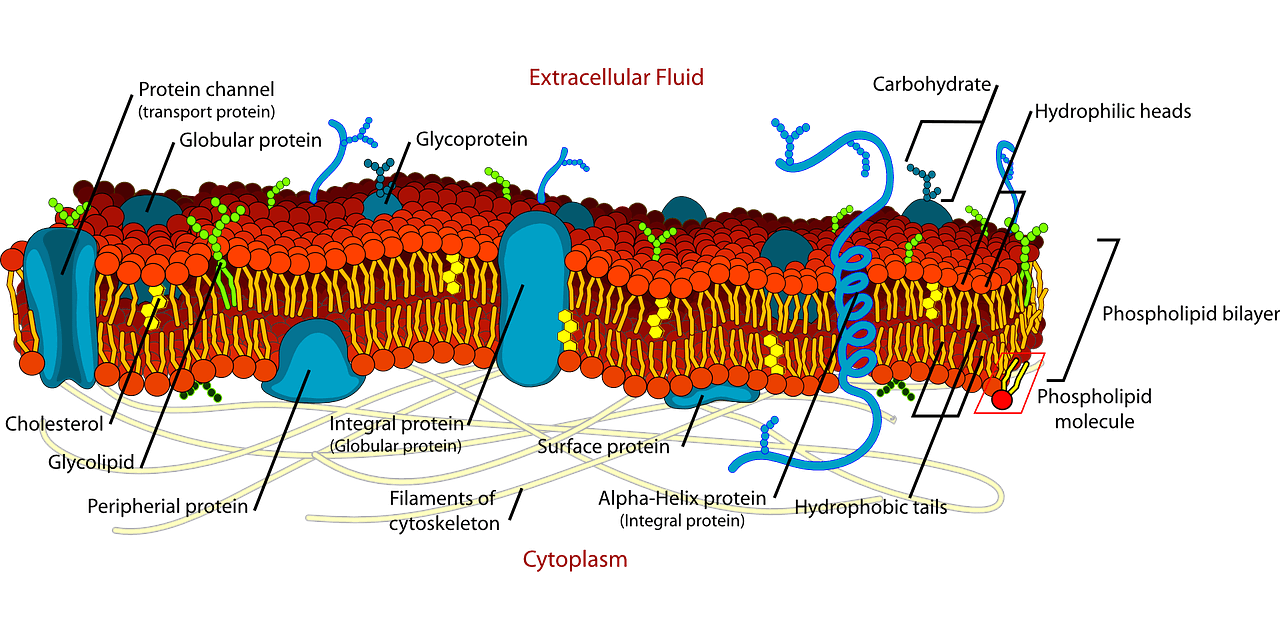
The molecular structure of the cell membrane arises from the organized assembly of lipids, proteins, and carbohydrates. These components determine the membrane’s physical properties and functions.
The fundamental structure of the cell membrane is formed by an arrangement known as the “phospholipid bilayer.” This structure consists of two layers of phospholipid molecules and determines the membrane’s primary physical characteristics. Due to the amphipathic nature of phospholipid molecules, their hydrophilic heads face the aqueous environments while their hydrophobic tails orient toward the interior of the membrane. This arrangement allows the membrane to remain stable in aqueous environments and forms a barrier.【1】
The degree of saturation of the fatty acid chains in phospholipids also affects membrane fluidity; unsaturated fatty acids, due to the presence of double bonds, form kinked structures that limit the tight packing of lipids, thereby increasing membrane fluidity.【2】
Proteins within the membrane are classified as integral and peripheral proteins. Integral proteins are embedded within the lipid layer, while peripheral proteins are attached to the membrane surface. These proteins play roles in transport, enzymatic activity, and signal transduction.【3】
Cholesterol molecules, particularly in eukaryotic cell membranes, insert themselves between phospholipids to regulate membrane fluidity and maintain structural stability against temperature fluctuations. Carbohydrates occur as glycoproteins and glycolipids and participate in cell recognition processes.【4】
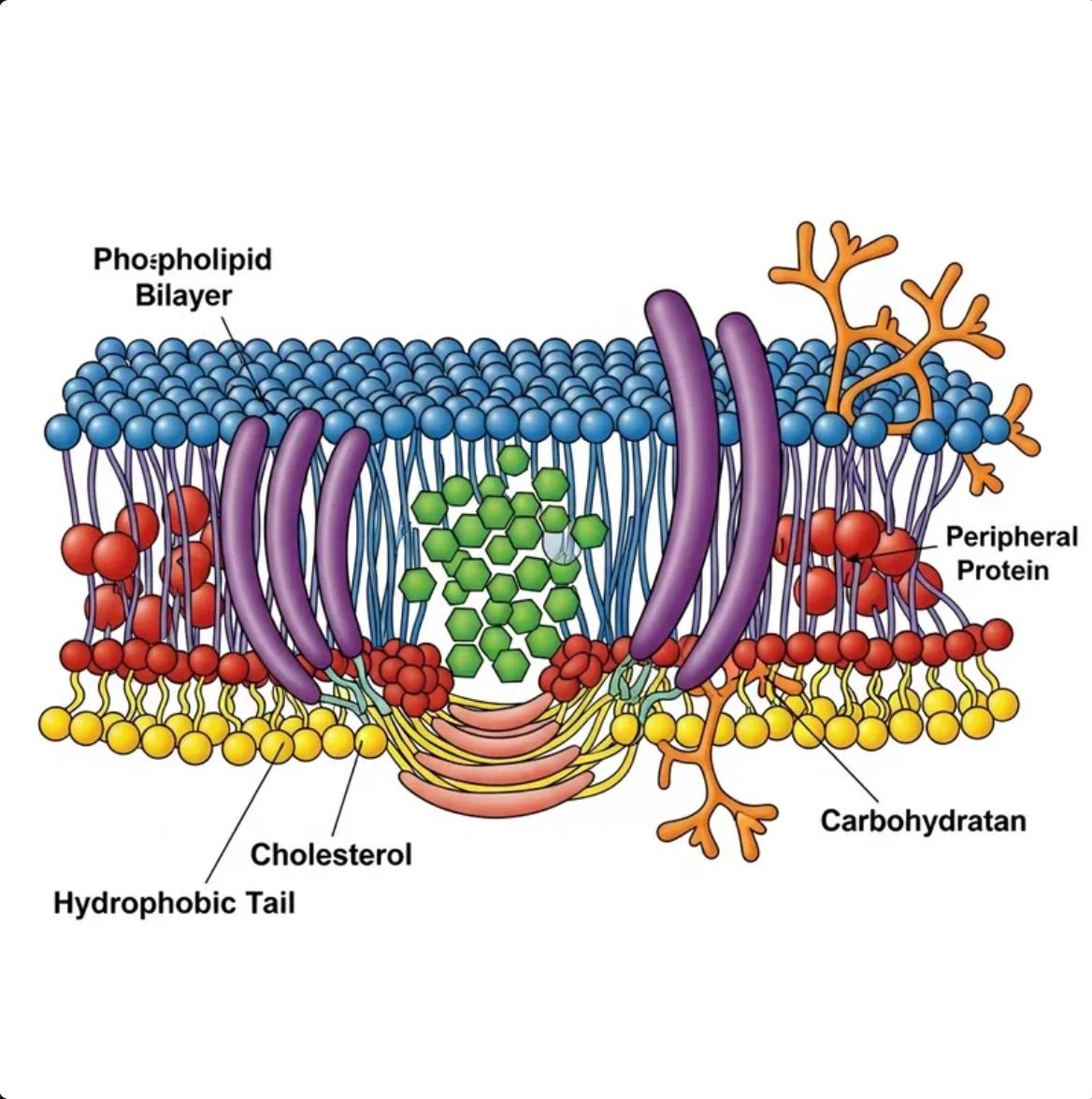
Fluid Mosaic Model of the Cell Membrane and Its Components.(Easy.Peasy.AI)
With advances in scientific understanding and microscopy techniques, it has become clear that the cell membrane is not a static structure but rather a dynamic and complex system in constant motion.
The structure of the cell membrane is described by the “fluid mosaic model,” proposed by Singer and Nicolson in 1972.【5】 According to this model, the membrane consists of proteins, cholesterol molecules, and carbohydrate components embedded within and laterally mobile in the lipid bilayer. Phospholipids form the fundamental structure, while other components are distributed throughout this framework.
The model demonstrates that membrane components possess specific mobility, which influences the membrane’s physical properties. Lipids and some proteins can move laterally within the membrane plane; this mobility contributes to the membrane’s flexibility and functional integrity.
The cell membrane contains various mechanisms that facilitate the transport of substances, contributing to the maintenance of balance between the intracellular and extracellular environments.
One of the membrane’s key properties is selective permeability, which regulates the movement of substances into and out of the cell. This property allows certain organic molecules, ions, water, and oxygen to enter the cell, while metabolic waste products such as carbon dioxide and ammonia are expelled.【6】 Selective permeability helps maintain substance balance across the membrane; the hydrophobic interior of the phospholipid bilayer restricts the free passage of ions and charged molecules but permits limited passage of small, uncharged molecules.
The movement of substances across the cell membrane occurs through passive and active transport mechanisms, depending on energy requirements and concentration gradients. Passive transport refers to the movement of substances from areas of higher concentration to areas of lower concentration without energy expenditure. This process can occur via simple diffusion, facilitated diffusion, or osmosis.
Active transport involves the movement of substances against their concentration gradient, from areas of lower concentration to areas of higher concentration, and typically requires ATP. This mechanism enables the cell to maintain appropriate concentrations of ions and other molecules. Transport is mediated by specific carrier proteins embedded in the membrane, which exhibit selectivity for particular substances.
An example of active transport is the sodium-potassium pump (Na⁺/K⁺-ATPase), which plays a role in maintaining intracellular ion balance. Osmosis, a form of passive transport, refers to the movement of water across a semipermeable membrane driven by concentration differences.【7】
The cell membrane contributes to the formation of internal organization in eukaryotic cells and facilitates interaction with the external environment.
Receptor proteins on the membrane detect chemical signals from external sources such as hormones, growth factors, and neurotransmitters. Upon binding of these signals, intracellular signaling pathways are initiated, activating specific biochemical cascades.
These processes can alter the activity of intracellular proteins and influence gene expression. Signal transduction enables cells to respond to environmental changes and sustain communication between cells.
In eukaryotic cells, the plasma membrane forms the outer boundary, while internal membranes of similar structure—including the nucleus, mitochondria, endoplasmic reticulum, and Golgi apparatus—participate in the processing, modification, and targeting of proteins and lipids within this system.
This structural compartmentalization, which divides the cell into distinct internal regions, allows different and sometimes opposing metabolic processes—for example, protein synthesis and degradation—to proceed efficiently and orderly in separate, specialized areas without interference.【8】 For instance, while prokaryotic cells typically possess only an external plasma membrane, eukaryotic cells use these internal membranes to physically separate their genetic material (DNA) and energy production centers from the rest of the cytoplasm.
[1]
Sarah Teakel. “Cell Membrane.” The Secret Lives of Cells: Foundations of Veterinary Cell Biology and Microbiology. Charles Sturt University. Erişim 10 Nisan 2026. https://opentext.csu.edu.au/secretlivesofcells/chapter/cell-membrane/
[2]
Geoffrey M. Cooper. “Cell Membranes.” The Cell: A Molecular Approach. 2nd edition. Sinauer Associates (2000). Erişim 10 Nisan 2026. https://www.ncbi.nlm.nih.gov/books/NBK9928/
[3]
J. Gordon Betts, Kelly A. Young, James A. Wise, Eddie Johnson, Brandon Poe, Dean H. Kruse, Oksana Korol, Jody E. Johnson, Mark Womble, Peter DeSaix. “3.1 The Cell Membrane.” Anatomy and Physiology 2e. OpenStax (2022). Erişim 10 Nisan 2026. https://openstax.org/books/anatomy-and-physiology-2e/pages/3-1-the-cell-membrane
[4]
Geoffrey M. Cooper. “Cell Membranes.” The Cell: A Molecular Approach. 2nd edition. Sinauer Associates (2000). Erişim 10 Nisan 2026.
[5]
Geoffrey M. Cooper. “Cell Membranes.” The Cell: A Molecular Approach. 2nd edition. Sinauer Associates (2000). Erişim 10 Nisan 2026.
[6]
J. Gordon Betts, Kelly A. Young, James A. Wise, Eddie Johnson, Brandon Poe, Dean H. Kruse, Oksana Korol, Jody E. Johnson, Mark Womble, Peter DeSaix. “3.1 The Cell Membrane.” Anatomy and Physiology 2e. OpenStax (2022). Erişim 10 Nisan 2026.
[7]
Geoffrey M. Cooper. “Cell Membranes.” The Cell: A Molecular Approach. 2nd edition. Sinauer Associates (2000). Erişim 10 Nisan 2026.
[8]
Geoffrey M. Cooper. “Cell Membranes.” The Cell: A Molecular Approach. 2nd edition. Sinauer Associates (2000). Erişim 10 Nisan 2026.

Molecular Composition and Architecture
Phospholipid Bilayer
Proteins and Other Components
Membrane Dynamics and Models
Fluid Mosaic Model
Physiological Transport Mechanisms
Selective Permeability
Passive and Active Transport
Cellular Interaction and Organization
Signal Transduction and Environmental Interaction
Endomembrane System and Compartmentalization