
This article was automatically translated from the original Turkish version.
The cell is the fundamental building block of all living organisms and the smallest unit that carries out all functions of life. Cells constitute the structural and functional units of living organisms. Living organisms are classified into two main groups based on cellular structure: prokaryotic and eukaryotic cells. These two groups differ in their cellular architecture, the organelles they contain, and the organization of their genetic material.
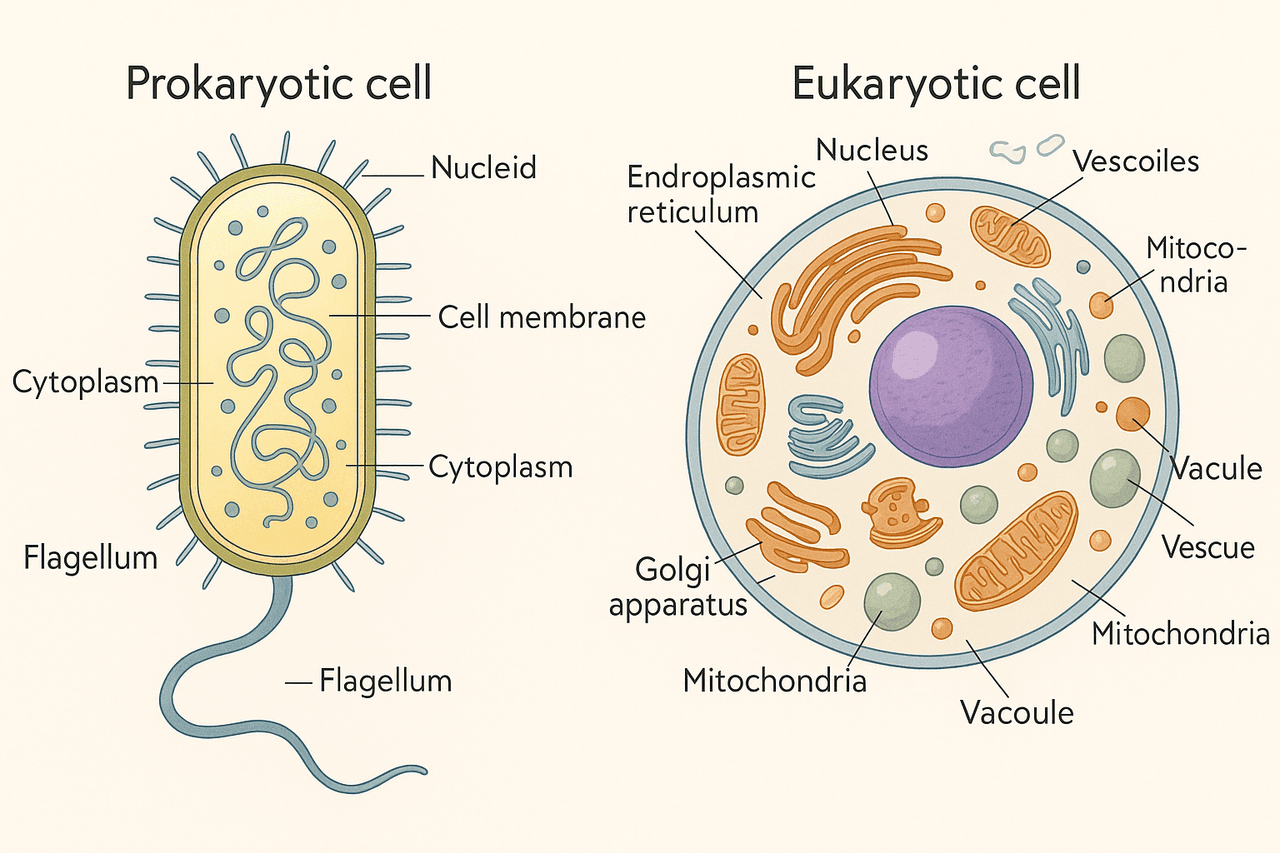
Prokaryotic and Eukaryotic Cells (Designed with Artificial Intelligence Assistance)
Prokaryotes represent simple organisms. Prokaryotic cells lack a nuclear membrane; their DNA is not enclosed within a nucleus but instead is concentrated in a region called the nucleoid. This structure indicates the absence of a true nucleus. Prokaryotic cells typically do not contain membrane-bound organelles. However, certain structures such as ribosomes play a role in intracellular protein synthesis. The cell wall of prokaryotes usually contains peptidoglycan, a polysaccharide-protein compound that provides shape and protection to the cell.
Prokaryotes are generally unicellular and can utilize a wide variety of metabolic pathways. They can survive in both oxygen-rich and oxygen-free environments. Their metabolic diversity enables them to adapt easily to environmental conditions. In terms of nutrition, they can be autotrophic, heterotrophic, or mixotrophic. Reproduction is typically asexual, occurring through binary fission. Additionally, they employ mechanisms such as conjugation, transformation, and transduction to exchange genetic material.
Bacteria and archaea are examples of prokaryotic organisms. Bacteria play important roles in human health, the environment, and industry, while archaea typically thrive in extreme environments.
Eukaryotic cells are structurally more advanced and complex. The DNA is enclosed within a membrane-bound nucleus, which plays a central role in the protection and regulation of genetic material. Eukaryotic cells contain numerous membrane-bound organelles including mitochondria (energy production), endoplasmic reticulum (protein and lipid synthesis), Golgi apparatus (material processing and packaging), and lysosomes (waste digestion), all of which coordinate cellular functions.
Eukaryotes can be either unicellular, such as protists, or multicellular, such as plants, animals, and fungi. The cytoskeleton provides shape to the cell, facilitates movement, and organizes organelles. The genetic material of eukaryotic cells is organized into linear DNA molecules arranged as chromosomes within the nucleus. Genetic processes such as replication, transcription, and translation are controlled by complex mechanisms.
Eukaryotic cells possess 80S ribosomes and carry out protein synthesis. Their cell size is significantly larger than that of prokaryotes, ranging from 10 to 100 micrometers. Moreover, eukaryotic cells have both sexual and asexual reproductive mechanisms.
In prokaryotic cells, genetic material is circular and replication occurs in the cytoplasm. In eukaryotes, genetic material is located within the nucleus and replication proceeds through complex mechanisms. Furthermore, gene expression regulation in eukaryotic cells is far more complex and includes features such as intron-exon structure.
Prokaryotes and eukaryotes use different pathways to sustain their cellular metabolism. Prokaryotes can employ aerobic and anaerobic respiration as well as energy-producing processes such as photosynthesis and chemosynthesis. In eukaryotic cells, mitochondria serve as the center of energy production. In plant cells, chloroplasts carry out photosynthesis.
Prokaryotes can rapidly replicate their genetic material and quickly adapt to environmental changes. Eukaryotes, by contrast, achieve advanced organization through complex signaling pathways and cell cycle control mechanisms.
Alberts, Bruce, Alexander Johnson, Julian Lewis, David Morgan, Martin Raff, Keith Roberts, and Peter Walter. *Molecular Biology of the Cell*. 6th ed. New York: Garland Science, 2014. Accessed June 12, 2025. https://www.ncbi.nlm.nih.gov/books/NBK21054/.
Campbell, Neil A., and Jane B. Reece. *Biology*. 9th ed. Boston: Pearson Education, 2011. Accessed June 12, 2025. https://archive.org/details/neil-a.-campbell-jane-b.-reece-biology-pearson-benjamin-cummings-2005-2.
Demirsoy, Ali. *Yaşamın Temel Kuralları: Biyoloji*. 6th ed. Ankara: Meteksan Yayınları, 2020. Accessed June 12, 2025. https://scholar.google.com.tr/citations?view_op=view_citation&hl=en&user=cYYPvsMAAAAJ&cstart=20&pagesize=80&citation_for_view=cYYPvsMAAAAJ:pyW8ca7W8N0C.
Margulis, Lynn. *Origin of Eukaryotic Cells*. New Haven: Yale University Press, 1970. Accessed June 12, 2025. https://archive.org/details/originofeukaryot0000marg.
Prokaryotic Cells
Eukaryotic Cells
Genetic Material and Cellular Functions