This article was automatically translated from the original Turkish version.
+1 More
Geography | Bosnia and Herzegovina | ||||||||
|---|---|---|---|---|---|---|---|---|---|
Category | Balkan Cuisine Traditional Meat Dishes / Grilled Meat Products | ||||||||
Geographic Origin | Montenegro and other Balkan countries North Macedonia Serbia (Novi Pazar / Leskovački ćevap) Bosnia and Herzegovina (especially Sarajevo – Sarajevski ćevapi) | ||||||||
Traditional Use | At regional festivals, national holidays | ||||||||
Material(s) | Other Regionally Used Spices Black Pepper Salt Lamb Beef | ||||||||
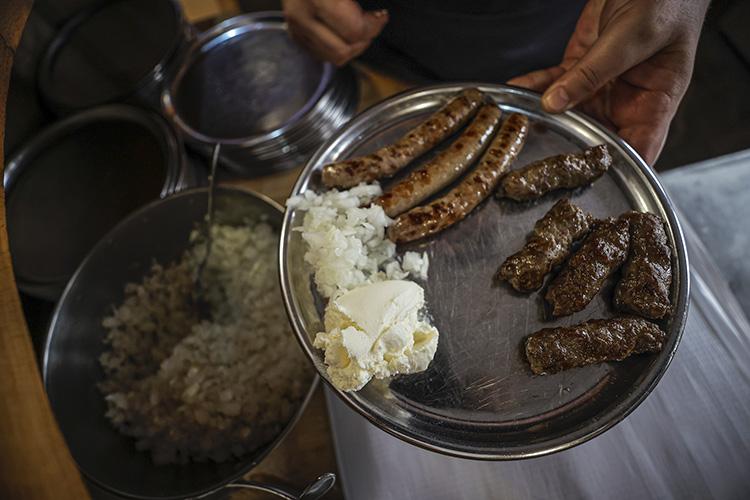
Cevapi (Ćevapi), one of the dishes that define the gastronomic identity of the Balkan region, particularly Bosnian cuisine. This dish consists of small, cylindrical-shaped meatballs made from minced meat and grilled over charcoal. It holds a central role both in the daily diet of local populations and in regional tourism. Typically served inside a flatbread called lepina or lepinja, accompanied by garnishes such as onions, kajmak, or yogurt, Cevapi represents not only a grilled dish but also a distinctive regional ritual.

Cevapi (AA)
The word Cevapi is etymologically derived from Persian and evolved from the Ottoman Turkish term kebap. The name Ćevapčići (meaning "small kebabs") refers to the dish’s compact form. The culture of grilled meat spread throughout the Balkans under the influence of the Ottoman Empire and gradually adapted to local palates and ingredient availability. In Bosnia and Herzegovina, Cevapi holds the status of a national dish and occupies a symbolic place in preserving cultural identity and gastronomic heritage.
Traditionally, beef (veal) is the preferred meat. To enhance flavor depth, lamb meat is sometimes added in specific proportions. While pork is not commonly used across Bosnia and Herzegovina, variations in other parts of the Balkans may include pork in the mixture.
To preserve Cevapi’s characteristic juicy texture, the fat content of the meat must be carefully balanced at approximately 20–25%. Meat that is too lean results in a dry and firm product, while excessively fatty meat loses its shape during cooking.
Salt and black pepper are the primary seasonings. Although some regional recipes include garlic water or a minimal amount of red pepper, the goal is not to mask the meat’s natural flavor but to highlight it.

Preparing Cevapi (AA)
The "resting" process is a critical factor in achieving high-quality Cevapi batter. After the minced meat is thoroughly mixed, it is not cooked immediately. Instead, it is chilled at +4°C for 24 to 48 hours. This step allows the meat’s pH to stabilize, enables the spices to fully integrate with the meat, and prevents the meatballs from falling apart during grilling. In some traditional methods, a small amount of baking soda is added to enhance the elasticity of the mixture.
In the final stage, the rested meat mixture is formed into long, thin cylinders—resembling fingers—using special funnels or by hand. Cooking must be done exclusively over charcoal or on a grill. The direct heat of the grill creates a rapid sear on the surface (Maillard reaction), trapping moisture and fat inside. An ideally cooked Cevapi has a lightly browned, elastic exterior and a juicy, tender interior.
Bread (Lepinja): The bread served is not an ordinary flatbread. Typically, while the meat is grilling, the lepinja is placed directly on the grill to absorb the meat’s steam and fat, softening and flavoring it.
Accompaniments: Finely chopped dried onions—often of the sweet "srebrenac" variety—and kajmak (a thickened salted cream made from milk) are essential complements. These ingredients balance the dense protein structure of the meat. Additionally, ajvar, a roasted pepper relish, and yogurt are commonly served alongside.

Serving Cevapi (AA)
Sarajevo Style: Cevapi prepared in Sarajevo typically use only beef. The meatballs are formed into small portions and served with kajmak and onions as the primary garnishes. Lepinja is the standard bread, and portions usually consist of five or ten pieces.
Banja Luka Style: The most distinctive difference is in shape: the meatballs are grilled not individually but as connected clusters of four, forming flat patties. The spice profile is more intense.
Other Countries: Variants in Serbia (particularly the Leskovac region), Croatia, and North Macedonia (known as Cevapcici) differ in meat blends and size. For example, in Leskovac-style grilling, the use of spicy peppers and a beef-pork mixture is more common.
Anadolu Ajansı. “Bosna Hersek'in Geleneksel Köftesi: Cevapi.” Anadolu Ajansı, Accessed January 5, 2026. https://www.aa.com.tr/tr/dosya-haber/bosna-hersekin-geleneksel-koftesi-cevapi/3004508.
Bestic-Bronza, Slavojka, and Boro Bronza. “Ćevapi: A Paradigm of Yugoslav Gastronomic Brandification.” ResearchGate, July 2020. Accessed January 5, 2026. https://www.researchgate.net/publication/343112036_Cevapi_A_Paradigm_of_Yugoslav_Gastronomic_Brandification.
Ercan, Mustafa Oğuzhan, and Taner Erdoğan. “Balkan Mutfak Kültürünün Gastronomi Turizmi Kapsamında Değerlendirilmesi (Evaluation of Balkan Culinary Culture Within the Scope of Gastronomy Tourism).” ResearchGate, 2024. Accessed January 5, 2026. https://www.researchgate.net/publication/381905002_Balkan_Mutfak_Kulturunun_Gastronomi_Turizmi_Kapsaminda_Degerlendirilmesi.
Ganić, A. and A. Zulić. “Kvalitativna analiza Sarajevskih ćevapa u cilju dobivanja oznake garantirano tradicionalnog specijaliteta na nacionalnoj razini.” *MESO: Prvi hrvatski časopis o mesu* 25, no. 3 (2023): 219–228. Accessed January 5, 2026. https://hrcak.srce.hr/file/437470.
İnce Karaçeper, E. “Yemek ve Kültür İlişkisi Bağlamında Balkan Restoranlarının Menü İçerik Analizi.” *Kent Akademisi Dergisi* 17, no. 5 (2024): 1975–1994. Accessed January 5, 2026. https://doi.org/10.35674/kent.1433018.

Geography | Bosnia and Herzegovina | ||||||||
|---|---|---|---|---|---|---|---|---|---|
Category | Balkan Cuisine Traditional Meat Dishes / Grilled Meat Products | ||||||||
Geographic Origin | Montenegro and other Balkan countries North Macedonia Serbia (Novi Pazar / Leskovački ćevap) Bosnia and Herzegovina (especially Sarajevo – Sarajevski ćevapi) | ||||||||
Traditional Use | At regional festivals, national holidays | ||||||||
Material(s) | Other Regionally Used Spices Black Pepper Salt Lamb Beef | ||||||||
Origin and Cultural Significance
Ingredients and Preparation
Main Ingredient
Spices and Flavor Enhancers
Shaping and Cooking
Serving and Presentation
Regional Variations and Differences