


This article was automatically translated from the original Turkish version.
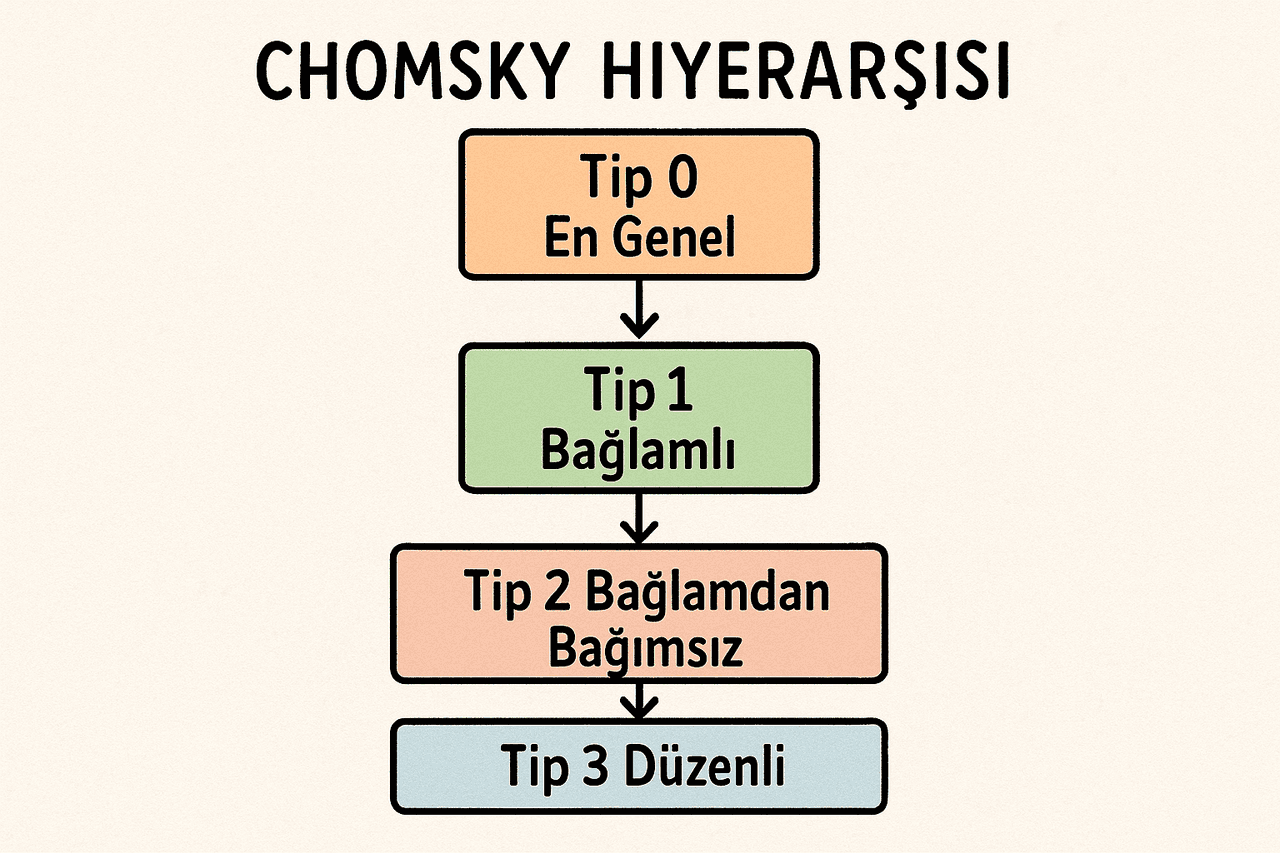
Generated with artificial intelligence.
Chomsky Hierarchy
Definition(s) | The Chomsky Hierarchy is a theoretical classification introduced by Noam Chomsky in 1956 that ranks formal languages by their structural complexity based on production rules. | ||||||||
|---|---|---|---|---|---|---|---|---|---|
Four Basic Levels | Type-3: Regular grammars (Finite State Automaton) Type-2: Context-free grammars (Pushdown Automaton) Type-1: Context-sensitive grammars (α→β rule) Type-0: Unrestricted grammars (Turing Machine) | ||||||||
The Chomsky Hierarchy, proposed through Noam Chomsky’s publications in 1956, argues that language should be analyzed not as random collections of observed word sequences, but as systems of rules that generate these sequences.
Formal Language Theory (FLT) is one of the foundational pillars of the linguistic paradigm shift led by Noam Chomsky in the mid-20th century. Drawing on Alan Turing’s theory of computability and the foundational approaches of pioneers such as Axel Thue and Emil Post, this theory aims to express the structure of language using formal mathematical concepts. This approach shifted the focus of linguistic inquiry from sentences and observations to rules and derivation processes, directly influencing not only modern linguistics but also theoretical computer science, artificial intelligence, and computational biology.
Chomsky’s hierarchical classification provides a systematic method for determining and measuring the structural complexity of a language. In this context, grammars are not merely summaries of observed patterns in language; rather, they are the mathematical representations of mental models that generate these patterns. Thus, the Chomsky Hierarchy divides formal grammars into four fundamental levels based on the production rules that either limit or expand their definitional power.
In formal language theory, the fundamental concepts are clearly defined. An alphabet (Σ) is a finite set of symbols upon which operations are performed. When these symbols are arranged in a specific order, they form a string or sequence. A language is a specific set of such strings, which may be finite or infinite.
The generation of a language is achieved through a grammar. A grammar consists of four components: a set of terminal symbols (Σ), a set of non-terminal symbols (NT), a start symbol (S), and a set of production rules (R). Each production rule is defined in the form α → β, indicating that the substring α within a string can be replaced by β. These replacement operations constitute the derivation process.
A formally defined grammar G is expressed as G = ⟨Σ, NT, S, R⟩. A string is considered generated by the grammar if, starting from the start symbol, it can be derived through a sequence of productions to contain only terminal symbols. The set of all such strings obtained at the end of this process is called the language itself, denoted L(G).
The Chomsky Hierarchy comprises four main levels that determine the expressive power of formal grammars:
This is the broadest class, encompassing all formal grammars without any restrictions. Production rules are of the form α → β, where α contains at least one non-terminal symbol. Type-0 grammars generate languages recognizable by Turing machines, known as recursively enumerable languages.
In these grammars, production rules are of the form α → β and must satisfy the condition |α| ≤ |β|. That is, the length of the string cannot decrease during derivation. This property ensures that the derivation process terminates in a finite number of steps. Type-1 grammars are recognized by linear bounded automata.
In this class, all rules are of the form A → β, where A is a non-terminal and β is any string composed of terminal and/or non-terminal symbols. Context-free grammars are associated with pushdown automata, and the syntactic analysis of programming languages is built upon this structure.
This is the most restricted class, defining regular languages. Rules are of the form A → aB or A → a, where a is a terminal symbol and B is a non-terminal. Type-3 grammars correspond to finite state automata, and regular expressions are their practical implementation.
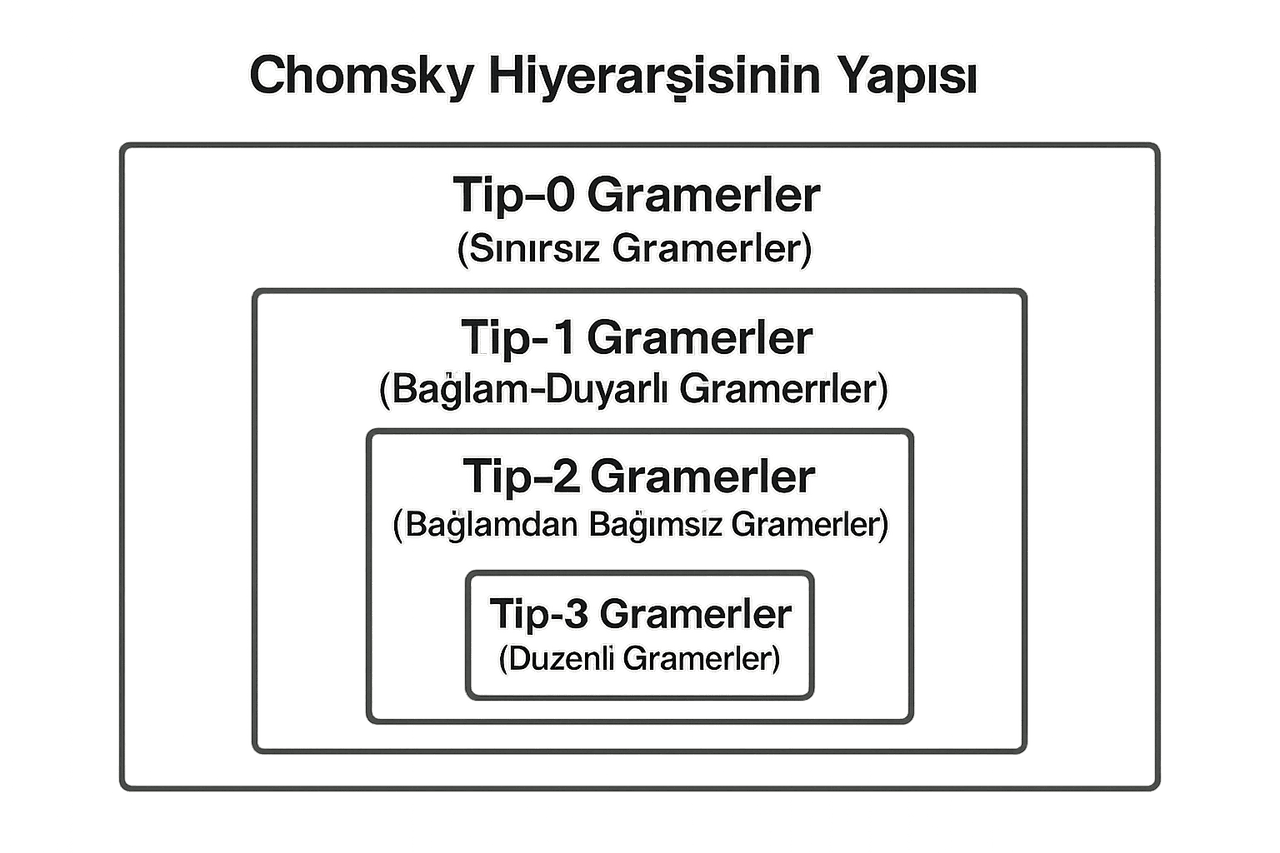
Structure of the Chomsky Hierarchy (generated by artificial intelligence.)
Each higher level encompasses all lower levels. This containment implies that regular languages can be context-free, but not all context-free languages are regular.
The Chomsky Hierarchy also specifies a corresponding computational model for each grammar type.
These automata represent the algorithmic dimensions of language recognizability and derivability.
Formal Language Theory encompasses not only the arrangement of symbols but also their classification. Intersubstitutability refers to the ability of certain sub-expressions within a language to belong to the same category and replace one another. For example, the words “cat” and “dog” can be used interchangeably in the same context, indicating they belong to the same category.
This property enables grammars to generate an infinite number of expressions using only a finite set of rules. If every expression were stored individually, the system would require an infinite number of rules to define an infinite set of expressions. Conversely, treating everything as substitutable would eliminate meaning. This balance forms the foundation of grammatical productivity.
Some complex structures in natural languages exceed the boundaries of the classical Chomsky Hierarchy. Therefore, the concept of Mildly Context-Sensitive Languages has been developed. Extended models such as Tree-Adjoining Grammars (TAG), Multiple Context-Free Grammars (MCFG), and Minimalist Grammars (MG) are used to describe linguistic patterns like cross-serial dependencies that context-free grammars cannot capture.
For instance, cross-serial dependencies in Swiss German cannot be described by classical context-free grammars; such structures require context-sensitive properties and advanced grammar models.
Natural languages are generally at the context-free grammar level because they require nested expressions and constituent structures. However, some linguistic features demand context-sensitivity. For example, Dutch and Swiss German exhibit cross-serial dependencies.
Programming languages rely on both regular and context-free structures. Lexical analysis is performed using regular expressions, while syntactic analysis is based on context-free grammars. The Backus-Naur Form (BNF) is the standard method for expressing this structure.
The Chomsky Hierarchy provides a systematic foundation for the mathematical analysis of language by grading the expressive power of formal grammars. Through this hierarchy, the computational resources required for language models, grammatical constraints, and recognizability limits can be clearly determined. In both linguistics and theoretical computer science, the expressive power of grammars, intertwined with automata theory, forms the basis of modern NLP approaches and programming languages.
The structure introduced by Chomsky has become an indispensable criterion for understanding linguistic productivity, not only revealing theoretical boundaries but also generating new solutions in applied fields.
Delétang, Grégoire, Anian Ruoss, Jordi Grau-Moya, Tim Genewein, Li Kevin Wenliang, Elliot Catt, Chris Cundy et al. "Neural networks and the chomsky hierarchy." *arXiv preprint arXiv:2207.02098* (2022). Accessed Adresi.
Devopedia. "Chomsky Hierarchy." 2021. Accessed July 8, 2025. Accessed Adresi.
Geeksforgeeks. "Chomsky Hierarchy in Theory of Computation". Accessed July 8, 2025. Accessed Adresi.
Hunter, Tim. "The chomsky hierarchy." A companion to Chomsky (2021): 74-95. Accessed Adresi.
Jäger, Gerhard, and James Rogers. "Formal language theory: refining the Chomsky hierarchy." *Philosophical Transactions of the Royal Society B: Biological Sciences* 367, no. 1598 (2012): 1956-1970. Accessed Adresi.
Lasnik, Howard. "Up and down the Chomsky hierarchy." In Paper presented. 2007. Accessed Adresi.
Tutorialspoint. "Chomsky Classification of Grammars". Accessed July 8, 2025. Accessed Adresi.

Generated with artificial intelligence.
Chomsky Hierarchy
Definition(s) | The Chomsky Hierarchy is a theoretical classification introduced by Noam Chomsky in 1956 that ranks formal languages by their structural complexity based on production rules. | ||||||||
|---|---|---|---|---|---|---|---|---|---|
Four Basic Levels | Type-3: Regular grammars (Finite State Automaton) Type-2: Context-free grammars (Pushdown Automaton) Type-1: Context-sensitive grammars (α→β rule) Type-0: Unrestricted grammars (Turing Machine) | ||||||||
Core Concepts: Alphabet, Language, and Grammar
Structure of the Chomsky Hierarchy
Type-0 Grammars (Unrestricted Grammars)
Type-1 Grammars (Context-Sensitive Grammars)
Type-2 Grammars (Context-Free Grammars)
Type-3 Grammars (Regular Grammars)
Relationship with Automata
Intersubstitutability and Productivity
Extensions of the Chomsky Hierarchy
Context of Natural and Programming Languages
Significance of the Chomsky Hierarchy