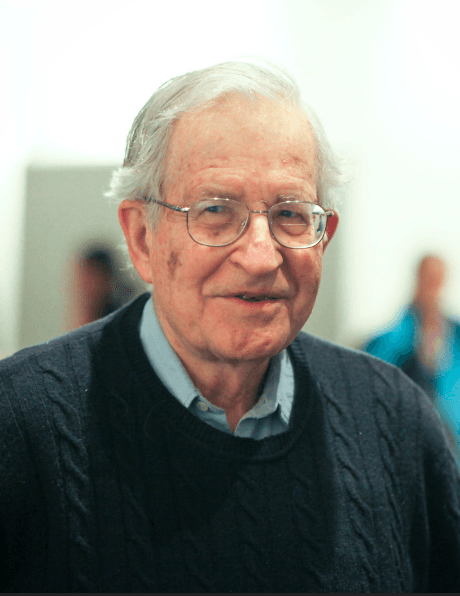
Noam Chomsky
Doğum tarihi | 1928-12-07 | ||||||||
|---|---|---|---|---|---|---|---|---|---|
Eş | Carol Chomsky (b. 1949–2008) Valeria Wasserman (b. 2014) | ||||||||
Çocuk | Diane Chomsky Harry Chomsky Aviva Chomsky | ||||||||
Annesi | Elsie Simonofsky | ||||||||
Babası | William Chomsky | ||||||||
Yaş | 96 | ||||||||
People Influenced | Roman Jakobson Ferdinand de Saussure | ||||||||
Education | University of Pennsylvania (1951–1955) | ||||||||
Avram Noam Chomsky was born on 7 December 1928 in Philadelphia; he is a highly influential American linguist philosopher political activist and public intellectual. Growing up in an intellectually rich and politically active family Chomsky developed a strong sense of social justice at an early age shaped by experiences such as witnessing the Great Depression and labor uprisings. He began his studies at the University of Pennsylvania where he studied under linguist Zellig Harris and later met prominent thinkers such as Nelson Goodman and W V Quine. Rejecting the notion that the human mind is a blank slate Chomsky argued that linguistic capacity is innate; this revolutionary idea was developed in his groundbreaking work Syntactic Structures (1957). He spent fifty years at MIT where he introduced transformational grammar and the Chomsky Hierarchy; these contributions profoundly influenced linguistics psychology and philosophy.
Noam Chomsky was born on 7 December 1928 in Philadelphia. Growing up during the Great Depression in the United States Chomsky witnessed social inequalities which significantly influenced his intellectual development. His family was middle class; his mother Elsie was actively involved in radical politics of the 1930s and his father William served as a professor of Hebrew at Gratz College.
At the age of ten Chomsky wrote an article for his school newspaper on the rise of fascism in Europe following the Spanish Civil War. This article later formed the basis of a paper he presented at New York University. At thirteen he traveled from Philadelphia to New York where he participated in environments where diverse political and social views were debated. This period played a crucial role in shaping his social and political thought.
Toward the end of World War II Chomsky began his higher education at the University of Pennsylvania. His encounter with linguist Zellig S Harris determined his academic direction leading him to focus on structural linguistics. During this time he completed both his undergraduate and graduate studies using nontraditional methods. Through Harris he met mathematician Nathan Fine and philosophers Nelson Goodman and W V Quine from Harvard University. Chomsky opposed Goodman’s view that the mind is a blank slate and instead argued that linguistic structures are innate. In 1951 he wrote his graduate thesis titled “The Morphophonemics of Modern Hebrew”.
He also conducted research at Harvard University and expanded the ideas developed in his doctoral dissertation in his 1957 publication Syntactic Structures which is now regarded as one of the foundational texts of modern linguistics.
In 1955 Noam Chomsky was invited to join the faculty of the Massachusetts Institute of Technology (MIT) where he served in the Department of Linguistics and Philosophy for approximately fifty years until 2005. During this time he introduced the theory of transformational grammar to linguistics. This theory posits that linguistic capacity is innate and that different languages arise only through the cultural environment shaping a limited set of parameters.
He also made significant contributions not only to linguistics but also to psychology cognitive science and computer science through the “Chomsky Hierarchy” which classifies grammatical structures in a hierarchical manner.

Set Ranges Defined by the Chomsky Hierarchy (Generated by Artificial Intelligence)
Chomsky has served as a visiting professor or invited speaker at universities including Columbia UCLA Princeton and Cambridge and has been awarded honorary doctorates by numerous institutions.
His work beyond linguistics has focused on political science and media criticism. While his views in these areas have sometimes sparked public controversy Chomsky has been honored with numerous academic and humanitarian awards at national and international levels. Among these prestigious awards are the Distinguished Scientific Contribution Award from the American Psychological Association the Kyoto Prize from Japan and the Sydney Peace Prize from Australia.
Chomsky’s revolutionary contribution to linguistics is the theory of Universal Grammar which asserts that human language is not merely a set of observable behaviors but is grounded in an innate mental faculty. According to this theory all humans possess an innate mental structure that processes limited linguistic input from the environment to generate a complex grammatical system. This accounts for what is known as “Plato’s problem” the question of how rich knowledge can be derived from limited data in the context of language acquisition.
According to Chomsky children learning language grasp not only words but also the underlying morphological and syntactic rules. This learning process cannot be reduced to behaviorist explanations based on imitation and reinforcement. In particular in his critiques of B F Skinner’s behaviorist theory of language Chomsky argued that language use cannot be explained solely by external stimulus-response relationships and that the human mind contains an independent and creative structure.
Chomsky’s generative grammar model proposes that language can be structurally infinite and creative. In this model the distinction between “deep structure” and “surface structure” plays a central role. Deep structure represents the abstract semantic structure of sentences while surface structure refers to the various syntactic forms through which these meanings are expressed. This distinction demonstrates that linguistic forms as well as meanings are connected to mental processes.
Chomsky’s political thought is shaped primarily within the frameworks of imperialism ideological manipulation definitions of terrorism U S foreign policy and media criticism. Positioning himself on a libertarian socialist spectrum Chomsky views the legitimization of violence by states and major powers alongside the labeling of individuals or weaker actors as “terrorists” using similar methods as a moral double standard.
In his work Pirates and Emperors, Chomsky references Saint Augustine’s observation that “the only difference between a pirate and an emperor is scale.” In this context, he criticizes how major powers such as the United States frame large-scale military interventions as “legitimate intervention” or “peace operations,” while labeling weaker groups that employ similar methods as “terrorists.” Through this approach, Chomsky questions the discursive distinctions constructed between power and legitimacy.
Moreover, in his book Democracy: The Real and the Illusory, Chomsky argues that the United States invokes human rights rhetoric solely as a tool to serve its strategic interests. According to him, the discourse of democracy is promoted only to the extent that it aligns with U.S. interests. In reality, many regimes supported by Washington are distinguished by their non-democratic practices. These critiques reflect Chomsky’s consistent emphasis on the vast gap between democratic ideals and actual political practice.
Additionally, in his critiques of the media, Chomsky developed the concept of the “propaganda model,” asserting that major media institutions function as ideological apparatuses of the state. He argues that the media systematically shapes public perception, presents selective information, and suppresses critical thought. This phenomenon is termed “manufacturing consent” and illustrates how media operations in liberal democracies can evolve into forms of authoritarian control.
Special Interview with Noam Chomsky by Cüneyt Özdemir (Cüneyt Özdemir)
Current Issues in Linguistic Theory (1964)
Aspects of the Theory of Syntax (1965)
The Sound Pattern of English (with Morris Halle, 1968)
Language and Mind (1972)
Studies on Semantics in Generative Grammar (1972)
Knowledge of Language (1986)
American Power and the New Mandarins (1969)
Peace in the Middle East? (1974)
Manufacturing Consent (with Edward S. Herman, 1988)
Profit Over People (1998)
Rogue States (2000)
Hegemony or Survival (2003)
Gaza in Crisis (with Ilan Pappé, 2010)
On Western Terrorism (2013)
1984 – American Psychological Association Award for Distinguished Scientific Contributions
1988 – Kyoto Prize
1996 – Berlin-Brandenburg Academy of Sciences Award
2004 – Carl von Ossietzky Award for Contemporary History and Politics, Oldenburg
2005 – Global Intellectual Award
2006 – Honorary Doctorate, Uppsala University
In 1949, Chomsky married Carol Schatz, an education specialist whom he had known since childhood. Their marriage lasted 59 years until her death from cancer in 2008. The couple had three children: two daughters, Aviva and Diane, and a son, Henry.
In 2014, at the age of 85, Chomsky married Valeria Wasserman in his second marriage. In June 2024, Valeria Wasserman announced that Chomsky had been receiving treatment in a hospital in Brazil following a serious stroke he suffered in June of the previous year. She noted that he experiences difficulty speaking and is monitored daily by a neurologist, a speech therapist, and a pulmonologist.
Barman, Binoy. 2014. “The Linguistic Philosophy of Noam Chomsky.” *Philosophy and Progress* 51. https://doi.org/10.3329/pp.v51i1-2.17681.
Jeanbaptisteparis. *Noam Chomsky – 2010*. March 25, 2010. Photograph. Flickr. https://www.flickr.com/photos/jeanbaptisteparis/4496805259.
Kerimoğlu, Caner. “Chomsky’nin Problemi: Dilin Evrimi.” *Çukurova Üniversitesi Türkoloji Araştırmaları Dergisi* 6, no. 2 (2021): 598–614. https://doi.org/10.32321/cutad.954455.
Rusk, Andrew. *Noam Chomsky*. April 8, 2011. Photograph. Flickr. https://www.flickr.com/photos/andrewrusk/5599576288.
Özdemir, Cüneyt. “Cüneyt Özdemir ile Noam Chomsky Özel Röportajı.” YouTube video, 53:07. February 3, 2022. https://www.youtube.com/watch?v=R7wQtDCL5_0.

Noam Chomsky
Doğum tarihi | 1928-12-07 | ||||||||
|---|---|---|---|---|---|---|---|---|---|
Eş | Carol Chomsky (b. 1949–2008) Valeria Wasserman (b. 2014) | ||||||||
Çocuk | Diane Chomsky Harry Chomsky Aviva Chomsky | ||||||||
Annesi | Elsie Simonofsky | ||||||||
Babası | William Chomsky | ||||||||
Yaş | 96 | ||||||||
People Influenced | Roman Jakobson Ferdinand de Saussure | ||||||||
Education | University of Pennsylvania (1951–1955) | ||||||||
Early Life and Education
Career and Achievements
Contributions to Linguistics: Universal Grammar and Deep Structure
Philosophical and Social Thought: Imperialism Terrorism and Media Criticism
Key Works
Major Works in Linguistics
Major Works on Politics and Media
Select Awards
Personal Life