

This article was automatically translated from the original Turkish version.
Church of Saint Eleni
Location | Sille Neighborhood Türkiye Konya Province Selçuklu District | ||||||||
|---|---|---|---|---|---|---|---|---|---|
Geographic Proximity | Approximately 7 km from the city center of Konya | ||||||||
Building Type | Church and Monastery Complex – Currently a Museum | ||||||||
Cultural Context | Karamanli Orthodox Greek Culture | ||||||||
The Church of Saint Elena is located in the Sille Neighborhood of the Selçuklu District, linked to Konya in Türkiye’s Central Anatolia Region. Sille, approximately seven kilometers from the city center of Konya, has been known throughout history by various names such as Sylata, Sile, Silles, and Sudiremi, and is a settlement notable for its origins dating back to the early Christian period. The church is situated in the Sille Subaşı Neighborhood, to the left of the Tatköy road junction, and is currently open to visitors as a museum.
The most widely held tradition regarding the construction of the Church of Saint Elena holds that Helena, mother of the Byzantine Emperor Constantine, visited Sille during her pilgrimage to Jerusalem in 327 CE, was inspired by the early Christian rock-cut places of worship she encountered there, and encouraged the building of a church. However, this date is not scientifically accepted as the origin of the structure; scholars believe the building in its current form dates to the 19th century. The architecture and decorative elements reflect a layered historical process spanning the Late Byzantine and Ottoman periods.
An inscription above the entrance door to the naos (main worship space) is written in both Turkish and Greek letters and bears the date 1833. It states that the building was restored for the third time during the reign of Sultan Mahmud II, and that its foundation was laid in the names of Saint Elena and the Archangel Michael. The inscription also records that Sarraf Hacı Elia, a prominent citizen of Sille, was appointed as epitropos (church supervisor). A three-line supplementary inscription in the same section indicates that the fourth major restoration occurred during the reign of Sultan Abdülmecid.
The church has been known by various names across different periods, including Saint Elena/Aghia Eleni, Hagios Mikhael (Saint Michael), Hagios Metamorfosis (Holy Transfiguration), and Archangelos (Archangel). The diverse naming conventions in historical sources reflect the building’s complex religious and cultural history.

Church of Saint Elena (Republic of Türkiye Selçuklu Subgovernorship)
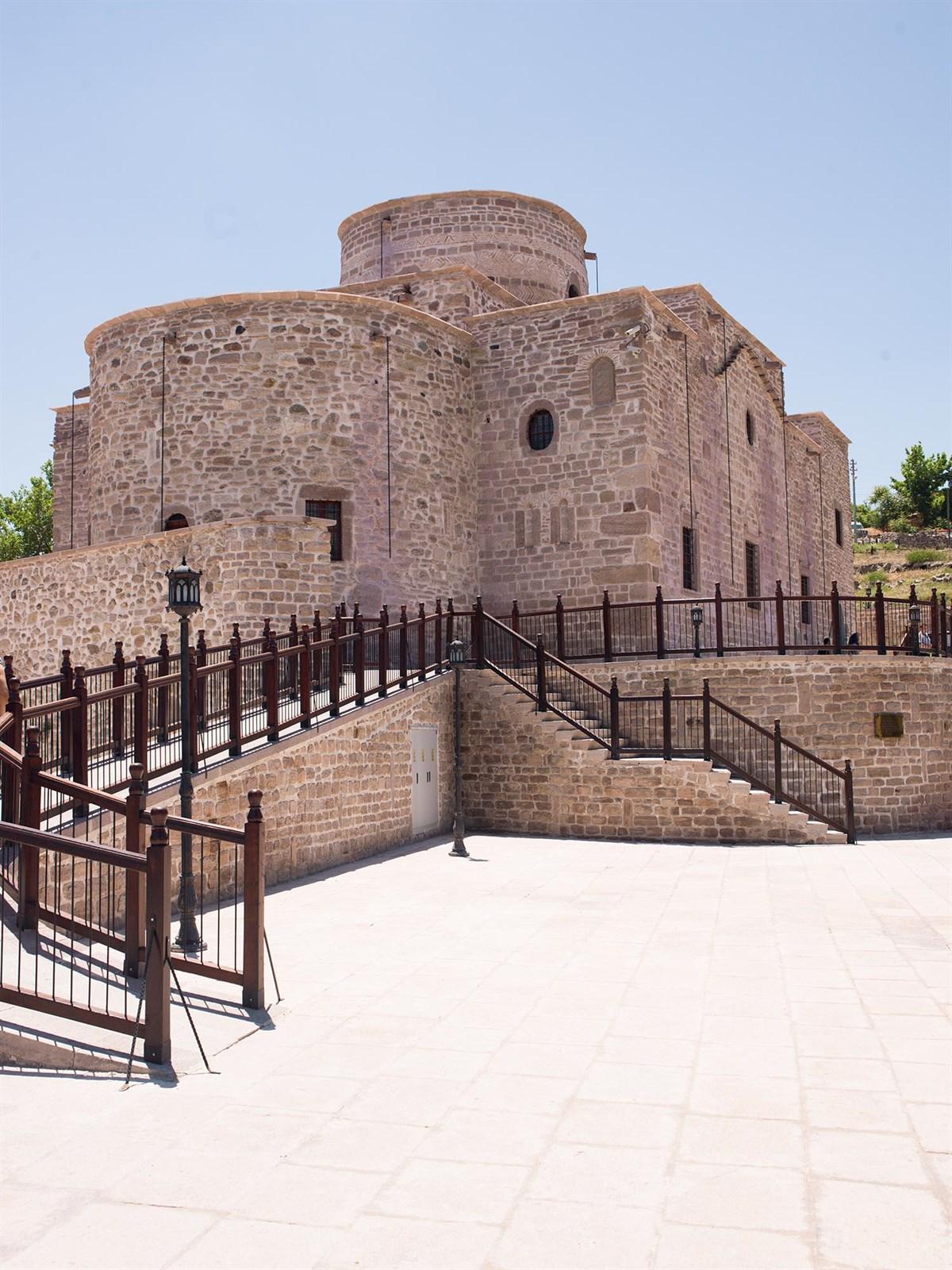
The structure has a rectangular plan oriented east-west and follows the closed Greek cross layout. At its center is a square space supported by four free-standing piers, covered by a high drum-supported dome. The arms of the cross are terminated by barrel vaults, and the apse is covered by a half-dome. The narthex (entrance space) is two-storied and opens externally through a door on the southern side. The apse at the eastern end is three-faceted externally and arched internally. The form of the apse and the drum architecture distinguish Saint Elena’s Church from other churches in Sille, such as Akmanastır, Kiriakon, and Koimesis Tes Panagias. The construction employed various materials including roughly cut stone, dressed stone, and brick. Particularly notable is the cylindrical drum supporting the dome, which features an aesthetic arrangement of irregularly combined brick and stone. All interior surfaces were covered with plaster, upon which frescoes were applied.

Church of Saint Elena Selçuklu District)
The church is one of the most comprehensive examples of late-period fresco programs in the Sille region. The extant frescoes were added during the post-Byzantine period and depict the following figures:

Stolen Saint Icons from the Church of Saint Elena General Directorate of Cultural Assets and Museums)
The Church of Saint Elena is regarded as a rural example of the four-piered closed Greek cross plan type. This architectural type is also found in the rock-cut churches of Cappadocia and the Fisandon Church in Karaman. However, Saint Elena’s tall cylindrical drum, three-faceted apse, late-period fresco program, and material composition distinguish it from other structures in the region. In particular, the drum architecture exhibits characteristics typical of Late Byzantine buildings and is among the rare examples surviving in Anatolia. Today, the Church of Saint Elena is under the protection of the Konya Mevlana Museum and is open to visitors. Thanks especially to its late-period restorations, the building remains structurally sound and represents an important cultural heritage both architecturally and iconographically.
Culture and Heritage General Directorate. "St. Helen Icons Stolen from the Church of Aya Eleni inSille Mahallesindeki,Selçuklu İlçesi,Konya İli." *Ministry of Culture and Tourism of the Republic of Turkey*, https://kvmgm.ktb.gov.tr/TR-44662/konya-ili-selcuklu-ilcesi-sille-mahallesindeki-aya-eleni-kilisesinden-calinan-aziz-tasvirleri.html. Accessed July 3, 2025.
Danık, Ertuğrul. “Konya Sille’deki Aya Elena Kilisesi.” *Sanat Tarihi Dergisi* 30, no. 1 (2021): 169–200. Accessed July 3, 2025. https://dergipark.org.tr/tr/download/article-file/2158480.
“Aya Elenia Müzesi.” *T.C. Selçuklu Kaymakamlığı Resmî Web Sitesi*. Accessed July 3, 2025.

Church of Saint Eleni
Location | Sille Neighborhood Türkiye Konya Province Selçuklu District | ||||||||
|---|---|---|---|---|---|---|---|---|---|
Geographic Proximity | Approximately 7 km from the city center of Konya | ||||||||
Building Type | Church and Monastery Complex – Currently a Museum | ||||||||
Cultural Context | Karamanli Orthodox Greek Culture | ||||||||
No Discussion Added Yet
Start discussion for "Church of Saint Eleni" article
History
Inscriptions and Restorations
Nomenclature
Architectural Features
Decoration (Frescoes)