


This article was automatically translated from the original Turkish version.
+1 More
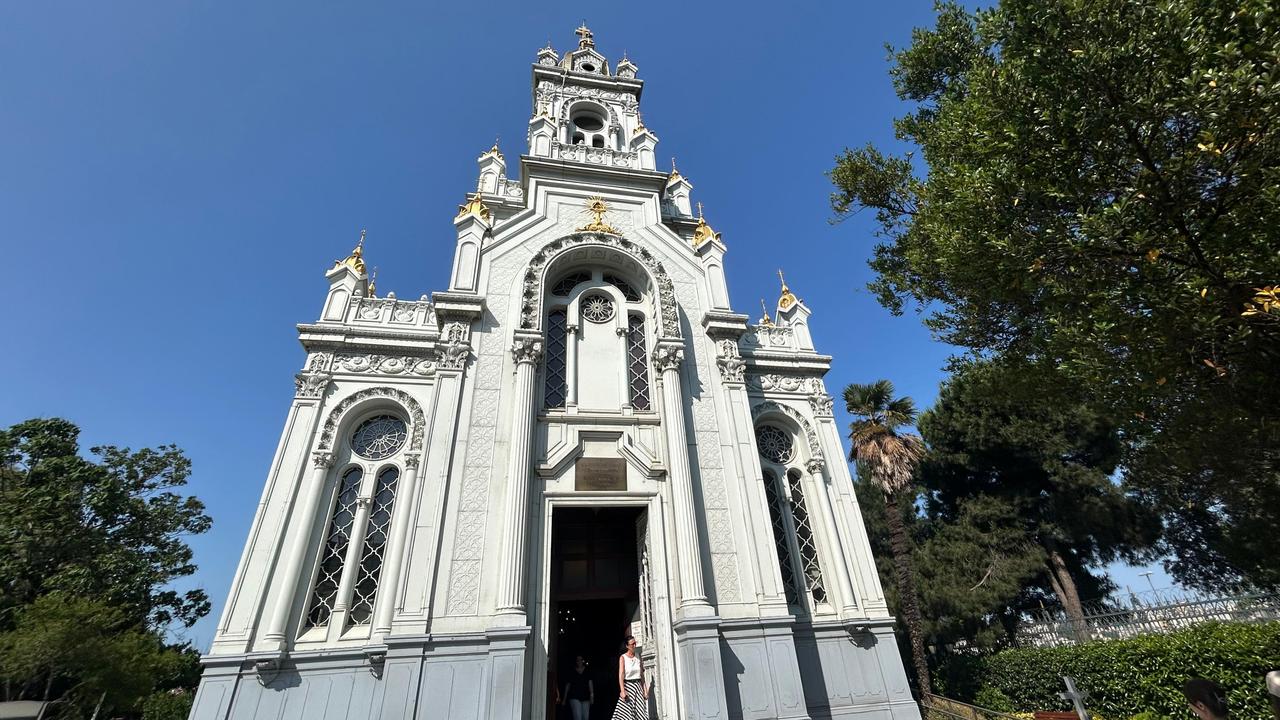
Church of Saint Stefan (Iron Church)
Location | Balat Türkiye Istanbul | ||||||||
|---|---|---|---|---|---|---|---|---|---|
Common Name in Folk Language | Demir Kilise | ||||||||
Religious Affiliation | Bulgarian Orthodox Church | ||||||||
Construction Year | 1892–1898 | ||||||||
Inauguration Ceremony | 1898 | ||||||||
Architect(s) | Hovsep Aznavur | ||||||||
Construction Technique | Prefabricated cast iron components (manufactured in Vienna, assembled in Istanbul) | ||||||||
Stylistic Features | Neogothic, Neobaroque | ||||||||
Sveti Stefan Church is a Bulgarian Orthodox church located on the shore of the Golden Horn in the Balat district of Istanbul, Türkiye. It is one of the world’s few surviving churches constructed entirely of cast iron and is commonly known among the public as the "Iron Church." The building was erected during the Ottoman period in the 19th century as a symbol of the Bulgarian community’s struggle to establish an independent church.

Exterior of the Church (Photo: Duygu Şahinler)
In the 19th century, Bulgarians living within the borders of the Ottoman Empire, though numbering in the tens of thousands, were officially recognized as part of the Rum Orthodox Patriarchate. This arrangement placed them under Greek ecclesiastical authority within the framework of the millet system, resulting in Greek dominance over religious, cultural, and educational institutions such as churches, schools, and cemeteries. Consequently, the Bulgarian community’s demand for an independent church and religious structure emerged as a vital component of their national awakening and identity formation. From the mid-19th century onward, efforts to establish the Bulgarian Exarchate gained momentum, and the idea of constructing an independent Bulgarian church in Istanbul took shape.

View of the Church (Photo: Duygu Şahinler)
The first step was taken when Istefanaki Bey, a prominent Bulgarian merchant of the time, donated his wooden mansion on the Golden Horn shore in Balat to the Bulgarian community for use as a place of worship. This building was converted into a temporary church in 1849. However, it proved symbolically inadequate and, over time, became structurally unsuitable for continued use.
In response to growing demands, a decision was made in the early 1890s to construct a new, permanent church. After the Ottoman authorities recognized the Bulgarian independence movement in ecclesiastical affairs, this new church came to be viewed as a symbol of Bulgarian national presence.
A remarkable feature of the new church’s construction was that it was built entirely from prefabricated cast iron components. This choice was necessitated by the marshy nature of the Golden Horn shoreline, which made it difficult to support a traditional stone foundation. The Viennese firm Rudolf Philipp Waagner manufactured the iron structural elements, which were transported to Istanbul via the Danube River and assembled on-site.
The architect of the building was Hovsep Aznavur, an Armenian born on Ottoman territory. Drawing inspiration from the neogothic and neobaroque architectural trends of the era, Aznavur designed a structure richly adorned with ornamentation intended to embody Bulgarian identity.
Construction began in 1892 and, after approximately six years, the church was inaugurated in 1898 with a grand ceremony. High-ranking representatives from both Bulgaria and the Ottoman Empire attended the opening, which the Bulgarian community regarded as a major triumph. The church also served as the principal representative institution of the Bulgarian Exarchate in Istanbul. During this period, a Metoh Building was also constructed adjacent to the church. This structure housed priests and hosted educational activities, playing a crucial role in fostering social ties between the Bulgarian community and the church.

Statue of Stefan Bogoridi in the Church Garden (Photo: Duygu Şahinler)

Graves in the Church Garden (Photo: Duygu Şahinler)
Sveti Stefan Church is one of the world’s few surviving cast iron religious buildings, making it a rare example in architectural history. This distinctive characteristic is closely linked to both the site’s environmental conditions and the architectural trends of the period.
The marshy soil of the Balat shoreline posed a risk of settlement and structural failure for large-scale buildings constructed with traditional materials such as stone or brick. Therefore, in the 19th century, the emerging European prefabricated iron construction technology was seen as a suitable solution, offering both durability and modernity.
The entire load-bearing system, decorative elements, interior features, and facade cladding of the church were manufactured entirely from cast iron. Each component was produced at the R. Ph. Waagner factory in Vienna and transported to Istanbul via the Danube River. The parts were assembled on a temporary site in Balat and then installed on location. This feature renders the structure almost like a "cast iron Lego construction."
The architect, Hovsep Aznavur, synthesized neogothic and neobaroque influences in the design, reflecting the historicist tendencies prevalent in European architecture of the time. Particularly on the facades, elaborate ornamentation, slender pointed arches, rose windows, gothic vaults, Corinthian columns, and angel motifs contribute to the building’s monumental appearance.

Prayer Niche Inside the Church (Photo: Duygu Şahinler)
The entire exterior facade and roof covering are made of cast iron. This enabled the creation of a composition based on symmetry and rhythm, with a high level of craftsmanship achieved through the precise pre-design and molding of every element. The church’s roof is designed as a barrel vault, rising in harmony with the internal load-bearing columns.

Interior of the Church (Photo: Duygu Şahinler)
The interior of the church follows a three-nave basilical plan. The central nave is higher and wider than the side naves and is covered by a coffered barrel vault. The gallery level extends along the north and south sides and plays an important role in both acoustics and seating capacity during religious ceremonies.
One of the most striking interior features is the iconostasis—a wooden screen richly adorned with iconographic decoration. This section displays icons of prominent figures including St. Stefan, the Virgin Mary, Jesus Christ, and Sts. Cyril and Methodius. Above the Royal Doors, a dove motif symbolizes the Holy Spirit.
Vegetal motifs, angel faces, friezes, egg-and-dart moldings, cornices, and ribbed vaults on walls and ceilings enhance both the structural and aesthetic impact of the building. Details such as the Latin cross, angel heads, and suspended garland motifs appear on column capitals. These decorations are not merely symbolic but also endow the structure with a unique character.

Stained Glass Window on the Upper Level of the Church (Photo: Duygu Şahinler)

Stained Glass Decorations Inside the Church (Photo: Duygu Şahinler)
Despite its iron construction, the church exhibits notable acoustic performance due to the materials used on interior surfaces. However, measurements have revealed that reverberation time (RT) is relatively high, resulting in reduced speech intelligibility in certain areas. To address this, various acoustic improvement interventions have been proposed and implemented, enhancing the building’s suitability for both worship and musical events.
As a significant symbol within Balat’s multicultural fabric, the church has become disconnected from its original context due to urban transformations and infrastructure interventions over time. Once an integral place of worship for the local community, it is now primarily perceived as a tourist monument.
Accessed November 26, 2025.
Eren, İrem. *Sveti Stefan Kilisesi’nin Ayrı İşlevler İçin Akustik Açıdan Değerlendirilmesi ve İyileştirme Önerisi Getirilmesi*. Master's thesis, Yıldız Teknik Üniversitesi Fen Bilimleri Enstitüsü, 2019. Accessed June 15, 2025. https://tez.yok.gov.tr/UlusalTezMerkezi/tezDetay.jsp?id=E0Q_vKIdzH4RVPDJxv_Z6A&no=GJA2E_8J9VboIxpB3Zk-qA
Nas Ahi, Begüm Kübra. *Sveti Stefan Kilisesi’nin Kentsel Koruma İlkeleri Bağlamında İncelenmesi*. Master's thesis, İstanbul Bilgi Üniversitesi Fen Bilimleri Enstitüsü, 2022. Accessed June 15, 2025. https://tez.yok.gov.tr/UlusalTezMerkezi/TezGoster?key=RsTBl6RWK25OBMIKtIgYYcN6J_cBJxiunifws-ySfo8HboNKB-uoUrEJIs2Se2_3
Çiçekliyurt, Gökhan. *İstanbul’da Bağımsız Bir Bulgar Kilisesinin Kurulma Aşaması ve Sveti Stefan Kilisesi*. Master's thesis,Ankara Üniversitesi Institute of Social Sciences, 2020. Accessed June 15, 2025.

Church of Saint Stefan (Iron Church)
Location | Balat Türkiye Istanbul | ||||||||
|---|---|---|---|---|---|---|---|---|---|
Common Name in Folk Language | Demir Kilise | ||||||||
Religious Affiliation | Bulgarian Orthodox Church | ||||||||
Construction Year | 1892–1898 | ||||||||
Inauguration Ceremony | 1898 | ||||||||
Architect(s) | Hovsep Aznavur | ||||||||
Construction Technique | Prefabricated cast iron components (manufactured in Vienna, assembled in Istanbul) | ||||||||
Stylistic Features | Neogothic, Neobaroque | ||||||||
No Discussion Added Yet
Start discussion for "Church of Saint Stefan (Iron Church)" article
History
Architectural Features
Construction Technology and Material Choice
Architectural Style and Design Elements
Interior Layout and Decorative Details
Acoustics and Functional Use
Its Place in the City and Transformation Process