

This article was automatically translated from the original Turkish version.
+1 More
Architectural Feature(s) | Defense Walls Embankments and Towers Multi-story Buildings | ||||||||
|---|---|---|---|---|---|---|---|---|---|
Height(s) | 7.90 m | ||||||||
Type(s) | Historical Defense Structure | ||||||||
Period(s) | Middle Ages | ||||||||
Conservation Status | Currently Preserved Restored | ||||||||
Location | Türkiye Rize Pazar | ||||||||
Significance | Cultural Heritage | ||||||||
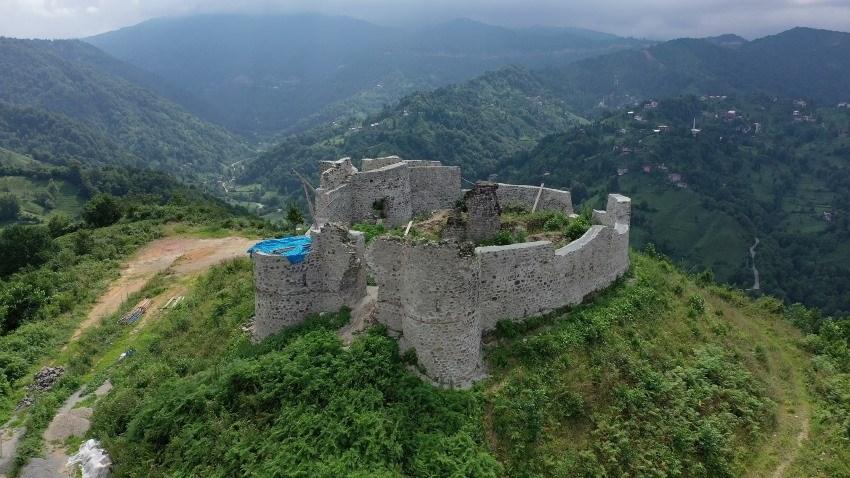
Ciha Castle is a polygonal defensive structure built on a strategic hilltop overlooking the Hemşin Valley, within the boundaries of Şentepe Village in the Pazar district of Rize province. Positioned on terrain approximately 350 meters above sea level, the castle is surrounded by walls and three towers. The structure contains a single-nave chapel and has yielded various artifacts made of stone, metal and fired clay. Lacking an inscription, the structure is dated to the period of the Empire of Trebizond based on its architectural features and constitutes one of the key defensive points in the Eastern Black Sea region.
The region where Ciha Castle stands has attracted the attention of different civilizations throughout history due to its strategic importance. This area, suitable for settlement since the Early Bronze Age, came under the influence of the Cimmerians in the 8th century BCE followed by the Scythians. In the 7th century BCE, the Milesians established a small port here as part of their colonies along the Black Sea coast, and it is believed that the foundations of the castle were laid at this time. The region known as Rhizios briefly came under Persian control and was incorporated into the Pontic Satrapy before passing under the authority of the Kingdom of Pontus. During the reign of Mithridates VI, the region gained strength due to its valuable mineral deposits and strategic location, drawing the attention of the Roman Empire. Following the conflicts between Rome and Pontus, the region became part of Roman territory from the 1st century CE onward, with various fortresses constructed to secure the area. After the division of the Roman Empire in 395, the region became a frontier zone of the Eastern Roman Empire and held strategic importance during prolonged conflicts with the Persians.【1】
With the rapid spread of Islam in the 7th century, Arab forces reached the Black Sea coast and gained control of the region in 646 and 737. During the Fourth Crusade in 1204, the Eastern Roman capital Constantinople was captured by the Latins, after which the Komnenos family established the Empire of Trebizond. During this period, particularly under the rule of Alexios III Komnenos, fortresses in the region were strengthened and construction activities intensified. During the Ottoman period, the region was permanently brought under control; in the 16th century, coastal fortresses gained importance in response to raids by the Abazas and Georgians, and various measures were taken during the reign of Selim II. In the early 20th century, during the Ottoman-Russian wars, the fortresses were restored and used; the region was under Russian occupation from 1916 for two years and became the provincial center of Rize in 1924. This historical trajectory highlights Ciha Castle’s role in both military and regional significance.【2】
Ciha Castle is situated on a strategic hilltop within the boundaries of the Pazar district of Rize province, near Şentepe Village, overlooking the Hemşin Valley and its surroundings. The castle is located on a summit approximately 350 meters above sea level and positioned as part of the region’s natural defensive line. A gate on the northeast side of the castle is flanked by two semicircular towers. A rectangular tower on the south side reinforces the castle’s defensive system. The curtain walls encircle the hilltop with variable heights. The southern sections of the walls are the best-preserved in terms of original height, reaching approximately 7.90 meters.【3】 The plan of the castle includes small openings between the towers and walls for observation and defense purposes; these openings are circular, square or rectangular in shape and serve different functions.
The interior area of the castle covers approximately 640 m² and exhibits an irregular polygonal plan adapted to the sloping terrain.【4】 Architectural elements associated with the gate and walls on the western side have been identified; these likely served as supports for wooden structures. The mazgal windows in the north and south towers were positioned to illuminate the interior and serve defensive functions. The upper part of the southern tower features a floor arrangement supported by wooden beams, reinforcing its tower function. These arrangements reflect the castle’s strategic location and its defensive design adapted to the sloping terrain.
Ciha Castle is a structure that integrates elements characteristic of the military and defensive architecture of its period. The castle is enclosed by rectangular outer walls with towers positioned at the corners for structural support. The walls were constructed with varying thicknesses to ensure both defense and structural durability, designed to withstand enemy attacks in terms of height and width. The castle includes parapets, observation towers and passageways for surveillance and defense. Within the inner courtyard, areas and corridors were arranged to meet daily operational and logistical needs, planned in harmony with the outer defenses. This holistic approach reflects both the military functionality and the architectural understanding of the period.
The chapel within Ciha Castle was designed to meet the religious and ritual needs of its inhabitants. The rectangular space features a simple interior layout illuminated by narrow window openings that allow natural light to enter. The walls were constructed in accordance with the general stone masonry system of the structure, with a simple altar and worship area established inside. The chapel functioned as a space for daily religious practices by both soldiers and residents of the castle.
In addition to the chapel, various interior structures within the castle were arranged to meet living and logistical needs. These include quarters for soldiers, storage areas, cisterns for water supply and connecting corridors. The rooms were planned in alignment with defensive requirements, connected by narrow passageways and positioned to ensure easy access to essential areas. These internal arrangements reflect an architectural approach that enhanced the castle’s functionality both strategically and for daily use.
Ciha Castle was primarily constructed using local stone materials. Large stone blocks were systematically stacked to ensure durability and longevity. Traditional mortar was used as a binding agent between stones, with particular attention paid to enhancing resistance against weather conditions on the exterior facades. In certain sections of the structure, wooden beams and flooring were also employed to provide structural support and connections between levels.
The construction technique was planned to meet both defensive and functional requirements. Wall thicknesses were increased at strategically important points, with additional reinforcements applied at corners and entrances. Structures such as cisterns and storage areas were designed to ensure water and food supply, with stone and mortar combinations providing watertight integrity. This technical approach enabled the castle’s durability and long-term usability.
Archaeological excavations at Ciha Castle have yielded various artifacts shedding light on its period of use. These include ceramic fragments used in daily life, tools made of iron and bronze, and small metal objects. Additionally, pottery and lid fragments found in different areas of the castle help to understand its function as well as the settlement and storage practices of the period. The artifacts indicate that the castle was used for both military and civilian purposes, reinforcing its historical context.【5】
Ciha Castle has undergone various restoration efforts over different periods to preserve its historical and cultural value. Due to natural erosion, climatic conditions and human-induced impacts, the castle has partially lost its structural integrity. Restoration activities have generally aimed to preserve the castle’s original architectural form and stabilize the existing structure. In this context, walls have been reinforced, some collapsed sections have been reconstructed using original materials, and roofs have been repaired.

Restoration Works at Ciha Castle (Rize Provincial Special Administration of the Republic of Türkiye)
In addition, drainage systems and water runoff channels have been improved during conservation efforts to enhance the castle’s resistance to environmental factors. Throughout the restoration process, scientific and archaeological data have been carefully considered to avoid damage to the castle’s historical fabric, and every intervention has been meticulously documented. These efforts ensure the castle’s transmission to future generations and its safe accessibility for visitors.
Culture Portal. "Ciha Kalesi." Culture Portal, Ministry of Culture and Tourism of the Republic of Türkiye. Accessed February 9, 2026. https://www.kulturportali.gov.tr/turkiye/rize/gezilecekyer/ciha-kalesi
Karadeniz Bölgesi Kalkınma Programı (DOKAP). "Ciha Kalesi." *Doğu Karadeniz Kültür Envanteri Projesi*. Accessed February 9, 2026. https://karadeniz.gov.tr/ciha-kalesi/
Mimiroğlu, İlker Mete. “Doğu Karadeniz’de Bir Bizans Karakolu Ciha (Cihar, Kise) Kalesi.” *Selçuklu Medeniyeti Araştırmaları Dergisi*, no. 8 (December 2023): 96–111. Accessed February 9, 2026. https://dergipark.org.tr/tr/pub/sema/article/1369407
T.C. Ministry of Culture and Tourism,Rize İl Directorate of Culture and Tourism. "Kaleler." *Rize Provincial Directorate of Culture and Tourism Official Website*. Accessed February 9, 2026. https://rize.ktb.gov.tr/TR-127865/kaleler.html
T.C. Rize Provincial Special Administration. "Tarihi Ciha Kalesinin Restorasyon Çalışmalarında Sona Gelindi." Rize İl Özel İdaresi Resmî Web Sitesi. Accessed February 9, 2026. https://www.rizeozelidare.gov.tr/tarihi-ciha-kalesinin-restorasyon-calismalarinda-sona-gelindi
T.C. Rize Valiliği. “Vali Çeber, Ciha Kalesinde İncelemelerde Bulundu.” Rize Valiliği Resmî Web Sitesi. Accessed February 9, 2026.
[1]
İlker Mete Mimiroğlu, “Doğu Karadeniz’de Bir Bizans Karakolu Ciha (Cihar, Kise) Kalesi,” Selçuklu Medeniyeti Araştırmaları Dergisi 8 (2023): 97–98, Son Erişim: 9 Şubat 2026, https://dergipark.org.tr/tr/pub/sema/article/1369407
[2]
A.e.,
[3]
A.e., syf. 100
[4]
A.e., syf. 98
[5]
A.e., syf. 104-105

Architectural Feature(s) | Defense Walls Embankments and Towers Multi-story Buildings | ||||||||
|---|---|---|---|---|---|---|---|---|---|
Height(s) | 7.90 m | ||||||||
Type(s) | Historical Defense Structure | ||||||||
Period(s) | Middle Ages | ||||||||
Conservation Status | Currently Preserved Restored | ||||||||
Location | Türkiye Rize Pazar | ||||||||
Significance | Cultural Heritage | ||||||||
Historical Development
Location and Plan Features
Architectural Features
Chapel and Interior Structures
Materials and Construction Techniques
Artifacts
Conservation and Restoration Status