


This article was automatically translated from the original Turkish version.
Çınarlar Camii is located in the city center of Giresun, Türkiye, in Çınarlar Mahallesi, Çınar Sokak. It was officially registered as a "Cultural Asset Requiring Protection" by the High Council for Immovable Cultural and Natural Heritage of the Ministry of Culture and Tourism on 14 February 1986 with decision number 1917 and is under state protection. Due to its central location, it is easily accessible by foot and vehicle.
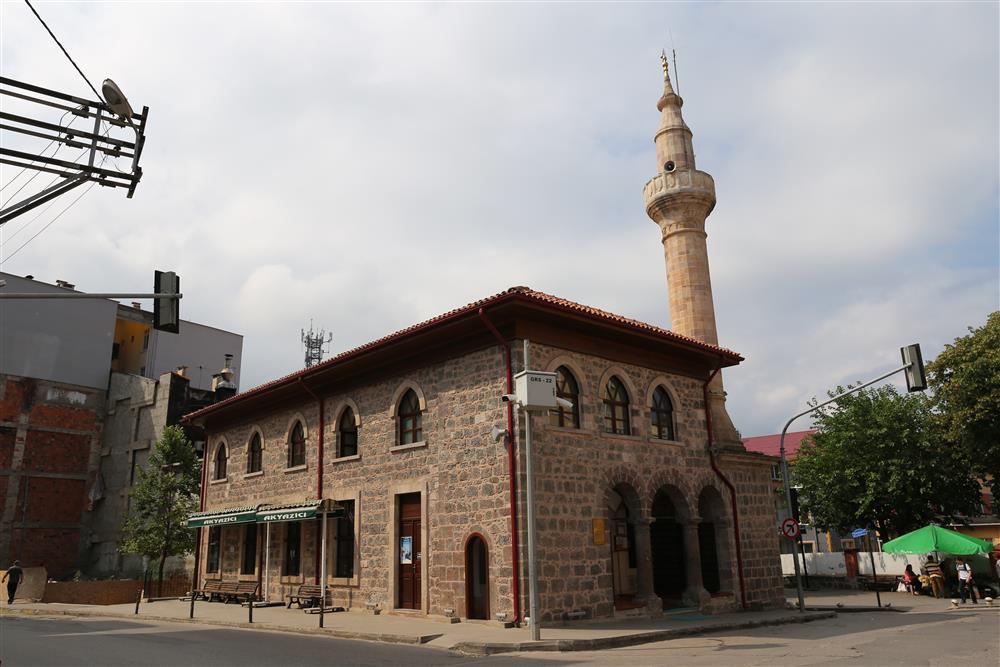
Çınarlar Camii (Giresun Provincial Directorate of Culture and Tourism)
Construction of the mosque began in 1888. The structure, built simultaneously with the Seydi Vakkas Türbesi, was opened for worship in 1896. The project was led by Hacı Vehbizâde Ali Ağa, a local notable. The original main dome collapsed during the earthquake of 1939, after which a flat tiled roof was installed in its place. The damaged structure was subsequently rebuilt by Sarıalemdarzâde Ahmet Efendi and Feridunzâde Hasan Muharrem Efendi. Partial repairs were carried out in 1996.
Comprehensive restoration work, initiated in 2015 and completed in 2016, included reinforcement of the roof, replacement of wooden ceilings and flooring, complete removal of interior plaster and re-plastering with horasan mortar, and removal of exterior plaster to reveal the original stone surfaces. Cleaning of the minaret and façade was also conducted as part of this restoration. The restoration, funded by the Trabzon Directorates of Foundations with a budget of 560,000 Turkish Liras, was inaugurated on 22 April 2016 in a ceremony attended by Giresun Governor Hasan Karahan.
Çınarlar Camii is constructed using a load-bearing masonry system with a rectangular longitudinal plan measuring 16 by 10 meters. Ashlar basalt stone is used for the main walls, while cut andesite stone is preferred for door and window surrounds. The roof structure, visible externally, is a four-sided gabled roof covered with tiles; internally, it is covered with a flat wooden ceiling.
The northern façade is the most prominent among all elevations; it contains the last congregation area, which is divided into three sections by three round arches supported by two stone columns. Above the last congregation area, three pointed-arch windows open onto the gallery. A double-leaf wooden door with a flat arch provides access to the women’s section from this area.
The eastern façade features four windows on the lower level and five on the upper level. A second entrance door is located on the northern side of this façade. The southern façade has two windows on the lower level and three on the upper level. The western façade contains doors and windows opening to the basement level as well as windows for the women’s section.
Windows are arranged differently on each façade: the lower row consists of rectangular openings, while the upper row features pointed or horseshoe arches. All windows are internally framed with mazgal detailing.
The mosque comprises the main prayer hall, the women’s gallery, and the last congregation area. The ceiling of the main prayer hall is ribbed in form. Access to the women’s gallery is via a single-flight staircase located to the east of the main hall. The mihrab is rectangular in shape and constructed of cut stone; it is flanked by columns and features stepped moldings. The inscription panel of the mihrab contains a sülüs script verse from Surah Al-i Imran, verse 37: “Küllema dehale aleyha Zekeriyye'l- Mihrab 1361-1942”. Above this section, on a voluted pediment, the phrase “Kelime-i Tevhid” is inscribed.
The minbar is made of plain wood and was added later. The pulpit for sermons was also constructed later from the same material. The last congregation area is divided into three sections: the central part is covered by a dome, while the side sections are covered by diagonal vaults. The entrance is framed by round arches supported by two stone columns resting on a rectangular base.
The basement level is used as a place of worship. Its entrance door, located on the southern façade, is a single-leaf rectangular iron door with three rectangular windows.
A single-balconied minaret made of stone stands at the northwestern corner of the mosque. It was constructed with stone masonry to harmonize with the architectural style of the façade.
Çınarlar Camii is a simple and functional structure that reflects Giresun’s stone craftsmanship and regional architecture. It is particularly notable for the triple-arch arrangement in the last congregation area and the cut-stone mihrab. The arrangement of windows in both interior and exterior spaces presents significant architectural features that enhance both aesthetic appeal and functional efficiency.
Located in the center of Giresun and possessing a distinct historical identity, the mosque is an important site for faith-based cultural tourism. Its designation for protection in 1986 underscores the importance of preserving its historical and architectural values.
The mosque, situated in Çınarlar Mahallesi in the city center of Giresun, is easily accessible by both foot and vehicle.

History
Architectural Features
Interior Layout
Minaret
Artistic and Architectural Significance
Cultural and Touristic Value
Access
