


This article was automatically translated from the original Turkish version.
+2 More
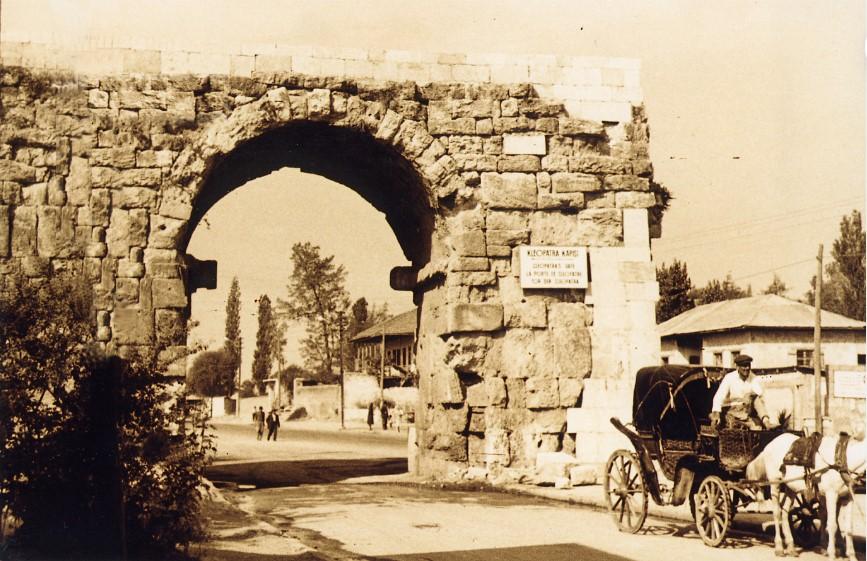
Republic of Türkiye, Tarsus District Governorate. "Cleopatra Gate (Sea Gate)." Accessed June 19, 2025. http://www.tarsus.gov.tr/kleopatra-kapisi.
Location | Tarsus Türkiye Mersin | ||||||||
|---|---|---|---|---|---|---|---|---|---|
Period(s) | Late Byzantine Period / Abbasid Period | ||||||||
Other Name(s) | Pier Gate Sea Gate | ||||||||
Material(s) | Cut stone Horasan mortar | ||||||||
Architectural Feature(s) | Single-arch width 5.60 m height 6.17–8.50 m horseshoe-shaped arch | ||||||||
Historical Significance | Meeting gate of Cleopatra and Marcus Antonius | ||||||||
The Kleopatra Gate is the only remaining structure among the three gates of the Byzantine-era city walls of Tarsus, originally known as the Sea Gate. The city walls included the Mountain Gate, Adana Gate, and Sea Gate. The gate was constructed using Horasan mortar and cut stone. The passage consists of a single horseshoe-shaped arch, with its height from ground level ranging between 6.17 and 8.50 metres and its depth approximately 6.18 metres. The width of the gate is reported to be about 5.60 metres. In the city with its double concentric wall system, the gates were closed during times of war.

Kleopatra Gate (T.C. Tarsus District Governorship)
Research on the construction period of the Kleopatra Gate, based on the materials used and architectural features, indicates that it dates to the late Byzantine period or the Abbasid era. Evidence also suggests that a different gate previously stood at this location. The triple-gated walls, which remained intact until the end of the 18th century, were demolished in 1835 by Egyptian commander Ibrahim Pasha, leaving only the single-arched, two-legged Sea Gate standing.

Kleopatra Gate (T.C. Tarsus District Governorship)
According to historical sources and local narratives, the meeting between Queen Cleopatra of Egypt and the Roman general Marcus Antonius in Tarsus gave rise to the alternative name “Kleopatra Gate” for the Sea Gate. In Evliya Çelebi’s Seyahatname, the gate is referred to as “İskele Gate.” Cleopatra and Marcus Antonius were welcomed with a grand ceremony at the Gözlü Kule, the ancient port of Tarsus, and entered the city through the Sea Gate. Marcus Antonius’s entry into Anatolia is associated with the formation of the Triumvirate following the assassination of Julius Caesar in 44 BC.
The original structure of the Kleopatra Gate was partially destroyed and replaced with a new gate built using repurposed stones. Today, the gate is presented to visitors with historical information. However, restoration efforts have altered its original appearance. The gate, now the sole surviving entrance of ancient Tarsus, is located in the city center along Mersin Street on a spacious site.
Accessed November 26, 2025.
T.C.Tarsus Kaymakamlığı Governorship. "Kleopatra Kapısı (Deniz Kapısı)." Accessed June 19, 2025. http://www.tarsus.gov.tr/kleopatra-kapisi.
Türkiye Kültür Portalı. "Kleopatra Kapısı - Mersin." Accessed June 19, 2025.

Republic of Türkiye, Tarsus District Governorate. "Cleopatra Gate (Sea Gate)." Accessed June 19, 2025. http://www.tarsus.gov.tr/kleopatra-kapisi.
Location | Tarsus Türkiye Mersin | ||||||||
|---|---|---|---|---|---|---|---|---|---|
Period(s) | Late Byzantine Period / Abbasid Period | ||||||||
Other Name(s) | Pier Gate Sea Gate | ||||||||
Material(s) | Cut stone Horasan mortar | ||||||||
Architectural Feature(s) | Single-arch width 5.60 m height 6.17–8.50 m horseshoe-shaped arch | ||||||||
Historical Significance | Meeting gate of Cleopatra and Marcus Antonius | ||||||||
Historical Period and Construction Date
Kleopatra and Marcus Antonius
Current Condition and Restorations