


This article was automatically translated from the original Turkish version.
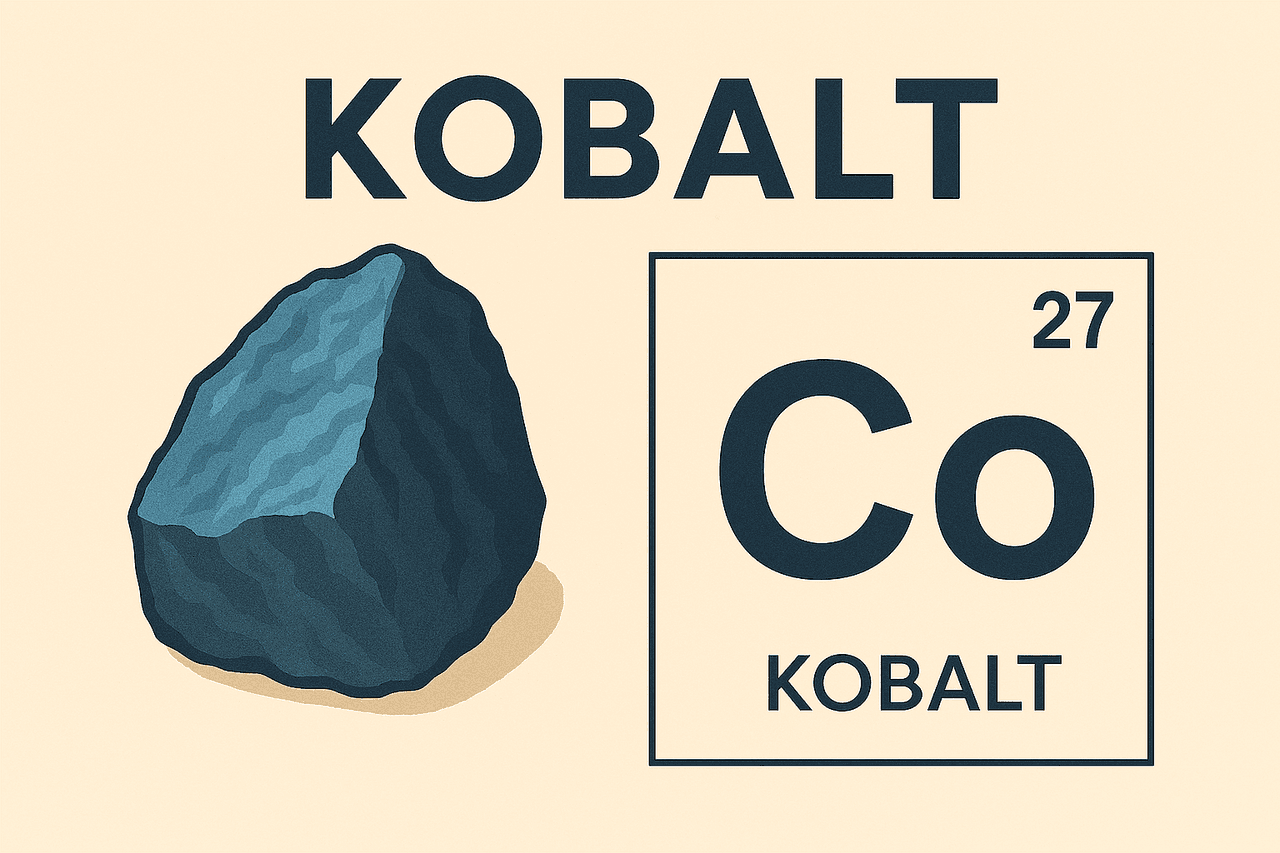
Cobalt (Co) (Generated by Artificial Intelligence.)
Atomic Mass | 58.933 u | ||||||||
|---|---|---|---|---|---|---|---|---|---|
Periodic Group / Period | Group 9 / Period 4 | ||||||||
Element Class | Transition metal | ||||||||
Physical State (25 °C) | Solid | ||||||||
Electron Configuration | [Ar] 3d⁷ 4s² | ||||||||
Electronegativity (Pauling) | 1.88 | ||||||||
Melting Point | 1495 °C | ||||||||
Boiling Point | 2927 °C | ||||||||
Density | 8.86 g/cm³ | ||||||||
Cobalt is a transition metal with atomic number 27 located in group 9 and period 4 of the periodic table. Historically used as a blue pigment in glass and ceramics, this element is now widely utilized across a broad spectrum of applications ranging from energy technologies to biomedical uses. Due to its physical durability, magnetic properties, and biological functions, cobalt holds a strategic position both industrially and scientifically.
Cobalt was discovered in the 18th century by the Swedish chemist Georg Brandt. Brandt was the first to identify the element and scientifically demonstrate its metallic properties. The name cobalt is derived from the German word kobald, meaning "goblin".【1】 This naming was linked to the difficulties encountered in mining and the toxic gases released during the processing of ores. Cobalt ores were previously mistaken for silver deposits but were regarded as "goblin stones" due to their undesirable effects.
Cobalt belongs to the class of transition metals and has the chemical symbol "Co". With an atomic number of 27, its electron configuration is [Ar] 3d⁷ 4s². At room temperature, cobalt exists as a solid and is positioned in group 9 and period 4 of the periodic table. Its atomic mass is approximately 58.933 u. These fundamental properties determine both its physical and chemical behavior.
Cobalt is a hard, silvery-blue, ferromagnetic metal. Its density is 8.86 g/cm³ and its atomic radius is approximately 2.00 Å. The melting point is 1495 °C and the boiling point is 2927 °C. This high-temperature resistance makes it an ideal component in superalloys and high-performance engineering applications. Its resistance to corrosion makes it preferred in coating technologies. Cobalt compounds, particularly in the glass and ceramic industries, are used as blue pigments.
The electronegativity of cobalt is 1.88 on the Pauling scale. Its electron affinity is 63.873 kJ/mol. These values determine cobalt’s tendency to form bonds with other elements and its potential for chemical reactions. Like iron, cobalt can be magnetized and is widely used in magnet production. Its resistance to oxidation also renders it resistant to environmental degradation.
The only stable isotope found in nature is ⁵⁹Co. Another isotope, ⁶⁰Co, is radioactive and is used in medical and industrial applications due to its gamma-ray emission. ⁶⁰Co is especially preferred in radiotherapy devices and food sterilization systems. The controlled use of this isotope is critically important for health and safety.
Cobalt does not occur freely in nature; it is typically found in association with nickel and copper ores. The most common cobalt minerals include cobaltite (CoAsS), erythrite (Co₃(AsO₄)₂·8H₂O), and skutterudite (CoAs₃). Trace amounts of cobalt are also found in iron-manganese nodules on the ocean floor. In Türkiye, cobalt-bearing ores have been identified primarily in the Eastern Black Sea and Southeastern Anatolia regions. According to data from the General Directorate of Mineral Research and Exploration (MTA), while domestic cobalt production is limited, potential resources exist.
Cobalt is the central atom in the vitamin B12 (cobalamin) molecule and is therefore essential for life. Vitamin B12 is required for proper nervous system function and red blood cell production. The human body contains approximately 1 mg of cobalt. Deficiency can lead to anemia and neurological disorders. In animal husbandry, cobalt salts are added to feed to correct mineral deficiencies. This practice is particularly important for the healthy development of ruminant animals.
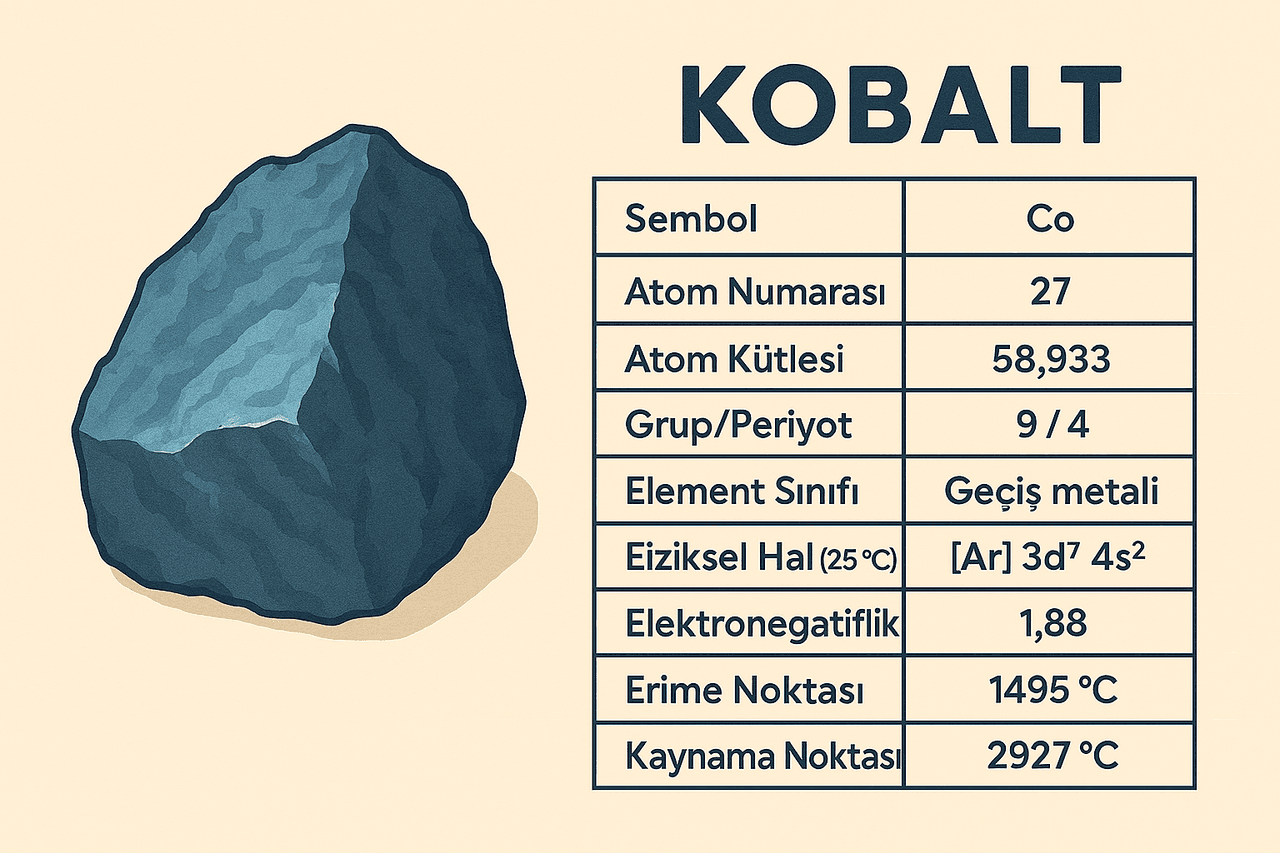
Cobalt Element (generated by artificial intelligence.)
Cobalt is used in a wide range of industrial applications. In the production of superalloys, it is preferred for its high-temperature resistance, especially in jet engines and gas turbines. Alloys formed with aluminum and nickel are used to produce strong magnets. Cobalt coatings provide resistance to corrosion. For centuries, cobalt has been used as a blue pigment in glass, porcelain, and ceramics. The isotope ⁶⁰Co plays a critical role in nuclear applications such as radiotherapy and food sterilization. Additionally, cobalt is regarded as a strategic metal in electric vehicle batteries and energy storage systems.
MTA. "KOBALT." Maden Tetkik ve Arama Genel Müdürlüğü. Accessed August 16, 2025. https://www.mta.gov.tr/v3.0/metalik-madenler/kobalt
National Center for Biotechnology Information. “Cobalt.” *PubChem.* Accessed August 16, 2025. https://pubchem.ncbi.nlm.nih.gov/compound/cobalt
TÜBİTAK Bilim Genç. "Kobalt." *Bilim Genç.* Accessed August 16, 2025. https://bilimgenc.tubitak.gov.tr/periyodik-tablo/kobalt
Yaylalı, Banu, Ersin Y. Yazıcı, Oktay Celep, and Hacı Deveci. “KRİTİK METAL KONUMUNDAKİ KOBALTIN BİRİNCİL VE İKİNCİL KAYNAKLARDAN ÜRETİMİ”. Bilimsel Madencilik Dergisi 59, no. 1 (2020): 35-50. Accessed August 16, 2025. https://dergipark.org.tr/tr/pub/madencilik/issue/53216/706490
İstanbul Maden İhracatçıları Birliği. *Kobalt Yataklarının Durumu, İşletmeciliği ve Geleceği.* İMİB. Accessed August 16, 2025. https://www.imib.org.tr/wp-content/uploads/kobalt.pdf
[1]
TÜBİTAK Bilim Genç, “Kobalt,” Bilim Genç, erişim tarihi 16 Ağustos 2025, https://bilimgenc.tubitak.gov.tr/periyodik-tablo/kobalt

Cobalt (Co) (Generated by Artificial Intelligence.)
Atomic Mass | 58.933 u | ||||||||
|---|---|---|---|---|---|---|---|---|---|
Periodic Group / Period | Group 9 / Period 4 | ||||||||
Element Class | Transition metal | ||||||||
Physical State (25 °C) | Solid | ||||||||
Electron Configuration | [Ar] 3d⁷ 4s² | ||||||||
Electronegativity (Pauling) | 1.88 | ||||||||
Melting Point | 1495 °C | ||||||||
Boiling Point | 2927 °C | ||||||||
Density | 8.86 g/cm³ | ||||||||
Historical Discovery and Nomenclature
Classification and Fundamental Atomic Properties
Physical and Chemical Properties
Electronegativity and Chemical Reactivity
Isotopes and Nuclear Applications
Occurrence in Nature and Ores
Biological Role and Importance to Living Organisms
Industrial and Technological Applications