This article was automatically translated from the original Turkish version.
Type of Geographical İndication | Origin Name | ||||||||
|---|---|---|---|---|---|---|---|---|---|
Registration Number | 1635 | ||||||||
Registration Date | 02.09.2024 | ||||||||
Product / Product Group(s) | Processed and unprocessed fruits vegetables and mushrooms | ||||||||
Province(s) | Balıkesir | ||||||||
Applicant/Registrant(s) | Bandırma Chamber of Commerce | ||||||||
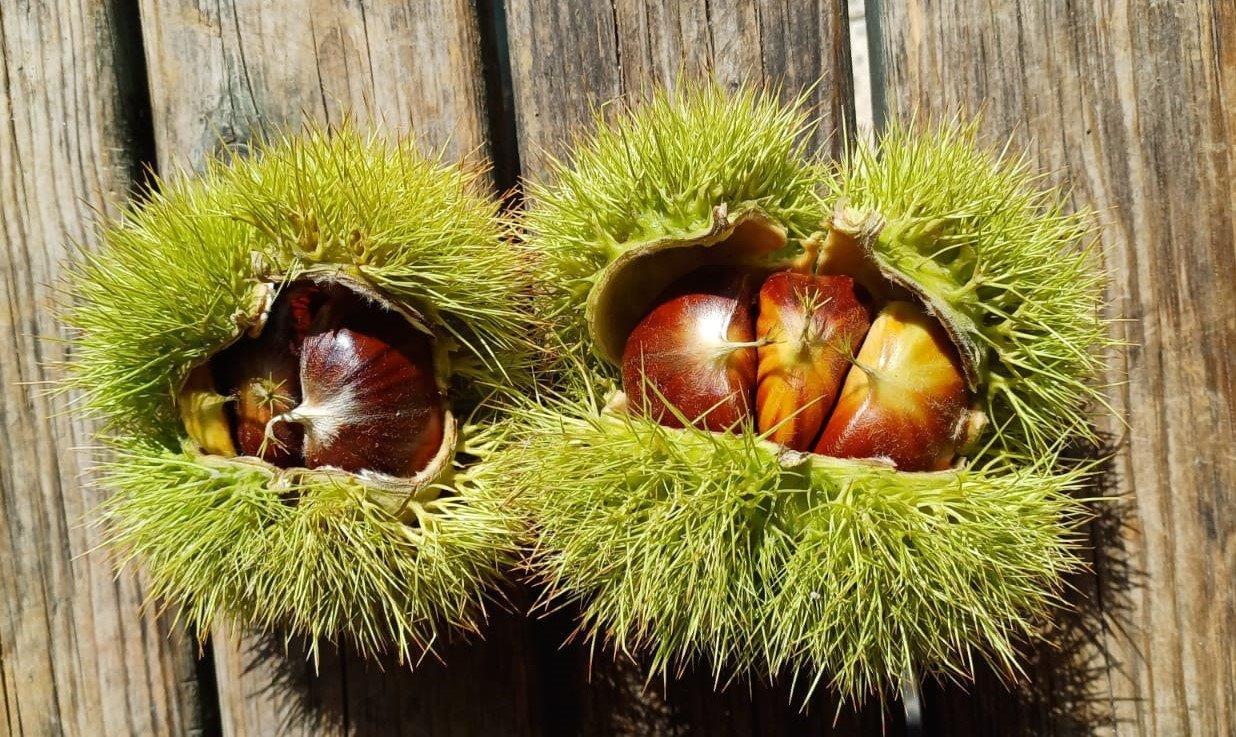
Çakıl Chestnut is a local fruit derived from the Osmanoğlu variety of the Castanea sativa Mill. species, which grows naturally within the boundaries of the Bandırma district in Balıkesir Province, Türkiye. Named after Çakıl Village, where it was first cultivated, this product was officially registered as a geographical indication on 2 September 2024 and is now protected under geographical indication status.
Çakıl Chestnut thrives in Bandırma at elevations between 250 and 550 meters, primarily on southern slopes and within moist valley interiors. The region lies at the intersection of the Mediterranean and Black Sea climate zones; annual rainfall exceeds 600 mm, and drought periods are typically short. Proximity to the Sea of Marmara ensures consistent humidity. These microclimatic conditions positively influence the yield and chemical composition of the Çakıl Chestnut. Trees growing on southern slopes produce at least 10% higher yields compared to those on northern slopes.
Çakıl Chestnut is recognized by its medium-sized, broad, and oval-shaped fruits. The outer shell is glossy brown and of medium thickness. The flesh is cream-colored, shiny, and soft. Its low ratio of reducing sugars to total sugars makes the fruit ideal for fresh consumption and roasting. Although the inner membrane is difficult to remove, the sucrose content is at least 35 g/L. One of the volatile aroma components, a derivative of 2H-benzocyclohepten-2-one, is present at levels exceeding 30%.
The fruit dimensions range from 15–35 mm in height, 24–34 mm in length, and 35–49 mm in width. Weight varies between 15 and 30 grams. The roundness index is between 1 and 2, and the dry matter content ranges from 40% to 55%.
Çakıl Chestnut is harvested from Castanea sativa trees grafted with the Osmanoğlu variety. Grafting is performed between late March and early April. Cuttings are taken from the previous year’s shoots and applied to the trunk in April. The earliest harvest can be obtained five years after grafting.
Soils for orchards must be loose, well-aerated, deep, rich in potassium, and low in lime content. A minimum spacing of 7 meters is maintained during planting. Irrigation is recommended during dry years between June and September. Fertilization is carried out in March using nitrate-based fertilizers, applying 100 grams per tree per year of age.
Pruning is conducted to develop a broad, open canopy. Unproductive branches and excessive shoots are removed annually. During the fruiting period, yield-pruning is applied.
Harvesting occurs between September and October, when the spiny burrs open and the fruits fall naturally. Collected fruits are stored in bags or crates suitable for food contact. The product is typically consumed fresh or used in chestnut sugar production. When storage is required, the fruits can be preserved for 3–4 months in cold storage at temperatures of 0–2 °C and relative humidity of 80–90%.
The production and marketing processes of Çakıl Chestnut are monitored by a control authority established under the coordination of the Bandırma Chamber of Commerce. This authority comprises representatives from the Bandırma Forest Management Directorate, the Bandırma Commodity Exchange, and the Bandırma Agricultural Chamber. Inspections are conducted annually during the harvest season as routine procedures, and may also be carried out at any time upon request or complaint.
Inspection criteria include compliance with production methods, control of physical and chemical properties, use of the geographical indication emblem on packaging, and, when necessary, analysis of aroma and sugar composition.
Turk Patent and Trademark Office. "Çakıl Kestanesi Coğrafi İşaret Tescil Belgesi." Coğrafi İşaretler Portalı. Accessed October 19, 2025. https://ci.turkpatent.gov.tr/Files/GeographicalSigns/965f9fc0-6b1d-4808-90d1-f33f90d85d40.pdf.
Turk Patent and Trademark Office. "Çakıl Kestanesi." *Coğrafi İşaretler Portalı.* Accessed October 19, 2025. https://ci.turkpatent.gov.tr/cografi-isaretler/detay/10283.

Type of Geographical İndication | Origin Name | ||||||||
|---|---|---|---|---|---|---|---|---|---|
Registration Number | 1635 | ||||||||
Registration Date | 02.09.2024 | ||||||||
Product / Product Group(s) | Processed and unprocessed fruits vegetables and mushrooms | ||||||||
Province(s) | Balıkesir | ||||||||
Applicant/Registrant(s) | Bandırma Chamber of Commerce | ||||||||
No Discussion Added Yet
Start discussion for "Cobblestone Chestnut" article
Ecological and Geographic Conditions
Distinctive Characteristics
Production Method
Harvest and Storage
Monitoring