


This article was automatically translated from the original Turkish version.
+2 More
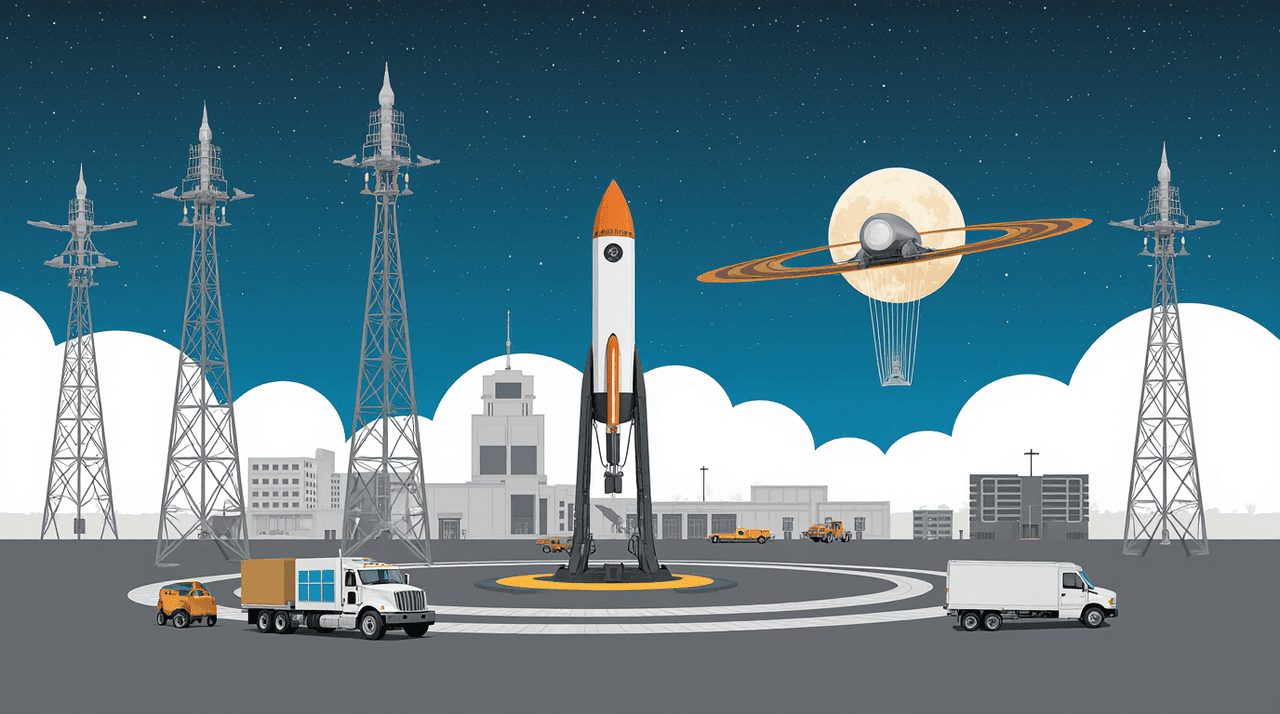
Commercial Space Transportation (Generated by Artificial Intelligence)
Scope(s) | Cargo and Satellite Transportation Spaceport Operations and Airspace Integration Suborbital Passenger Transportation Reusable Rocket Systems | ||||||||
|---|---|---|---|---|---|---|---|---|---|
Main Actors | Private Space Initiatives (e.g. Companies Developing Reusable Systems), Government Institutions, State and Local Authorities, International Regulatory Bodies | ||||||||
Technological Focus | Reusable Carrier Systems, Automated Flight Control, Hypersonic Transportation Concepts and Digital Air Traffic Integration | ||||||||
Future Trends | Hypersonic Passenger Transportation, Digital Air-Space Traffic Management, Low-Cost Launch Systems and Sustainable Orbital Logistics Solutions | ||||||||
Commercial space transportation refers to the diversification of access to space beyond state monopolies through private sector participation. This concept encompasses the commercial execution of launch, re-entry, and orbital operations, including the transport of cargo and passengers. The sector’s growth has accelerated due to technological advancements, cost reductions, and the adoption of reusable launch systems. The commercialization of space transportation has brought about a transformative process on both industrial and strategic levels globally.
Space transportation activities have become a global industry in recent years, driven by increasing private initiatives and public-private partnerships. Orbital cargo and satellite delivery services have begun to be conducted more regularly and cost-effectively through the development of reusable systems. This trend, alongside other components of the space economy, has created a new supply chain. Production, launch, and maintenance processes have transformed into an ecosystem involving actors from different countries and sectors, rather than being confined to a single institution.
Alongside the sector’s expansion, the number of private investments and initiatives has also increased. Growth in capital flow now encompasses not only launch services but also orbital logistics, maintenance, refueling infrastructure, and reuse systems. This structure has produced an economic model that integrates government-supported projects with innovative solutions from the private sector.
One of the most prominent features in the development of commercial space transportation has been the establishment of next-generation spaceports. Traditionally constructed by state institutions, launch facilities have gradually diversified through the involvement of private enterprises and local authorities. Today, many spaceports are managed through public-private partnerships, with maintenance, operations, and security processes carried out within a multi-layered organizational structure.
Launch sites are no longer limited to state bases. Commercial firms are building their own facilities or adapting existing airport infrastructure to accommodate spacecraft operations. This approach enables the simultaneous implementation of different operational modes, such as vertical takeoff and horizontal landing. As a result, space transportation has evolved into an integrated transportation model linked with aviation infrastructure.
The increasing scale of commercial space transportation activities has necessitated the restructuring of regulatory bodies at both national and international levels. Within this context, licensing, safety inspections, and airspace coordination procedures have been redefined. New governance models have been developed for areas where space activities intersect with air traffic.
The regulatory framework covers not only launch and re-entry operations but also their impacts on civil aviation. Temporary airspace restrictions are imposed during launches, and coordinated safety measures are applied during re-entries in alignment with air traffic management. These practices aim to safeguard civil aviation safety while ensuring the continuity of space transportation operations.
The sustainability of commercial space transportation is directly linked to the efficient management of airspace. The interaction between spacecraft and civil air traffic during launch and re-entry phases has created a new domain for air traffic management. In this context, information-sharing systems have been developed to enable real-time tracking of spacecraft trajectories and coordinated management with air traffic control.
Within this integration process, predictable flight planning and the dynamic identification of risk zones are fundamental principles. The systems developed aim to allow both spacecraft and conventional aircraft to safely share the same airspace. This approach provides the infrastructure necessary for future transitions to high-speed air-space transportation models such as suborbital passenger transport.
New-generation transportation systems are focused on reusability, automation, and safe landing technologies. The goal of these systems is to reduce launch costs and accelerate mission cycles. Reusable rocket systems have made space access more sustainable by enabling the safe return of rocket first stages to Earth.
Parallel to this, research into high-altitude transportation and hypersonic flight technologies indicates that intercontinental passenger transport in the future may be achieved through space-based systems. These systems represent hybrid transportation models designed to cover long distances in very short times by utilizing brief transitional phases within the upper atmosphere.
The space transportation industry aims not only to generate economic gains but also to enhance national strategic capacity. This field occupies a critical position by supporting infrastructure in diverse sectors such as national security, communications, scientific research, and climate observation. Consequently, commercial space transportation plays a decisive role not only in technological innovation but also in economic independence and global competitiveness.
This structure, where public investments, international collaborations, and private initiatives operate in concert, represents a new high-tech dimension of the global economic system. Space transportation lies at the center of an industrial transformation process that integrates sustainable energy, materials science, and artificial intelligence applications.
Commercial space transportation has evolved beyond state-led space programs into a multi-actor industry. Technological innovation, infrastructure diversity, and regulatory alignment efforts demonstrate that this field will become an inseparable component of future global transportation systems. Its sustainability will be enabled through the international harmonization of safety standards, the widespread adoption of digital solutions in airspace management, and the strengthening of public-private partnerships. Thus, space transportation will not merely remain a scientific endeavor but will be positioned as a fundamental component of the global economic and logistical network.
Bureau of Transportation Statistics (U.S. Government Accountability Office). *Commercial Space Transportation: Improvements to FAA’s Workforce Planning Needed to Prepare for the Industry’s Anticipated Growth.* GAO-19-437. May 2019. Accessed November 1, 2025. https://www.gao.gov/assets/gao-19-437.pdf.
European Space Agency (ESA). *Report on the Space Economy 2024.* Accessed November 1, 2025. https://space-economy.esa.int/documents/b61btvmeaf6Tz2osXPu712bL0dwO3uqdOrFAwNTQ.pdf.
Kaltenhäuser, Sven, Frank Morlang, Tanja Luchkova, Jens Hampe, and Martin Sippel. “Facilitating Sustainable Commercial Space Transportation Through an Efficient Integration into Air Traffic Management.” *New Space* 5, no. 4 (2017): 244–256. Accessed November 1, 2025. https://doi.org/10.1089/space.2017.0010.
Ni, Zeyu. “Commercial Space Industry Development from the Perspective of the Triple Helix: Evidence from China and the United States.” *Advances in Economics, Management and Political Sciences* 119 (2024): 140–148. Accessed November 1, 2025. https://doi.org/10.54254/2754-1169/119/20242429.
Tinoco, J. K., R. Firmo, C. Yu, M. Moallemi, C. Castro, and T. Waller. *Commercial Space Transportation: A Simulation and Analysis of Operations Impacts on the United States National Airspace System and Airline Stakeholders.* Embry-Riddle Aeronautical University, 2018. Accessed November 1, 2025. https://commons.erau.edu/publication/960.
Tokudome, Shinichiro, Yusuke Maru, and Satoshi Nonaka. “Medium-to Long-Term Strategies in the Field of Space Transportation Systems Formulated by the Institute of Space and Astronautical Science of the Japan Aerospace Exploration Agency under the Inter-University Research Institute System.” *Space Policy* 68 (2024): 101623. Accessed November 1, 2025. https://doi.org/10.1016/j.spacepol.2024.101623.
Özgür, N., and S. J. Truxal. “On Increasing Commercial Space Operations and Global Integrated Airspace Safety Governance.” *Journal of Space Law* 47, no. 1 (2023): 1–35. Accessed November 1, 2025. https://hdl.handle.net/1887/4150190.

Commercial Space Transportation (Generated by Artificial Intelligence)
Scope(s) | Cargo and Satellite Transportation Spaceport Operations and Airspace Integration Suborbital Passenger Transportation Reusable Rocket Systems | ||||||||
|---|---|---|---|---|---|---|---|---|---|
Main Actors | Private Space Initiatives (e.g. Companies Developing Reusable Systems), Government Institutions, State and Local Authorities, International Regulatory Bodies | ||||||||
Technological Focus | Reusable Carrier Systems, Automated Flight Control, Hypersonic Transportation Concepts and Digital Air Traffic Integration | ||||||||
Future Trends | Hypersonic Passenger Transportation, Digital Air-Space Traffic Management, Low-Cost Launch Systems and Sustainable Orbital Logistics Solutions | ||||||||
No Discussion Added Yet
Start discussion for "Commercial Space Transportation" article
Global Development and Industrial Structure
Infrastructure and Spaceports
Management and Regulatory Framework
Airspace Integration
Technological Trends
Economic and Strategic Dimensions