


This article was automatically translated from the original Turkish version.
+2 More
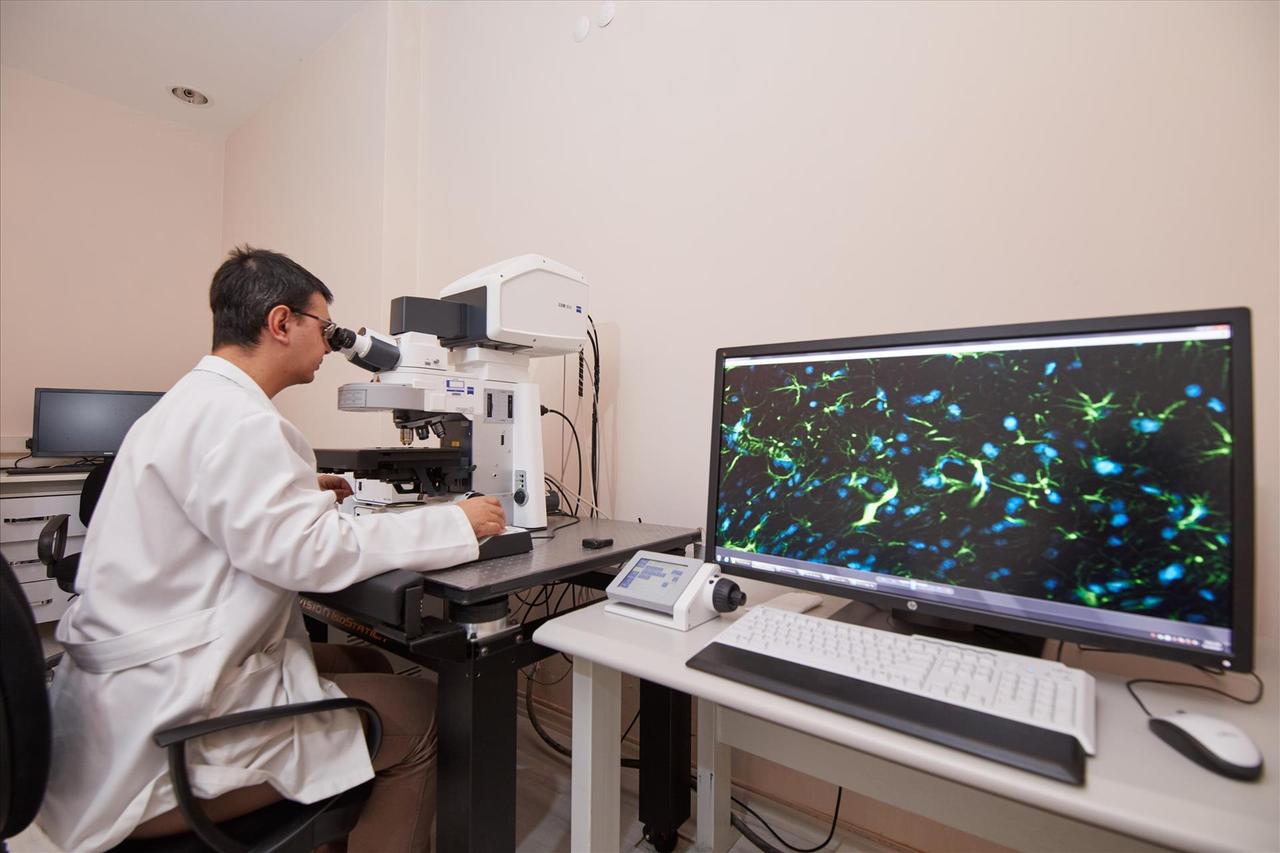
https://arum.ogu.edu.tr/Sayfa/Index/20/konfokal-mikroskop-birimi
Laser Scanning Confocal Microscope (CLSM)
Component(s) | Laser light source Imaging software. Detector (PMT) Pinhole aperture Objective lenses Galvanometer mirrors | ||||||||
|---|---|---|---|---|---|---|---|---|---|
Applications | Cell and organelle imaging, Protein localization, Cancer tissue diagnosis. | ||||||||
Advantage(s) | High resolution (200 nm) Multi-fluorescent labeling capability. Three-dimensional structure analysis | ||||||||
Definitions | Optical sectioning, Fluorescence, Pinhole. | ||||||||
Confocal laser scanning microscopy (CLSM) is an advanced microscopy technology that enables high-resolution, three-dimensional (3D) imaging of biological and material samples. In this system, only light originating from the focal plane reaches the detector, allowing lateral resolution up to approximately 200 nm—nearly twice that of conventional wide-field fluorescence microscopes. It plays a crucial role in detailed analysis of fluorescently labeled cells and tissues. In recent years, the use of these microscopes in biological imaging has increased by 30%.
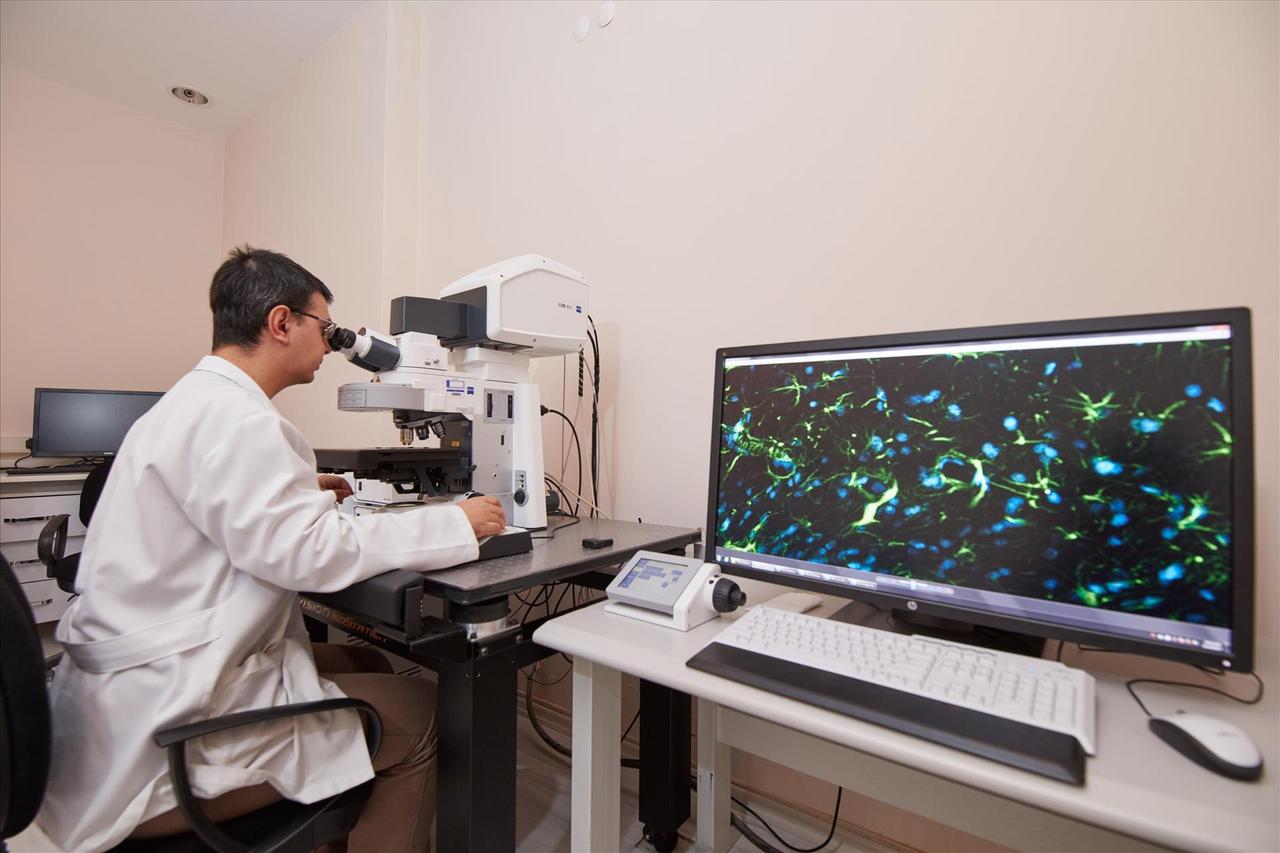
CONFOCAL MICROSCOPE (1)
Confocal microscopy is based on the principle of scanning the sample with a laser beam and passing fluorescent signals from the focal plane through a pinhole aperture. This eliminates out-of-focus light, allowing only a single plane to be imaged. Thanks to this “optical sectioning,” consecutive planes can be combined to generate 3D structures. With sensitive fluorescence detection, fluorescent signals as low as 10⁻¹² M can be detected.

Confocal Microscope (2)
Confocal microscopes consist of the following components:
Confocal microscopes are used across a wide range of scientific fields:
Advantages include high lateral and axial resolution (approximately 200 nm/500 nm), enhanced contrast imaging, and the ability to perform multichannel (multiplexed fluorescence) analysis. Additionally, reconstruction of 3D structures enables evaluation of spatial relationships at the cellular level.
However, key limitations include photobleaching (light-induced dye degradation), limited penetration depth in thick tissues, and high instrument costs. Solutions to these issues include the use of low-power lasers and next-generation fluorophores (e.g. Alexa Fluor series).
In some systems, confocal microscopy is integrated with Raman spectroscopy and photoluminescence measurement techniques to enable chemical mapping at the molecular level. Such systems offer analytical capabilities with structural sensitivity approaching 95%, particularly valuable in materials science.
Anadolu Üniversitesi. "Konfokal Mikroskop." AÜBİBAM. https://aubibam.anadolu.edu.tr/analizler/cihaz-ve-donanimlar/konfokal-mikroskop
Atatürk Üniversitesi. "Laser Scanning Confocal Microscope." DAYTAM. https://daytam.atauni.edu.tr/altyapi/yasam-bilimleri/mikroskobi-ve-ileri-goruntuleme-laboratuvari/lazer-taramali-konfokal-mikroskop/
Dönmez, Y., T. Dilek, and D. Karakoç. (2021). “Histoloji ve Embriyoloji Eğitiminde Konfokal Mikroskopinin Rolü.” *Akdeniz Üniversitesi Sağlık Bilimleri Dergisi* 10(2): 279–286. https://dergipark.org.tr/tr/pub/akd/issue/64117/981912
Food Association. "Yeni Görüntüleme Teknikleri ile Hücre, Doku ve Mikroorganizma Tespiti." Accessed [insert date if provided]. https://www.gidadernegi.org/TR/Genel/240934968aced.pdf?DIL=1&BELGEANAH=1612&DOSYAISIM=240934968.pdf
Istanbul University. "Laser Scanning Confocal Microscopy Laboratory." Accessed [insert date if available]. https://deneyseltip.istanbul.edu.tr/tr/content/tani-ve-arastirma-hizmetleri/lazer-taramali-konfokal-mikroskop-laboratuvari
Koç Üniversitesi. "Hücresel ve Moleküler Görüntüleme Laboratuvarı." Accessed [Date]. https://research.ku.edu.tr/tr/hucresel-ve-molekuler-goruntuleme-laboratuvari/
Middle East Technical University. "Laser Scanning Confocal Microscope." MERLAB. http://merlab.metu.edu.tr/tr/lazer-taramali-konfokal-mikroskop
Osmangazi Üniversitesi. "Confocal Microscopy Unit." ARUM Araştırma Uygulama Merkezi. https://arum.ogu.edu.tr/Sayfa/Index/20/konfokal-mikroskop-birimi
Taner, A., M. Güler, and T. Karaman. (2021). “Biyolojik Numunelerin Mikroskopik İncelenmesinde Kullanılan Görüntüleme Teknikleri.” *Bitlis Eren Üniversitesi Fen Bilimleri Dergisi* 10(1): 236–252. https://dergipark.org.tr/en/download/article-file/1921169
TÜBİTAK MAM. "Konfokal Lazer-Raman/Fotolüminesans Mikrospektrometresi." Accessed [Date]. https://mam.tubitak.gov.tr/tr/icerik/konfokal-lazer-ramanfotoluminesans-mikrospektrometresi
Tüfekçi, Nazlı, and Mehmet Salih Gürel. (2023). “Confocal Microscopy: Working Principle and Applications in Dermatology.” *Journal of Skin and Sexually Transmitted Diseases* 5(2): 65–72. https://jsstd.org/confocal-microscopy-working-principle-and-applications-in-dermatology/

https://arum.ogu.edu.tr/Sayfa/Index/20/konfokal-mikroskop-birimi
Laser Scanning Confocal Microscope (CLSM)
Component(s) | Laser light source Imaging software. Detector (PMT) Pinhole aperture Objective lenses Galvanometer mirrors | ||||||||
|---|---|---|---|---|---|---|---|---|---|
Applications | Cell and organelle imaging, Protein localization, Cancer tissue diagnosis. | ||||||||
Advantage(s) | High resolution (200 nm) Multi-fluorescent labeling capability. Three-dimensional structure analysis | ||||||||
Definitions | Optical sectioning, Fluorescence, Pinhole. | ||||||||
No Discussion Added Yet
Start discussion for "Confocal Microscope" article
Working Principle
Hardware and Components
Applications
Advantages and Limitations
Advanced Systems and Combined Technologies