


This article was automatically translated from the original Turkish version.
Radius | ~1.58 Earth radii (R⊕) | ||||||||
|---|---|---|---|---|---|---|---|---|---|
Mass | ~4.8 Earth masses (M⊕) | ||||||||
Average Density | ~6.6 g/cm³ | ||||||||
Surface Gravity | ~2 g (approximately twice that of Earth) | ||||||||
Orbital Period | ~0.854 day (approximately 20.5 hours) | ||||||||
Orbital Radius | ~0.0172 AU (Astronomical Unit) | ||||||||
CoRoT-7b is one of the first terrestrial exoplanets discovered by the CoRoT (Convection, Rotation and planetary Transits) space telescope, led by the French space agency CNES (Centre National d'Études Spatiales) in collaboration with the European Space Agency (ESA). Announced in 2009, CoRoT-7b has become one of the key examples studied among super-Earth-class exoplanets with short orbital periods, due to its physical and dynamical characteristics.
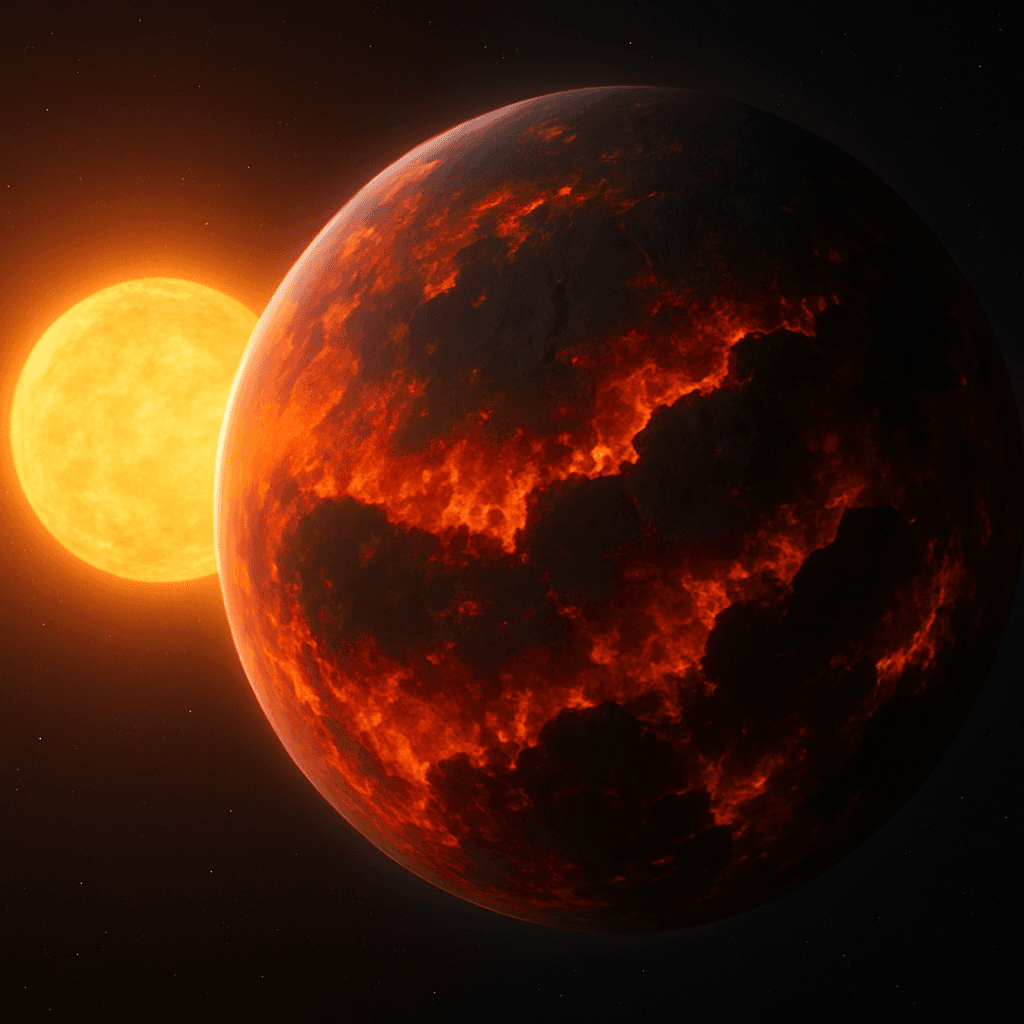
Image of CoRoT-7b. (Generated by Artificial Intelligence.)
CoRoT-7b was discovered using the transit method, which measures the dip in brightness caused by an exoplanet passing in front of its host star. This method allows the planet’s radius to be calculated, while ground-based spectroscopic observations determined its mass. Combining these measurements enabled the calculation of the planet’s density.
CoRoT-7b is one of at least two known planets orbiting its host star, CoRoT-7. Another planet, CoRoT-7c, has also been observed in the same system.
The planet’s extremely short orbital period results from its proximity to its host star. This distance classifies CoRoT-7b among the “ultra-short period” exoplanets.
CoRoT-7b’s density is similar to Earth’s, supporting the hypothesis that it has a terrestrial composition dominated by metals and silicates. However, its surface conditions are vastly different from any environment on Earth. Due to its extreme closeness to the star, it is believed to be tidally locked, meaning one hemisphere permanently faces the star while the other remains in darkness.
Models suggest that CoRoT-7b may exhibit strong volcanic activity due to high internal temperatures and pressures. In this regard, the planet may share similarities with Io, a moon of Jupiter in our Solar System. However, direct observation of such volcanic activity remains currently impossible.
CoRoT-7b is scientifically significant as one of the first terrestrial exoplanets for which both transit and mass measurements were combined. It provides critical insights into planetary formation, internal structure, and dynamical evolution in close-in orbits around stars. Furthermore, its extreme surface temperature contrast has served as a foundation for theoretical studies on exotic material cycles, such as “rock vapor” cycles.
CoRoT-7 is a more active star than the Sun. Stellar spots and brightness variations from the star can mask the planet’s transit signals. As a result, uncertainties in the determination of the planet’s mass and orbital parameters are higher compared to those of other exoplanets.
CoRoT-7b represents an important example in exoplanet research due to its short orbital period, high surface temperatures, and terrestrial structure. Its physical and chemical conditions are used to understand exoplanetary environments that lie outside classical habitability criteria. Additionally, this planet is considered an ideal target for future high-resolution telescopes and spectroscopic studies.
NASA. "Artist’s impression of Corot-7b." NASA. Accessed July 20, 2025. https://exoplanetarchive.ipac.caltech.edu/overview/CoRoT-7.
NASA. "Most Earthlike Exoplanet Started out as Gas Giant." NASA. Accessed July 20, 2025. https://science.nasa.gov/exoplanet-catalog/corot-7-b/.
NASA. “CoRoT-7 Overview.” NASA. Accessed July 20, 2025. https://www.nasa.gov/news-release/most-earthlike-exoplanet-started-out-as-gas-giant/.
NASA. “CoRoT-7 b.” NASA. Accessed July 20, 2025. https://ciencia.nasa.gov/exoplanet-catalog/corot-7-b/.
NASA. “CoRoT-7 b.” NASA. Accessed July 20, 2025. https://exoplanets.nasa.gov/exoplanet_watch_results/corot-7_b/.

Radius | ~1.58 Earth radii (R⊕) | ||||||||
|---|---|---|---|---|---|---|---|---|---|
Mass | ~4.8 Earth masses (M⊕) | ||||||||
Average Density | ~6.6 g/cm³ | ||||||||
Surface Gravity | ~2 g (approximately twice that of Earth) | ||||||||
Orbital Period | ~0.854 day (approximately 20.5 hours) | ||||||||
Orbital Radius | ~0.0172 AU (Astronomical Unit) | ||||||||
Discovery and Observational Method
Stellar System and Location
Key Physical Properties
Structural Properties and Geology
Probability of Volcanic Activity
Scientific Significance
Observational Challenges Related to CoRoT-7b
