


This article was automatically translated from the original Turkish version.
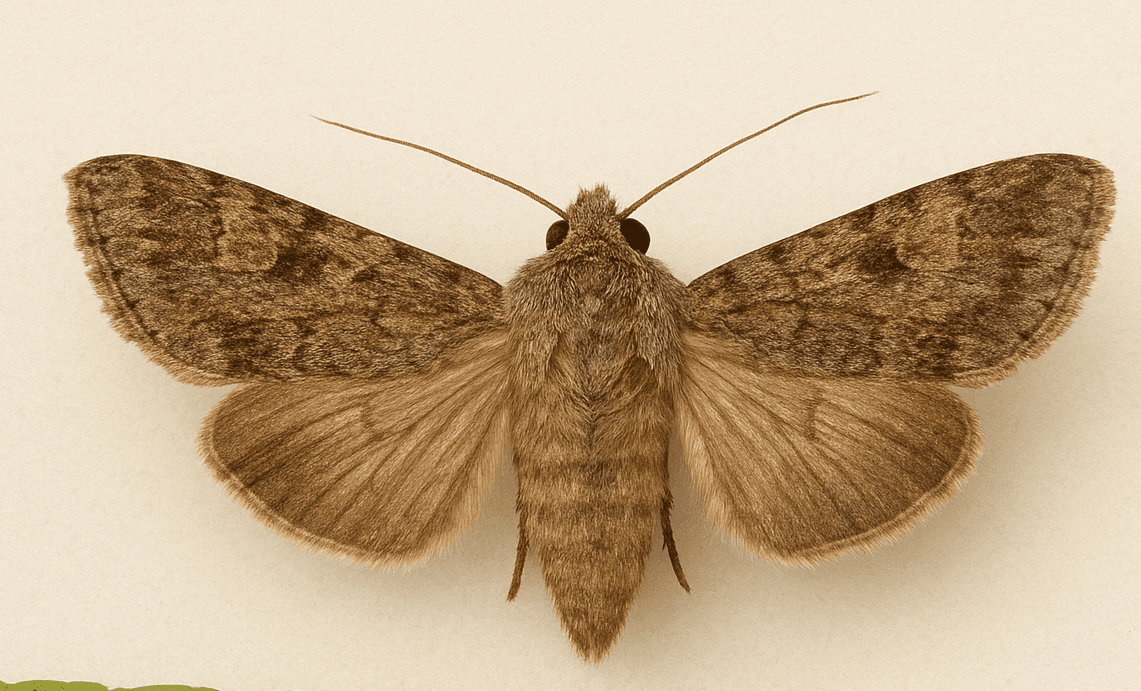
Generated by artificial intelligence.
Cotton Leafworm (Spodoptera littoralis)
Team(s) | Lepidoptera | ||||||||
|---|---|---|---|---|---|---|---|---|---|
Family | Noctuidae | ||||||||
Distribution Area | Africa, Middle East, Mediterranean countries | ||||||||
Host Plants | Cotton, maize, tomato, pepper, eggplant, ornamental plants | ||||||||
Damage Symptoms | Irregular holes in leaves, chewed areas on flowers and fruits, damage and shedding of cocoons | ||||||||
Spodoptera littoralis (Boisduval, 1833) is one of the most economically significant leaf worms in the family Noctuidae. Commonly known as the cotton leafworm or African cotton leafworm, this species is recognized for its ability to feed on a wide variety of plants. A widespread pest in Mediterranean countries, the Middle East and Africa, it can rapidly reach high population densities under favorable conditions, causing severe economic losses.
Adult moths have a wingspan ranging from 30 to 38 mm. The forewings are gray to brown with wavy and zigzag patterns, while the hindwings are whitish with darker edges. Females lay eggs in clusters on the underside of leaves; the eggs are initially yellow and darken as they develop. Larvae are initially greenish, developing dark bands in later stages and reaching lengths of approximately 35 to 40 mm. After completing their feeding phase, larvae pupate in the soil, forming brown pupae.
This species, capable of producing multiple generations per year in warm climates, is distinguished by its rapid development. The time from egg to adult typically ranges from 25 to 40 days. Eggs hatch within 3 to 5 days, the larval stage lasts about 2 to 3 weeks, and pupae emerge as adults within 1 to 2 weeks. Adult lifespan generally lasts 1 to 2 weeks, during which females can lay hundreds of eggs. This reproductive capacity enables populations to intensify rapidly.
Spodoptera littoralis is a polyphagous pest reported to feed on over 80 plant species. Major host plants include cotton (Gossypium spp.), tomato (Solanum lycopersicum), eggplant (Solanum melongena), pepper (Capsicum spp.), maize (Zea mays), sunflower (Helianthus annuus), and pea (Pisum sativum). Other susceptible hosts include beans, groundnut, lettuce, cabbage, sugar beet, potato, tobacco, and various ornamental plants. Its polyphagous nature allows the pest to spread easily between different production areas and ensures a continuous food supply throughout the year.
The cotton leafworm causes significant damage in agricultural fields, primarily during the larval stage. Early-stage larvae scrape the epidermis of leaves, creating small holes, while later-stage larvae consume entire leaf tissues, leaving large cavities. In high population densities, leaves can be completely defoliated, drastically reducing photosynthetic capacity. Larvae are not limited to leaves; they also feed on young shoots, flowers, buds, and fruits, directly affecting crop development and quality. In cotton, they can disrupt boll formation; in tomato and pepper, they bore into fruits, reducing market value; in maize, they damage ears and tassels, leading to yield loss. Particularly in export-oriented crops, visible damage to fruits and vegetables results in severe economic losses. Due to the pest’s broad host range and high reproductive capacity, control becomes increasingly difficult, heightening the importance of integrated pest management strategies.
Various methods are used in an integrated approach to manage S. littoralis. Chemical control has long been the most common method, particularly involving synthetic pyrethroids and organophosphates. However, intensive pesticide use has led to environmental harm and the development of pest resistance. Consequently, in recent years chemical applications have become more controlled and selective. Biological control has proven effective using entomopathogenic fungi (Beauveria bassiana, Metarhizium anisopliae), bacteria (Bacillus thuringiensis), and nucleopolyhedroviruses. Natural enemies such as parasitoid wasps (Trichogramma spp.) and predatory insects also play a significant role. Pheromone traps are employed to monitor population density and control populations through mass trapping. Cultural control methods include crop rotation, selection of resistant varieties, destruction of plant residues after harvest, and early planting. These practices reduce larval feeding and shelter opportunities, thereby suppressing pest populations. The combined implementation of all these strategies aims to control the pest while minimizing environmental impact and delaying the development of resistance.
Pavela, R. “Insecticidal Activity of Some Essential Oils against Larvae of Spodoptera littoralis.” Fitoterapia 76, no. 7–8 (2005): 691–696. https://doi.org/10.1016/j.fitote.2005.06.001
Salama, H. S., N. Z. Dimetry, and S. A. Salem. “On the Host Preference and Biology of the Cotton Leaf Worm Spodoptera littoralis Bois.” Zeitschrift für Angewandte Entomologie 67, no. 1–4 (1971): 261–266. https://doi.org/10.1111/j.1439-0418.1971.tb02122.x

Generated by artificial intelligence.
Cotton Leafworm (Spodoptera littoralis)
Team(s) | Lepidoptera | ||||||||
|---|---|---|---|---|---|---|---|---|---|
Family | Noctuidae | ||||||||
Distribution Area | Africa, Middle East, Mediterranean countries | ||||||||
Host Plants | Cotton, maize, tomato, pepper, eggplant, ornamental plants | ||||||||
Damage Symptoms | Irregular holes in leaves, chewed areas on flowers and fruits, damage and shedding of cocoons | ||||||||
No Discussion Added Yet
Start discussion for "Cotton Leafworm (Spodoptera littoralis)" article
Morphology
Life Cycle
Host Plants
Agricultural Damage
Control Methods