


This article was automatically translated from the original Turkish version.
+2 More
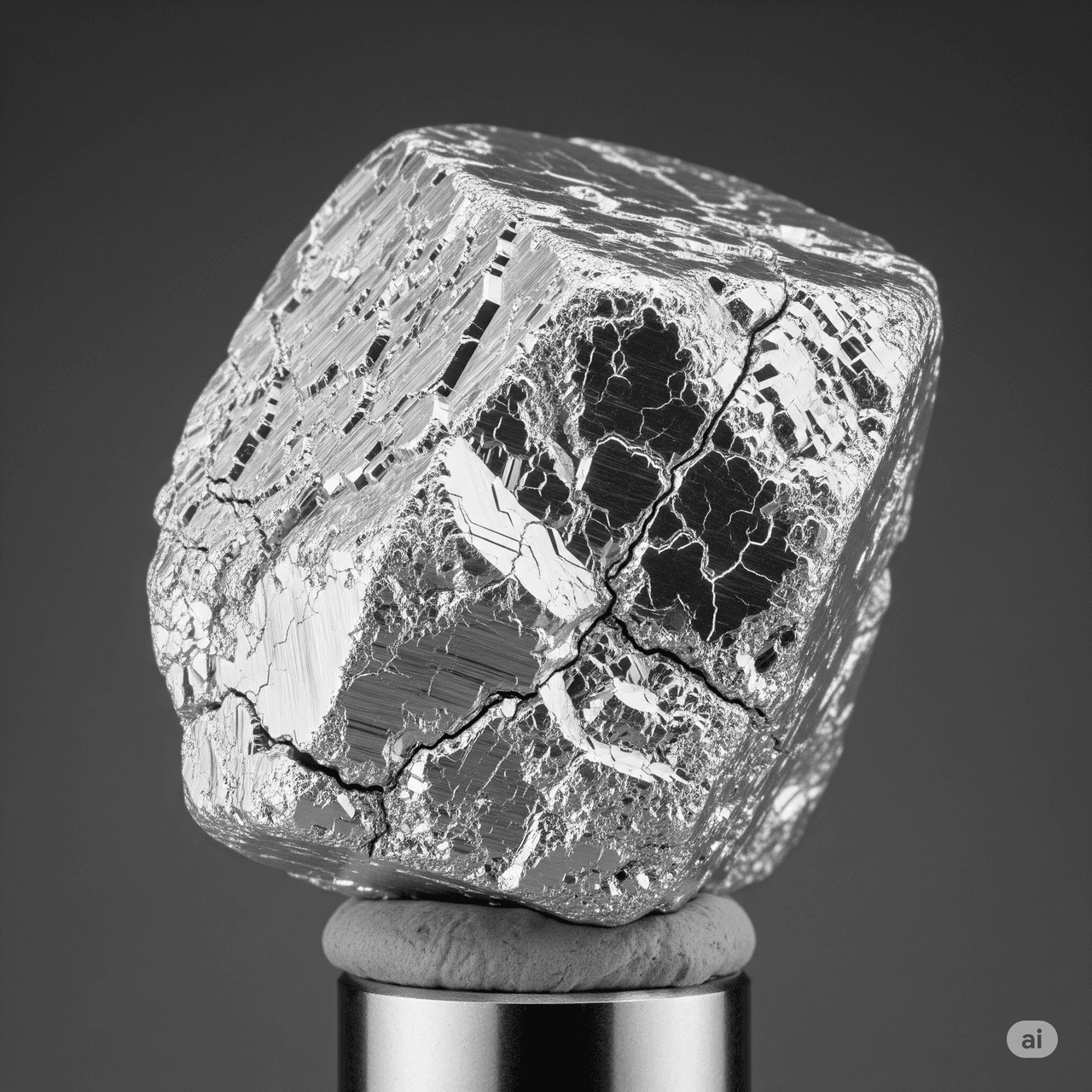
Darmstadtium (Ds)
Periodic Table | 7 | ||||||||
|---|---|---|---|---|---|---|---|---|---|
Atomic Number | 110 | ||||||||
Group | 10 (Transition Metal) | ||||||||
Atomic Weight | (281) g/mol (for the most stable isotope ²⁸¹Ds) | ||||||||
Electron Configuration | [Rn] 5f¹⁴6d⁹7s¹ (expected) | ||||||||
Important Isotopes | ²⁸¹Ds (Half-life: ~12.7–22.8 seconds) | ||||||||
Year of Discovery(ies) | 1994 | ||||||||
Discoverer(s) | G. Münzenberg and colleagues P. Armbruster GSI (Darmstadt) team | ||||||||
Etymology(s) | the city of Darmstadt in Germany | ||||||||
Darmstadtium is a synthetic and highly radioactive element located at position 110 in the periodic table. It was discovered in 1994 at the GSI Helmholtz Centre for Heavy Ion Research in Darmstadt, Germany, and derives its name from the city of Darmstadt where the research center is located. All of its properties are based on observations and theoretical calculations performed on the very small number of atoms produced to date.
Darmstadtium (Ds) is a transition metal located in period 7 and group 10 of the periodic table. Its electron configuration is expected to be [Rn] 5f¹⁴6d⁹7s¹. This electronic structure positions it as a heavier homologue of platinum, one of the noble metals in the periodic table. Theoretical calculations predict that darmstadtium will be a solid at room temperature and exhibit properties similar to those of the platinum group metals.
Darmstadtium was first synthesized on 9 November 1994 by an international team led by Peter Armbruster and Gottfried Münzenberg at the GSI Helmholtz Centre for Heavy Ion Research (Gesellschaft für Schwerionenforschung) in Darmstadt, Germany. The discovery was achieved by bombarding lead-208 (²⁰⁸Pb) targets with nickel-62 (⁶²Ni) ions accelerated to high velocities in a particle accelerator. This fusion reaction produced and identified only a few atoms of the isotope darmstadtium-269 (²⁶⁹Ds). The discovery was officially recognized by the International Union of Pure and Applied Chemistry (IUPAC) in 2001.
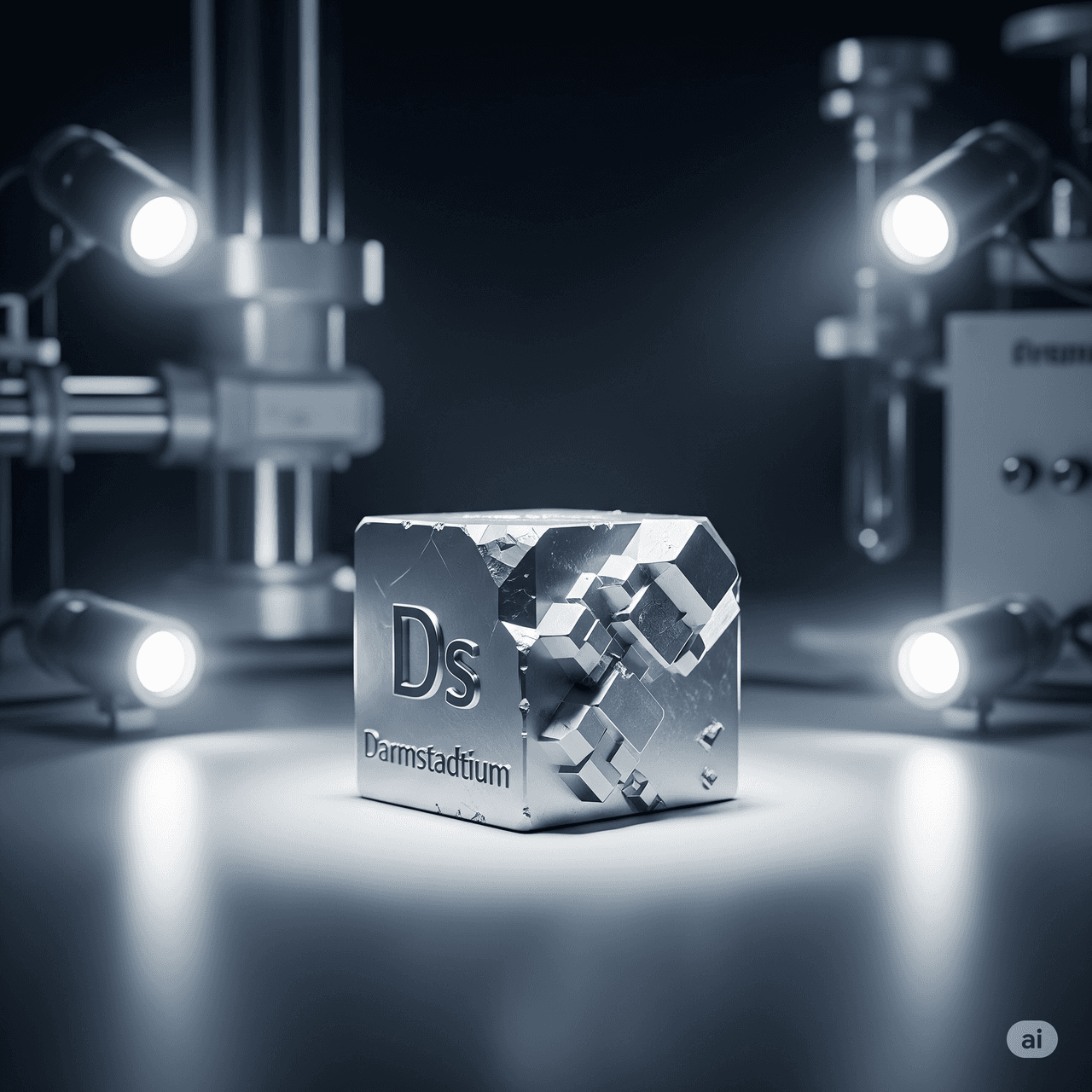
Darmstadtium (Generated by Artificial Intelligence.)
The element's name was proposed by the GSI team, its discoverers, in honor of Darmstadt, Germany—the city where the discovery was made and where the GSI laboratory is located. The name "darmstadtium" was officially adopted by IUPAC in 2003.
Darmstadtium is a completely synthetic element and does not occur naturally. It can only be produced in minute quantities under laboratory conditions through nuclear reactions such as the fusion of nickel and lead atoms in particle accelerators. To date, only a few atoms have been successfully synthesized and observed.
Current knowledge of darmstadtium's physical and chemical properties is extremely limited and largely based on theoretical models. It is predicted to be a solid at room temperature and likely to have a metallic appearance. Its density, melting point, and boiling point have not yet been determined experimentally.
Chemically, it is expected to exhibit properties similar to those of the platinum group metals (platinum, palladium, etc.) and behave as a noble metal. Possible oxidation states include +2, +4, and +6. The atomic weight of its longest-lived known isotope, ²⁸¹Ds, is approximately 281 g/mol.
Darmstadtium has seven known isotopes, all of which are highly radioactive and unstable. The known isotopes range from ²⁶⁷Ds to ²⁸¹Ds.
Darmstadtium has no practical applications outside of basic scientific research due to its extremely short half-life, difficulty of production, and the minuscule quantities produced—only a few atoms at a time. Its synthesis is carried out solely to advance understanding of nuclear physics and chemistry, including the structure, stability, and chemical behavior of heavy nuclei.
Darmstadtium has no known biological role. Due to its extreme radioactivity and instability, it would be highly hazardous and toxic if produced in sufficient quantities. However, since only a few atoms have ever been synthesized, discussing standard biological effects or special precautions is practically meaningless. When produced in laboratory settings, standard safety protocols applicable to all radioactive materials are followed.
National Center for Biotechnology Information. "Darmstadtium." *PubChem Compound Database CID 135476787*. Accessed July 2, 2025. https://pubchem.ncbi.nlm.nih.gov/compound/Darmstadtium
TÜBİTAK Bilim Genç. "Darmstadtiyum." *Bilim Genç*. Accessed July 3, 2025. https://bilimgenc.tubitak.gov.tr/periyodik-tablo/darmstadtiyum

Darmstadtium (Ds)
Periodic Table | 7 | ||||||||
|---|---|---|---|---|---|---|---|---|---|
Atomic Number | 110 | ||||||||
Group | 10 (Transition Metal) | ||||||||
Atomic Weight | (281) g/mol (for the most stable isotope ²⁸¹Ds) | ||||||||
Electron Configuration | [Rn] 5f¹⁴6d⁹7s¹ (expected) | ||||||||
Important Isotopes | ²⁸¹Ds (Half-life: ~12.7–22.8 seconds) | ||||||||
Year of Discovery(ies) | 1994 | ||||||||
Discoverer(s) | G. Münzenberg and colleagues P. Armbruster GSI (Darmstadt) team | ||||||||
Etymology(s) | the city of Darmstadt in Germany | ||||||||
Classification and Fundamental Properties
Discovery
Etimology
Natural Occurrence
Physical and Chemical Properties
Isotopes
Applications
Biological Role and Precautions