


This article was automatically translated from the original Turkish version.
+2 More
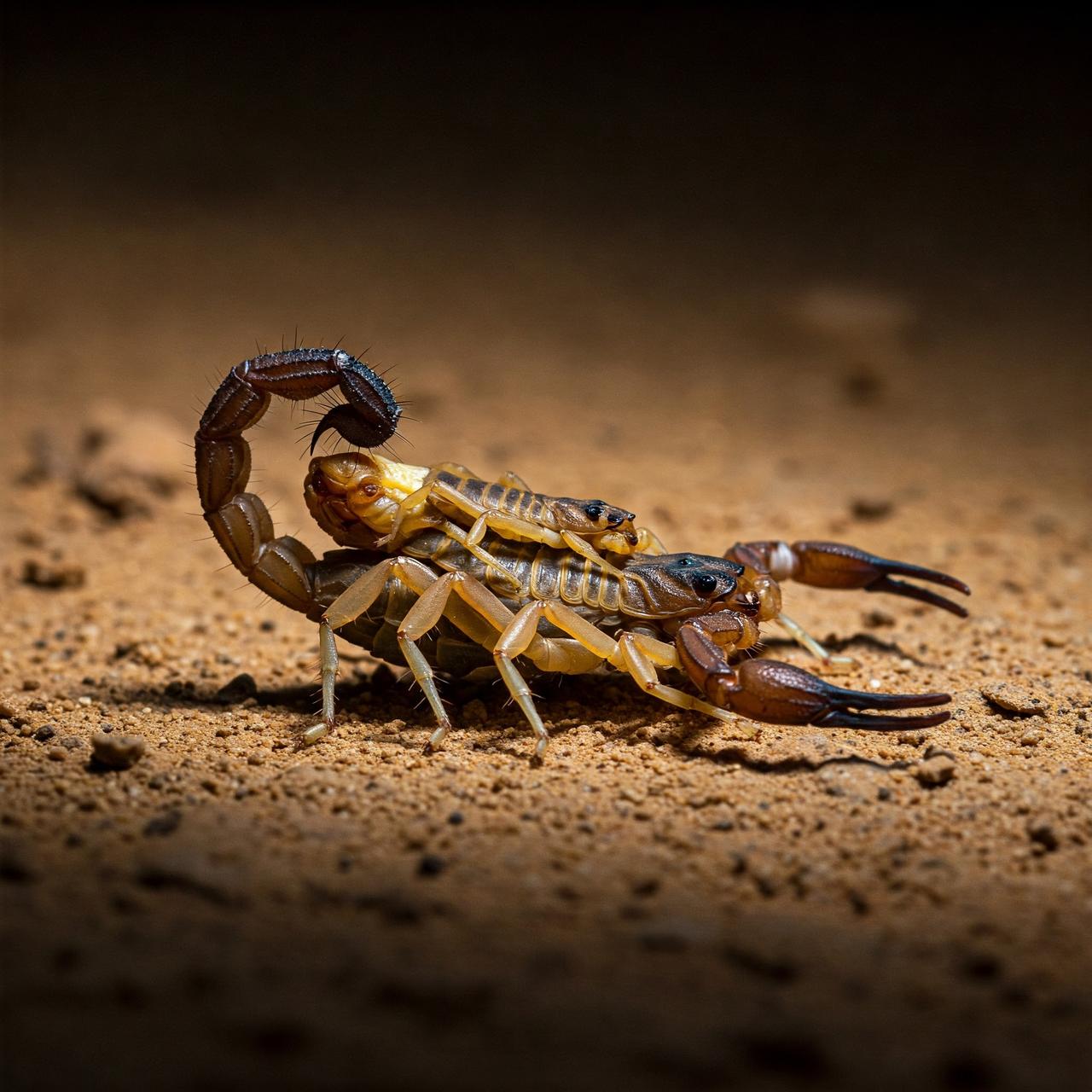
Death Hunter Scorpion
Team(s) | Scorpiones | ||||||||
|---|---|---|---|---|---|---|---|---|---|
Size(s) | 80–110 mm | ||||||||
Family | Buthidae | ||||||||
Diet(s) | Small Invertebrates | ||||||||
Application Area(s) | Pharmaceutical Research Toxicology | ||||||||
Habitat | Middle Eastern Deserts North Africa | ||||||||
Medical Importance | Potentially Fatal High | ||||||||
Toxin Type | Chlorotoxin Neurotoxin | ||||||||
Lifestyle | Solitary Nocturnal | ||||||||
Latin Name | Leiurus quinquestriatus | ||||||||
The Deathstalker Scorpion (Leiurus quinquestriatus), a scorpion species of major medical and toxicological importance, is widely distributed across the deserts of North Africa and the Middle East. This species is also known by various common names such as “yellow scorpion” or “Palestinian yellow scorpion,” though these refer to different species. Notable for its venom composition, behavioral traits, habitat preferences, and impact on human health, this species is regarded both as an ecologically significant organism and as a model organism in toxicological research.
Leiurus quinquestriatus belongs to the phylum Arthropoda, class Arachnida, and order Scorpiones. Within the family Buthidae, it is among the most toxic members. Distinctive features of the genus Leiurus include a segmented body structure, prominent pedipalps (claw-like mouth appendages), and characteristic metasomal (tail) structures. The specific epithet “quinquestriatus” refers to the five dorsal stripes that define the scorpion’s distinctive back pattern.
This species can reach an average length of 80 to 110 mm. The body consists of three main parts: the prosoma (cephalothorax), the mesosoma (abdomen), and the metasoma (tail). The prosoma is covered by a chitinous carapace and bears a pair of median eyes of moderate size, along with three lateral eyes on each side. The pedipalps are used for capturing prey and defense, while the four pairs of walking legs are symmetrically arranged.
Coloration is predominantly yellowish-orange, which enhances the species’ camouflage in desert environments. The metasomal segments are cylindrical, with the final segment called the telson, which houses the venom glands and stinger. The stinger (aculeus) at the tip of the telson serves as the scorpion’s primary tool for defense and predation.
Leiurus quinquestriatus possesses various sensory organs to perceive its environment. Hair-like structures on the leg segments, known as trichobothria, function as mechanoreceptors. Additionally, comb-like structures called pectines play a crucial role in detecting vibrations and chemical traces on the ground. These adaptations are vital for locating prey and finding mates.

Deathstalker Scorpion Feeding (Generated by Artificial Intelligence)
Leiurus quinquestriatus is commonly found in northern regions of the African continent (particularly Egypt, Sudan, and Ethiopia) and in Middle Eastern countries (Israel, Jordan, Saudi Arabia, Iran, and Iraq). It thrives in desert and semi-arid environments, particularly on stony and sandy substrates. This species is distinguished by its tolerance to high temperatures and low humidity levels.
This scorpion species typically shelters during the day in protected microhabitats such as under rocks, in crevices, or within loose soil, emerging at night to hunt. Its nocturnal lifestyle minimizes water loss in the hot desert climate. In its natural habitat, it feeds on ants, spiders, insects, and other small invertebrates. Similar diets can be maintained under laboratory conditions.
Leiurus quinquestriatus reproduces sexually. The male performs a distinctive courtship dance, during which he deposits a spermatophore on the ground. The female then takes up the spermatophore into her genital opening to achieve fertilization. Gestation lasts approximately three to six months. A female may give birth to 30 to 40 offspring. The young remain on their mother’s back for about a week after birth before becoming independent. During this period, they undergo their first molts. Maturation to adulthood typically occurs between 12 and 18 months.
This species is generally solitary and territorial. It exhibits an aggressive posture when disturbed, extending its pedipalps forward and raising its tail to intimidate potential threats. Venom is used only in response to serious threats. Although not inherently aggressive toward humans, it will sting if stepped on or trapped in a confined space.
The venom of Leiurus quinquestriatus is highly complex and contains neurotoxins, cardiotoxins, enzymes, and peptides. One of its primary components, chlorotoxin, is a neurotoxin that specifically targets chloride channels. The venom also includes low-molecular-weight peptides that affect sodium and potassium ion channels. These peptides exert specific effects on nerve cells, disrupting neuromuscular communication.
In humans, stings by Leiurus quinquestriatus typically cause localized pain, swelling, and a burning sensation. In severe cases, systemic effects may occur, including tachycardia, hypertension, respiratory distress, seizures, loss of consciousness, and rarely, death. Children and the elderly are at higher risk. Death, when it occurs, is usually due to cardiopulmonary failure. Although the mortality rate is low, immediate medical intervention is essential.
Warning: The content presented here is for general encyclopedic informational purposes only. It must not be used for diagnosis, treatment, or medical advice. Always consult a qualified healthcare professional before making any decisions regarding health. The author and KÜRE Encyclopedia assume no responsibility for any consequences arising from the use of this information for diagnostic or therapeutic purposes.
Borges, A., R. Miranda, and J. Pascale. 2012. “Scorpionism in Central America, with Special Reference to the Case of Panama.” *Journal of Venomous Animals and Toxins Including Tropical Diseases* 18, no. 2: 130–143. Accessed May 24, 2025. https://doi.org/10.1590/s1678-91992012000200002.
Gosik, R., and P. Sprick. 2017. “Description of the Larvae and Pupae of Eight Species of the Tribe Sitonini Gistel, 1848 (Coleoptera, Curculionidae) from Central Europe.” *Zootaxa* 4324, no. 3. Accessed May 24, 2025. https://doi.org/10.11646/zootaxa.4324.3.1.
Klement, H., M. Helfrich, U. Oster, S. Schoch, and W. Rüdiger. 1999. “Pigment‐Free NADPH:Protochlorophyllide Oxidoreductase from Avena sativa L.” European Journal of Biochemistry 265, no. 3: 862–874. Accessed May 24, 2025. https://doi.org/10.1046/j.1432-1327.1999.00627.x.
Pinto-Silva, C. C., J. Ferreira, R. Costa, P. B. Filho, E. Creppy, and W. Matias. 2002. “Micronucleus Induction in Mussels Exposed to Okadaic Acid.” *Toxicon* 41, no. 1: 93–97. Accessed May 24, 2025. https://doi.org/10.1016/s0041-0101(02)00214-3.

Death Hunter Scorpion
Team(s) | Scorpiones | ||||||||
|---|---|---|---|---|---|---|---|---|---|
Size(s) | 80–110 mm | ||||||||
Family | Buthidae | ||||||||
Diet(s) | Small Invertebrates | ||||||||
Application Area(s) | Pharmaceutical Research Toxicology | ||||||||
Habitat | Middle Eastern Deserts North Africa | ||||||||
Medical Importance | Potentially Fatal High | ||||||||
Toxin Type | Chlorotoxin Neurotoxin | ||||||||
Lifestyle | Solitary Nocturnal | ||||||||
Latin Name | Leiurus quinquestriatus | ||||||||
No Discussion Added Yet
Start discussion for "Death Scorpion (Leiurus quinquestriatus)" article
Morphology and Systematic Position
Taxonomic Classification
Body Structure and Dimensions
Sensory Organs and Perception
Habitat, Distribution, and Behavioral Traits
Geographic Distribution
Habitat Characteristics
Reproduction and Development
Social Behavior and Defense
Toxicology
Venom Composition
Envenomation Symptoms