This article was automatically translated from the original Turkish version.
Type of Geographical İndication | Signpost | ||||||||
|---|---|---|---|---|---|---|---|---|---|
Registration Number | 686 | ||||||||
Registration Date | 09.03.2021 | ||||||||
Product / Product Group(s) | Meals and soups | ||||||||
Province(s) | Aydın | ||||||||
Applicant/Registrant(s) | Nazilli Chamber of Commerce | ||||||||
Dedebağ Keşkeği is a traditional dish prepared for seven centuries on the Dedebağ Plateau in the Karacasu district of Aydın Province. Also known as “Karacasu Keşkeği,” this product is protected under Industrial Property Law No. 6769 as a geographical indication and was officially registered on 9 March 2021. The registration process was carried out by the Nazilli Chamber of Commerce.
Dedebağ Keşkeği derives its name from a benevolent individual named Dedebağ, originally from the Horasan region, whose primary occupation was shepherding. He became renowned for personally preparing and serving keşkek to caravans passing through the region and to the poor. After his death, the charitable meal prepared in his name on the plateau became a tradition sustained by the local community through the imece system of collective labor. Every year during the last week of August, the event titled “Dedebağ Keşkek Hayrı” is held, contributing to the preservation of this cultural heritage.
The most distinctive feature of Dedebağ Keşkeği is the exclusive use of carcass meat obtained from young male goats (erkeç). Typically, goats weighing around 20 kg are selected, and no other type of meat is permitted. For the wheat component, aşurelik or cracked wheat is used. Meat and wheat are combined in a one-to-one ratio; for example, 20 kg of meat is paired with 20 kg of wheat and approximately 500 grams of salt.
The preparation process begins one day in advance. Meat and wheat are separately boiled in copper cauldrons. The meat is manually cleaned of bones, fat, and tendons, then cut into small pieces. Subsequently, the meat and wheat are combined in the same cauldron and cooked together with the addition of salt. During this stage, a pounding process carried out with wooden paddles and mallets suitable for food contact gives the dish its characteristic texture. After approximately seven hours of this process, the keşkek achieves a consistency similar to chewy gum or paste, indicating the complete homogenization of meat and wheat.
Keşkek is traditionally cooked over wood fires in copper cauldrons. This method imparts a smoky and distinctive flavor to the dish. No mechanical or electrical equipment is used during production; all procedures are performed entirely by hand.
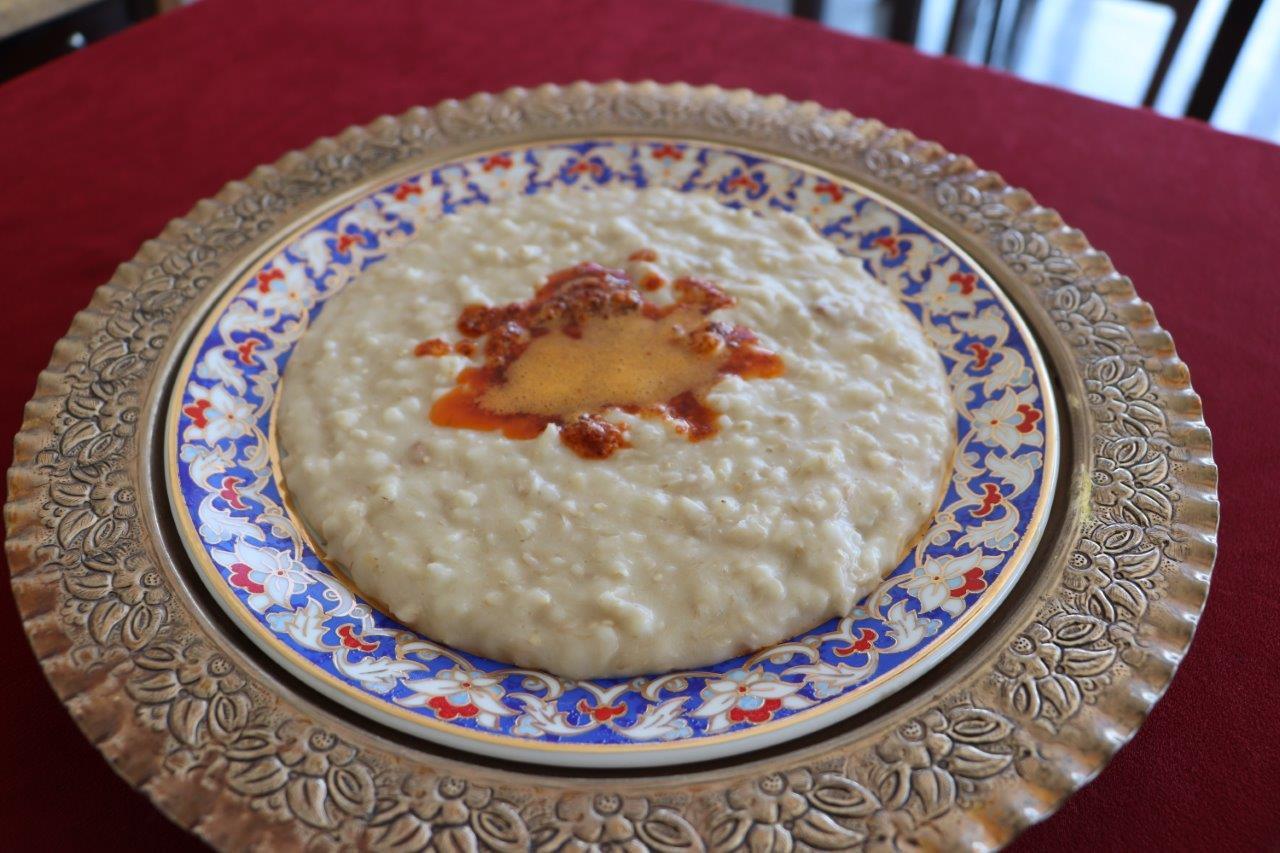
Dedebağ Keşkeği is typically served with tarator sauce made from fresh chili peppers, olive oil, and garlic. During serving, hot butter mixed with red chili powder is traditionally poured over the top.
All stages of production must take place within the boundaries of the Karacasu district of Aydın Province. This requirement is directly linked to the dish’s historical context and the skilled craftsmanship required in its preparation.
The production of Dedebağ Keşkeği / Karacasu Keşkeği and the use of its geographical indication are monitored by a three-member oversight body established under the coordination of the Nazilli Chamber of Commerce. This body consists of representatives from the Nazilli Chamber of Commerce, the Karacasu District Directorate of Agriculture and Forestry, and the Karacasu Municipality. Inspections are conducted at least once per year; additional inspections may be carried out as needed or upon complaint. Inspection results are reported to the Turkish Patent and Trademark Office.
Turk Patent and Trademark Office. "Dedebağ Keşkeği / Karacasu Keşkeği Mahreç İşareti Tescil Belgesi." Accessed October 19, 2025. https://ci.turkpatent.gov.tr/Files/GeographicalSigns/4ac95576-e8b2-420a-b0b7-8313f8f8aa80.pdf.
Turkish Patent and Trademark Office. "Dedebağ Keşkeği / Karacasu Keşkeği." *Coğrafi İşaretler Portalı*. Accessed October 19, 2025. https://ci.turkpatent.gov.tr/cografi-isaretler/detay/1004.

Type of Geographical İndication | Signpost | ||||||||
|---|---|---|---|---|---|---|---|---|---|
Registration Number | 686 | ||||||||
Registration Date | 09.03.2021 | ||||||||
Product / Product Group(s) | Meals and soups | ||||||||
Province(s) | Aydın | ||||||||
Applicant/Registrant(s) | Nazilli Chamber of Commerce | ||||||||
No Discussion Added Yet
Start discussion for "Dedebağ Keşkeği / Karacasu Keşkeği" article
Historical Background
Product Characteristics
Presentation and Serving
Geographical Boundaries and Production Conditions
Supervision Process