


This article was automatically translated from the original Turkish version.
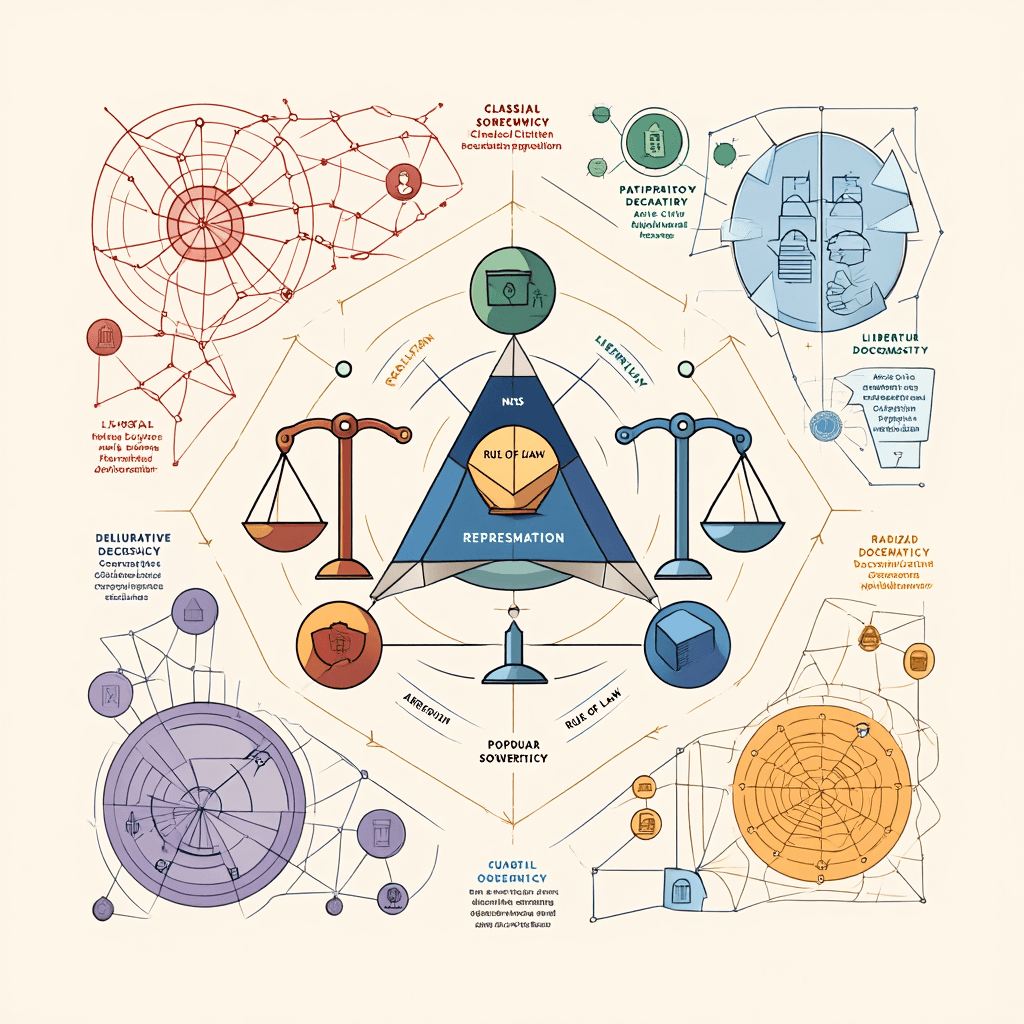
(Generated by Artificial Intelligence)
Democratic Theories
Area(s) | Political Theory and Comparative Politics | ||||||||
|---|---|---|---|---|---|---|---|---|---|
Fundamental Approaches | Classical, Liberal, Participatory, Negotiative, Radical | ||||||||
Key Concepts | Popular Sovereignty, Rule of Law, Participation, Legitimacy, Representation | ||||||||
Content Focuses | Institutional Functioning, Civic Awareness, Democratization Process | ||||||||
Democratic theories are theoretical approaches that examine forms of governance whose legitimacy is based on the consent of the governed. These theories address principles such as citizen participation in governance, transparency in decision-making processes, protection of freedoms, and the accountability of the state from different perspectives. In the modern sense, democracy is defined not only by the existence of elections but also by the rule of law, human rights, freedom of expression, and institutional checks and balances. Theories examine both the normative and empirical dimensions of democratic systems to investigate under what social conditions democracy can be sustained.
The classical understanding of democracy emerged in the city-states of Ancient Greece as a system in which the people directly participated in governance. In this model, citizens directly took part in the making of laws and the adoption of public decisions. However, this system was limited to a specific group of citizens, regarded as a privilege granted only to them. The large populations and complex structures of modern states have rendered direct democracy impractical. Therefore, the concept of “representative democracy” was developed to sustain democratic participation. In this model, the people exercise sovereignty through representatives, and power is periodically checked through elections.

Democratic Theories (Generated by Artificial Intelligence.)
Liberal democracy is a political system concept in which individual rights are constitutionally protected and power is limited. Its fundamental assumption is that political stability can be achieved through the protection of freedoms. This model is built on principles such as free elections, the rule of law, freedom of expression, and separation of powers. Democratic competition rests on the consent of voters; however, the legitimacy of power is measured not only by the will of the majority but also by the protection of minority rights.
This understanding forms the foundational framework of modern democracies. However, critical approaches argue that liberal democracies have increasingly acquired a “formal” character, with economic and media power centers becoming decisive in political decision-making processes. As a result, while elections are maintained, the democratic nature of decision-making mechanisms may weaken.
Participatory democracy aims to involve citizens not only during election periods but in every aspect of daily life. In this model, political participation goes beyond voting; it seeks the active involvement of citizens in policy-making, planning, and oversight. Social equality is viewed as a prerequisite for participation. Levels of education, economic opportunity, and access to information determine the quality of democratic participation.
Participatory democracy advocates that individuals should influence governance not only through representatives but also through direct communication and organization. This approach seeks to strengthen the legitimacy of political processes through local councils, citizen initiatives, and civil society organizations. The depth of participation is evaluated as a measure of a society’s democratic capacity.
Deliberative democracy envisions decisions being made not solely through majority voting but through reasoned discussion processes. In this approach, citizens and representatives listen to and evaluate diverse viewpoints to generate solutions based on common reason. Democracy is seen not merely as the aggregation of preferences but as a process of consensus grounded in information and mutual understanding.
This model emphasizes the importance of rational communication and common reason in public policy. Local forums, community meetings, and citizen councils serve as practical arenas for deliberative democracy. In these settings, citizens engage in equal information sharing and evaluation with public officials, directly contributing to decision-making processes. Such structures enhance accountability and strengthen public trust.
Radical democracy accepts social diversity, conflict, and difference as natural elements of democracy. This approach views democracy as an ongoing, evolving process and opposes the fixation of power. It aims to include all groups, identities, and ideas within the political sphere.
In this model, politics is based not only on consensus but also on legitimate conflict and competition. Recognizing the demands of different segments is essential for the renewal of the democratic system. Radical democrats argue that democracy is not merely an institutional structure but a social practice requiring continuous deliberation and participation.
Modern political science demonstrates that democracy is not a single uniform system but can exist in various forms and levels. Conceptual analyses approach democracy through two fundamental hierarchies: typological and component-based. In the typological hierarchy, democracy is divided into different forms—for example, parliamentary, presidential, or semi-presidential systems. In the component-based hierarchy, situations in which certain elements of democracy are missing or weak are defined as “partial” or “limited” democracies.
This classification helps explain emerging concepts in the modern era such as “illiberal,” “protected,” or “paternalistic” democracy. In such regimes, elections are held, but fundamental freedoms and rule of law principles do not function fully. Thus, a country may be formally democratic while exhibiting authoritarian tendencies in substance. This analytical approach underscores that democratization must be measured not only by elections but also by the quality of institutions.
In the last quarter of the 20th century, a global process of democratization led many countries to transition to electoral regimes. However, in the 21st century, this trend has stalled, and in some countries, democracy has begun to regress. This period is characterized as “democratic stagnation” or “democratic recession” on a global scale.
During this process, despite the continued existence of elections, the rule of law, press freedom, judicial independence, and civil society space have weakened in many countries. Some regimes have adopted the form of “competitive authoritarianism,” using elections as a tool of democratic legitimacy while systematically restricting opposition and social oversight.
Among the causes of democratic regression, economic inequality, poor governance, polarization, and declining trust in institutions are highlighted. The sustainability of democratic systems depends not only on holding elections but also on preserving the rule of law, a free press, and an active civic consciousness.
Democratic theories aim to explain not only the formal structure of political systems but also their social legitimacy. Classical models emphasize popular sovereignty, liberal approaches highlight the balance between freedom and law, participatory and deliberative approaches stress active citizenship, and radical approaches foreground social pluralism.
Today, the quality of democracy is measured less by election outcomes and more by institutional transparency, the accountability of leaders, and the level of citizen participation in decision-making processes. Therefore, democracy is not a static form of governance but a dynamic process requiring continuous societal renewal.
Collier, David, and Steven Levitsky. *Conceptual Hierarchies in Comparative Research.* Berkeley: University of California, Department of Political Science, 1997. Accessed November 11, 2025. https://polisci.berkeley.edu/sites/default/files/people/u3827/Conceptual%20Hierarchies.pdf.
Diamond, Larry. “Facing Up to the Democratic Recession.” *Journal of Democracy* 26, no. 1 (2015): 141–155. Accessed November 11, 2025. https://www.journalofdemocracy.org/wp-content/uploads/2015/01/Diamond-26-1_0.pdf.
Fung, Archon. *Deliberative Democracy, Chicago Style.* Real Utopias Project Paper, University of Wisconsin–Madison, 1999. Accessed November 11, 2025. https://www.ssc.wisc.edu/soc/faculty/pages/wright/fung.pdf.
Karagöz Yerdelen, Betül, ed. *Demokrasi: Darbeler ve Tepkiler.* E-book. Giresun: Giresun Üniversitesi İktisadi ve İdari Bilimler Fakültesi Yayınları, 2017. ISBN 978-605-4239-65-8. Accessed November 11, 2025. https://iibf.giresun.edu.tr/Files/ckFiles/iibf-giresun-edu-tr/etkinlik/1._demokrasi_sempozyumu_kitabi__2._e-yayim-2017.pdf.
Mounk, Yascha. “The Undemocratic Dilemma.” *Journal of Democracy*, 2024. Accessed November 11, 2025. https://www.journalofdemocracy.org/articles/the-undemocratic-dilemma/.
Stanford Encyclopedia of Philosophy. “Democracy.” First published July 27, 2006; last updated June 18, 2024. Accessed November 11, 2025. https://plato.stanford.edu/entries/democracy/.

(Generated by Artificial Intelligence)
Democratic Theories
Area(s) | Political Theory and Comparative Politics | ||||||||
|---|---|---|---|---|---|---|---|---|---|
Fundamental Approaches | Classical, Liberal, Participatory, Negotiative, Radical | ||||||||
Key Concepts | Popular Sovereignty, Rule of Law, Participation, Legitimacy, Representation | ||||||||
Content Focuses | Institutional Functioning, Civic Awareness, Democratization Process | ||||||||
No Discussion Added Yet
Start discussion for "Democratic Theories" article
Classical Understanding of Democracy
Liberal Democracy
Participatory Democracy
Deliberative Democracy
Radical Democracy
Conceptual Diversity of Democracy
Democratization Waves and Regression