


This article was automatically translated from the original Turkish version.
+2 More
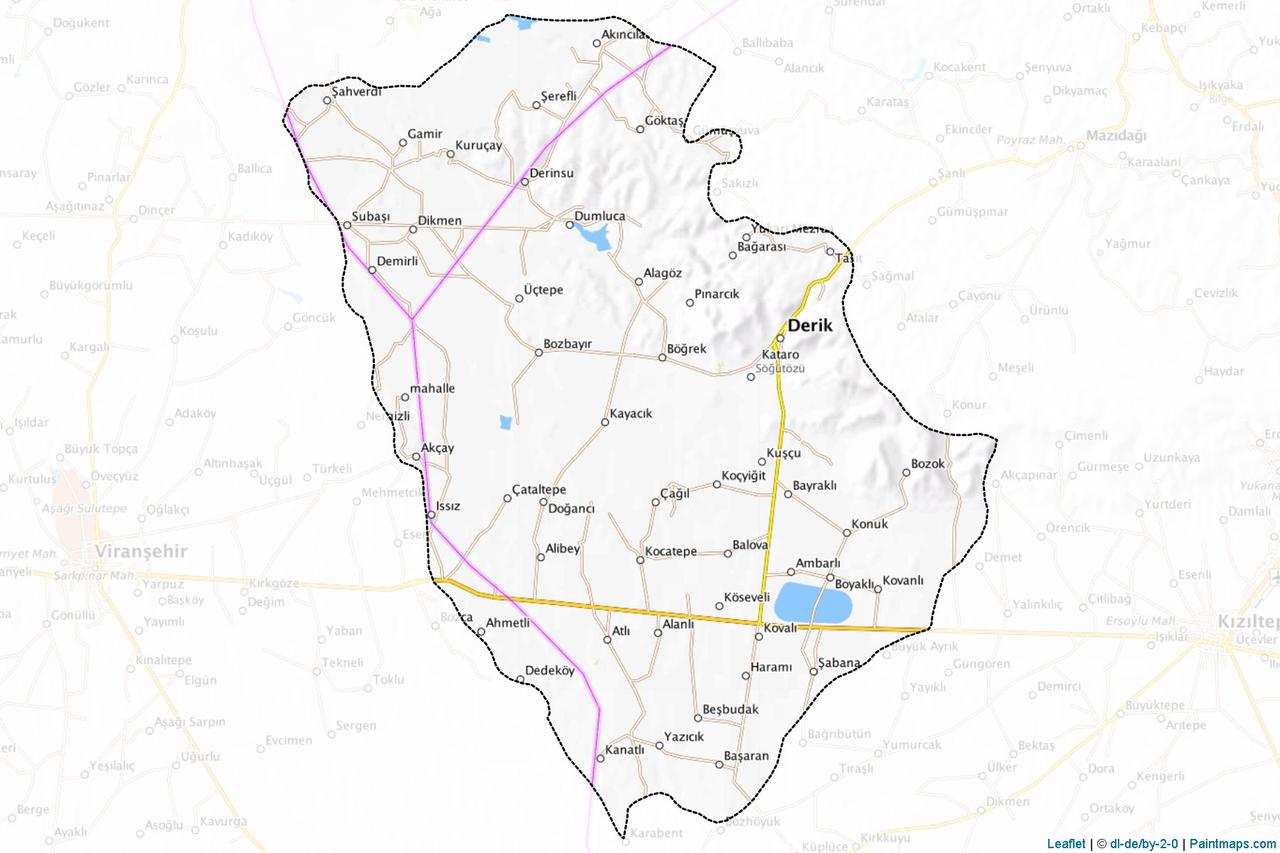
Derik is a district of Mardin Province in Türkiye. According to the 2015 general population census, the district, which covers an area of 1,367 km², has a total population of 62,175. Derik possesses a deep historical legacy and a rich cultural heritage, and its geographical location grants it significant strategic importance. The municipality administration was established in 1874 and has been attached to Mardin since 1923.
The history of Derik is examined along two main axes: the founding of the district center and the civilizations that developed in its surroundings. Settlement traces in the region extend back to the Neolithic period and the area has been home to numerous civilizations until the Republican era of 1923. Throughout history, Derik was commonly referred to as the “threshold of Mardin” or the “foot of the Mazı Mountains.” In Şemseddin Sami’s work Kâmusül Alâm, it is described as a accident center within the Mardin sanjak, subordinate to the Diyarbakır vilayet.
The district has been under the dominion of many civilizations before and after Christ. Before Christ, the Mitanni (3000 BCE), Akkadians, Sumerians, Babylonians, Assyrians, Medes, Persians, the era of Alexander the Great, the Seleucids, Parthians, and Romans ruled the region. Particularly, the Kingdom of Tigranes, established in Silvan in 83 BCE and later expanded to include Derik in 77 BCE, laid the foundation for Derik’s world-renowned famous olive groves. After Christ, the Sassanids, Byzantines, Islamic armies (conquered in 639 during the time of Hz. Omar), Artuqids, Marwanids, Kara Koyunlu, Akkoyunlu, Safavids, and Ottomans (1515–1923) governed the region. Since 1923, it has been within the borders of the Republic of Türkiye.
Historical remnants such as “King Throne of the Maiden,” “Rabat Castle,” “Sisan Ruins,” “Dermetinan Castle and Monastery,” and “Sign (astrological) Castle” are found in and around Derik. Rabat Castle, expanded during the Artukid period, stands out with its 13 towers and four watchtowers across an area of 1,500 square meters. Neolithic caves and artifacts in Tepebağ Neighborhood indicate the region’s scientific and commercial center significance.
Derik is surrounded by the districts of Mazıdağı, Viranşehir, and Kızıltepe. Located at an elevation of 780 meters above sea level, the district descends from the southern slopes of the Mazı Mountains toward the Kızıltepe-Ceylanpınar plains. The terrain slopes from north to south and is bordered by mountains on three sides; its highest point is the 1,208-meter-high Gıriguzi Hill. The south opens into a flat area extending to the Syrian border. This geographical building has endowed Derik with strategic location importance. There are no major rivers in the district; instead, water sources are formed by streams such as Şip, Circip, and Turcel, and reservoirs including Künreş, Şerefli, Yıldız, and Dumluca. Additionally, 16 cave caves have been used for temporary shelter; the largest are Herzin (capacity 500 people) and Habis (capacity 200 people).
Derik’s climate exhibits continental characteristics with proximity to a tropical climate. The local “baykür” wind, which blows during Winter and early spring, is a distinctive regional feature. Vegetation cover consists of limited oak forests in mountainous areas (around Bozok and Meşeli villages) and arable plains. In the district, wheat, barley, lentils, chickpeas, cotton, olive, figs, pomegranate, walnut, almonds, grape, watermelon, watermelon and seasonal vegetables are cultivated. Three-quarters of the 950,000 dekars of arable land are used for cereal production, while there are 20,000 dekars of vineyard and 140,000 olive trees. Olive, fig, and grape are the products that have enhanced Derik’s reputation.
Derik’s social structure has been shaped over centuries by the influence of various civilizations. The district is said to have been founded in 610 CE by the Kayıhan tribe of Turan Turks and has endured invasions by Byzantines, Persian and Turkish. For a time, Christians and Armenians formed the majority population. Today, life continues in both the plains and mountain villages of the district’s 71 villages. The name “Derik” may derive from the Persian word “Dirrik,” meaning “thorny place,” or from the local word “Der,” meaning “church.” Indeed, until 40 years ago, six churches existed in the area, and today only one remains active: the Surp Kevork Armenian Church (Dêra Sor).
Derik’s economy is based on agriculture and animal husbandry. In the plain villages, wheat, barley, lentils, cotton, chickpeas, watermelon, and melon are widely produced; agriculture is carried out over a total area of 634,370 hectares (514,940 dekars dryland, 119,430 dekars irrigated). Olive cultivation is a major source of income in the district center; with 103,000 olive trees, annual production reaches 3,500 tons of production, mostly exported. Viticulture has also developed over 13,390 dekars. In the mountain villages, animal husbandry dominates; there are 16,500 head of large livestock and 197,000 head of small livestock animal. The GAP project has the potential to strengthen agricultural production by expanding irrigated land. Additionally, limited mineral resources such as pumice stone are found in Tepebağ, Gırkemin, and Bozbayır.
Derik holds significant tourism potential due to its rich historical and natural attractions. Rabat Castle, dating from the Artukid period, is a structure with 15 towers and four watchtowers, preserving traces of Roman and earlier civilizations. Surp Kevork Armenian Church (Dêra Sor), built in 1650 from red earth, was restored in 2004 and reopened for worship. Areas such as Tepebağ and Beşkavak ruins also reflect the historical fabric. Olive groves and natural caves further enhance the region’s tourist appeal.
According to 2015 data, Derik’s population is 62,175; 49.68% are male (30,889) and 50.32% are female (31,286). In the 1927 census, 2,657 people lived in the district center and 15,111 in total including villages. The current population has declined to 57,719 (latest data). The district has one municipality and 71 village. The population structure reflects diversity shaped by historical migrations and the influence of civilizations.
Derik is a district notable for its thousands of years of history, agricultural richness, and cultural heritage. Known as one of the ancestral homelands of the olive, region awaits discovery by history and nature enthusiasts alike.
Derik Belediyesi. "Coğrafi Yapısı." Accessed April 8, 2025. http://www.derik.bel.tr/cografi-yapisi.
Derik Belediyesi. "Zeytinin Ana Vatani." Accessed April 8, 2025. http://www.derik.bel.tr/zeytinin-ana-vatani.
Derik Belediyesi. “Tarihi ve Kuruluşu.” Accessed April 8, 2025. http://www.derik.bel.tr/tarihi-ve-kurulusu.
Derik Kaymakamlığı. "Surp Kevork Ermeni Kilisesi." Accessed April 8, 2025. http://www.derik.gov.tr/surp-kevork-ermeni-kilisesi.
Derik Kaymakamlığı. "Turizm Tarihi Yerler." Accessed April 8, 2025. http://www.derik.gov.tr/turizm-tarihi-yerler.
Mardin Valiliği. “Derik.” Accessed April 8, 2025. http://www.mardin.gov.tr/derik.
Mardin İl Kültür ve Turizm Müdürlüğü. “Derik İlçesi.” Accessed April 8, 2025. https://mardin.ktb.gov.tr/TR-56494/derik-ilcesi.html.

History
Geographical Structure
Climate and Vegetation
Social Structure
Economic Structure
Tourism Potential
Demographic Structure