


This article was automatically translated from the original Turkish version.
+1 More
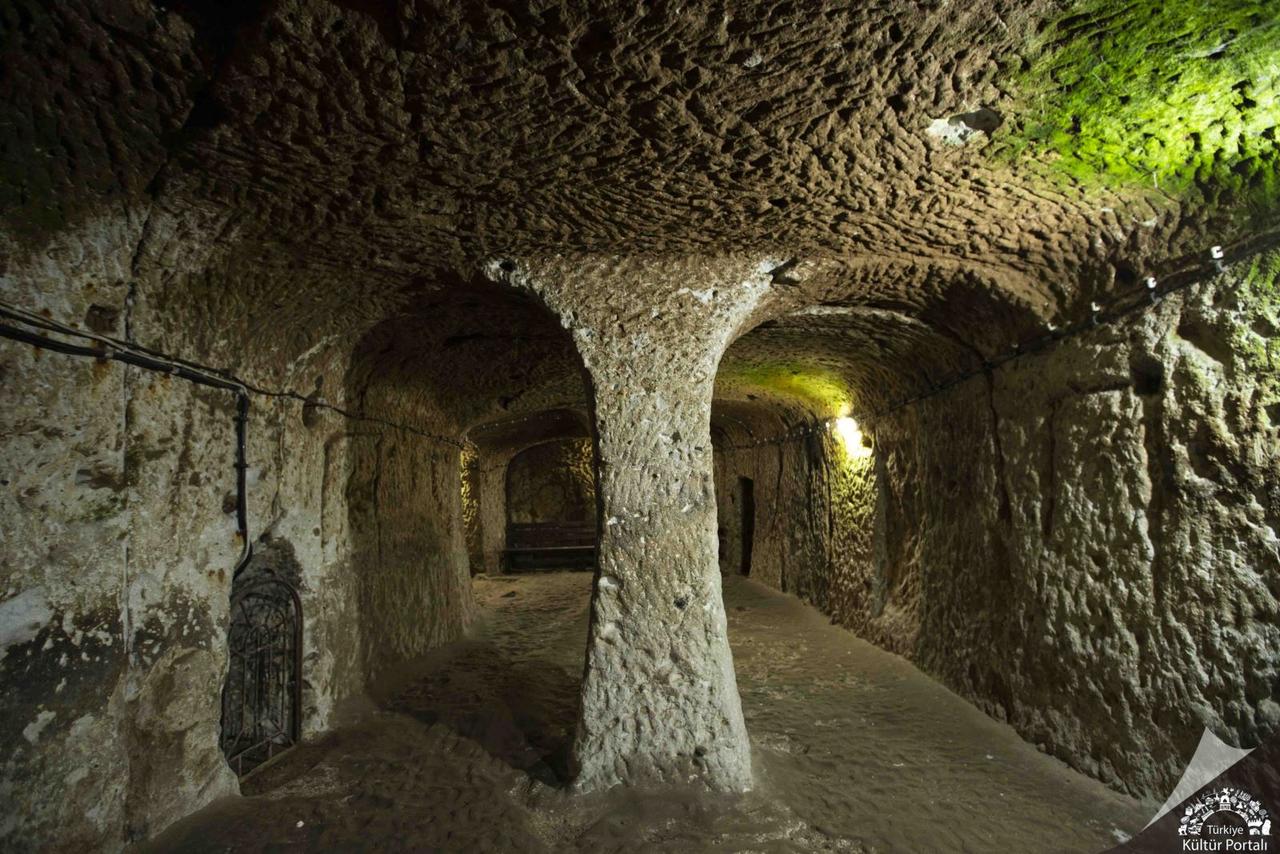
Derinkuyu Underground City
Location | Derinkuyu District Türkiye Nevşehir | ||||||||
|---|---|---|---|---|---|---|---|---|---|
Depth(s) | Approximately 85 metres | ||||||||
Number of Floors | At least 12 levels, with 8 levels accessible to visitors | ||||||||
Historical Origin | Believed to extend as far back as 2000 BCE; systematic use dates to the 2nd century CE | ||||||||
Purpose of Construction | Shelter, defense, housing — to protect against pressures | ||||||||
Derinkuyu Underground City is one of the deepest underground settlements in Cappadocia, located within the boundaries of the Derinkuyu district in Nevşehir Province, Türkiye. This structure reaches approximately 85 metres below the surface and holds significant historical and archaeological value due to its multi-level architecture and advanced defensive systems.

Derinkuyu Underground City (Türkiye Culture Portal)
The exact construction date of Derinkuyu Underground City is unknown, but its foundations are believed to date back to around 2000 BCE, during the period of Assyrian colonies in the Cappadocia region. However, the transformation of this site into a systematic urban complex occurred largely during the early Christian period, especially from the 2nd century onward, as Christian communities fleeing persecution under the Roman Empire migrated to the area. These communities established a self-sufficient lifestyle within the underground city, capable of sustaining life for days or even weeks without contact with the outside world.
Derinkuyu Underground City consists of at least 12 levels, of which approximately 8 are accessible to visitors. All areas necessary for daily life during that era have been meticulously planned:
One of the most remarkable features of underground city architecture is its sophisticated defense system. Main entrances were designed to be sealed from the inside during enemy attacks using massive stone cylinders. Additionally, tunnels connecting different underground cities were constructed narrow enough to allow passage for only one person at a time. This defense system effectively transformed the underground cities into hybrid refuges-fortresses.
One of the most impressive aspects of the underground city is its ventilation and water supply system. Approximately 52 ventilation shafts have been identified within the city. While some shafts connect directly to the surface, others are accessible only from within the underground levels, a precaution against poisoning or sabotage from outside. Thanks to this system, prolonged underground habitation was made possible.
Derinkuyu Underground City was accidentally discovered in 1963 and opened to tourism by the Ministry of Culture and Tourism in 1967. Today, only about 10 percent of the city is open to visitors. The full extent of the remaining sections and their connections to neighboring underground cities are still under investigation. Daily visiting hours are established, and the site attracts significant attention during the tourist season.
Derinkuyu is not only one of the most prominent structures in Cappadocia but also one of the standout sites in world archaeology. Its multi-level underground living arrangement is among the earliest known examples of such large-scale planning. The underground city provides vital insight into the social structure of the past, serving as a living space where communal solidarity, architectural planning, crisis management, and religious practices were simultaneously maintained.
Derinkuyu Belediyesi. "Yeraltı Şehirleri." Derinkuyu Municipality Official Website. Accessed May 24, 2025. https://derinkuyu.bel.tr/sehir/yeralti-sehirleri/21/.
Kapadokya Alan Directorate. "Derinkuyu Yeraltı City." *Kapadokya Regional Directorate Official Website.* Accessed May 24, 2025. https://kapadokyaalan.ktb.gov.tr/TR-288407/derinkuyu-yeralti-sehri.html.
Ministry of Culture and Tourism. "Derinkuyu Yeraltı Şehri Müzesi." *Müze.gov.tr.* Accessed May 24, 2025. https://muze.gov.tr/muze-detay?DistId=DKY&SectionId=DKY01.
Ministry of Culture and Tourism. "Derinkuyu Yeraltı Şehri." *Kültür Portalı.* Accessed May 24, 2025. https://www.kulturportali.gov.tr/turkiye/nevsehir/gezilecekyer/derinkuyu-yeralti-sehri.
Nevşehir Valiliği. “Derinkuyu Yeraltı Şehri.” Nevşehir Valiliği Resmi Web Sitesi. Accessed May 24, 2025. http://www.nevsehir.gov.tr/derinkuyu-yeralti-sehri.

Derinkuyu Underground City
Location | Derinkuyu District Türkiye Nevşehir | ||||||||
|---|---|---|---|---|---|---|---|---|---|
Depth(s) | Approximately 85 metres | ||||||||
Number of Floors | At least 12 levels, with 8 levels accessible to visitors | ||||||||
Historical Origin | Believed to extend as far back as 2000 BCE; systematic use dates to the 2nd century CE | ||||||||
Purpose of Construction | Shelter, defense, housing — to protect against pressures | ||||||||
No Discussion Added Yet
Start discussion for "Derinkuyu Underground City " article
Historical Background
Architectural Structure and Function
ventilation and Water System
Discovery and Preservation
Cultural and Archaeological Significance