


This article was automatically translated from the original Turkish version.
+2 More
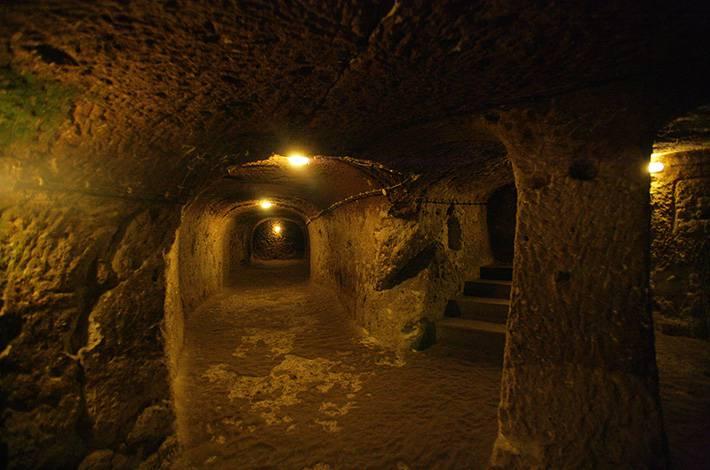
Derinkuyu Underground City
Location | Derinkuyu Türkiye Nevşehir | ||||||||
|---|---|---|---|---|---|---|---|---|---|
Depth(s) | 60-85 metres | ||||||||
Capacity | 20,000 people | ||||||||
Derinkuyu Underground City is a multi-level subterranean settlement located within the boundaries of the Derinkuyu district in Nevşehir Province, in Türkiye’s Central Anatolia Region. The region features tuff rock formations that are easily excavated due to the geological structure of Cappadocia. Thanks to this characteristic, underground cities have been used for thousands of years for defense, habitation, and production purposes.
The initial construction of Derinkuyu Underground City is believed to date back to the 8th century BCE during the Phrygian period. The structure was later expanded and reorganized during the Roman and Byzantine periods, coinciding with the spread of Christianity and adapted for various purposes.
Evidence of both pre-Christian and post-Christian usage has been identified in certain areas of the city, suggesting that some worship spaces were used during the early Christian period. In this context, it is understood that the initial construction phase was carried out by the Phrygians, while the more extensive use and expansion were undertaken by the Byzantines.
The underground city extends to a depth of 60 to 85 meters below the surface and consists of seven to eight levels. However, these levels do not correspond directly to modern architectural floors. Between the levels, narrow passages, tunnels, and door systems have been designed for both functional and defensive purposes.
Main structural elements include:
The city achieves natural air circulation through four main ventilation shafts and approximately 15,000 auxiliary air channels. These systems were also utilized for acoustic directionality and vertical communication.
Your documents indicate that Derinkuyu Underground City contains its own underground water source, which provided a secure water supply during defensive periods, disconnected from external sources.
The acoustic properties of Derinkuyu are evaluated in terms of sound direction, reflection, and control. In enclosed spaces, the sense of hearing becomes paramount. It is understood that individuals in Derinkuyu could distinguish sounds arriving from different directions through ventilation shafts and connecting tunnels. The ability to identify the source of sound was crucial for security and communication. It is believed that sound was used to convey early warnings and share information among community members based on its meaning.
Derinkuyu was not merely a shelter but a structure designed to enable long-term defense and communal living. It is estimated that approximately 20,000 people could be accommodated simultaneously within the city.
In this context, the city integrates the following elements:
The city’s access via a single main entrance provided a strategic defensive advantage.
Derinkuyu Underground City (YouTube/TRT Documentary)
Derinkuyu District Governorship. "Tarihi." *T.C. Derinkuyu Kaymakamlığı Resmi Web Sitesi*. Accessed May 22, 2025. http://www.derinkuyu.gov.tr/tarihi.
Kapadokya Alan Directorate. "Derinkuyu Yeraltı City." *Official Website of the Kapadokya Regional Directorate, Ministry of Culture and Tourism of the Republic of Turkey*. Accessed May 22, 2025. https://kapadokyaalan.ktb.gov.tr/TR-288407/derinkuyu-yeralti-sehri.html.
Nevşehir Valiliği. “Derinkuyu Yeraltı Şehri.” *T.C. Nevşehir Valiliği Resmi Web Sitesi*. Accessed May 22, 2025. http://www.nevsehir.gov.tr/derinkuyu-yeralti-sehri.
T. C. Ministry of Culture and Tourism. "Derinkuyu Yeraltı Şehri." *Müze.gov.tr*. Accessed May 22, 2025. https://muze.gov.tr/muze-detay?DistId=DKY&SectionId=DKY01.
TRT Belgesel. “Derinkuyu Yeraltı Şehri'ni Kimler İnşa Etti? | Gizemli Tarih | TRT Belgesel.” YouTube. Date Published: August 6, 2021. Accessed May 22, 2025. https://www.youtube.com/watch?v=OV8Py3tJxo4.

Derinkuyu Underground City
Location | Derinkuyu Türkiye Nevşehir | ||||||||
|---|---|---|---|---|---|---|---|---|---|
Depth(s) | 60-85 metres | ||||||||
Capacity | 20,000 people | ||||||||
No Discussion Added Yet
Start discussion for "Derinkuyu Underground City" article
Historical Origins and Construction Process
Structural Features
ventilation and Water Systems
Acoustic and Auditory Architecture
Social and Defensive Use