This article was automatically translated from the original Turkish version.
+1 More
Flight Axis Triple | Roll (Yalpa): Up-and-down wing tilt Pitch (Yunuslama): Up-and-down nose movement Yaw (Sapma): Side-to-side nose movement | ||||||||
|---|---|---|---|---|---|---|---|---|---|
Yaw Axis | roll). pitch Extends along the fuselage perpendicular to the wings. It is part of the three-dimensional coordinate system (yaw | ||||||||
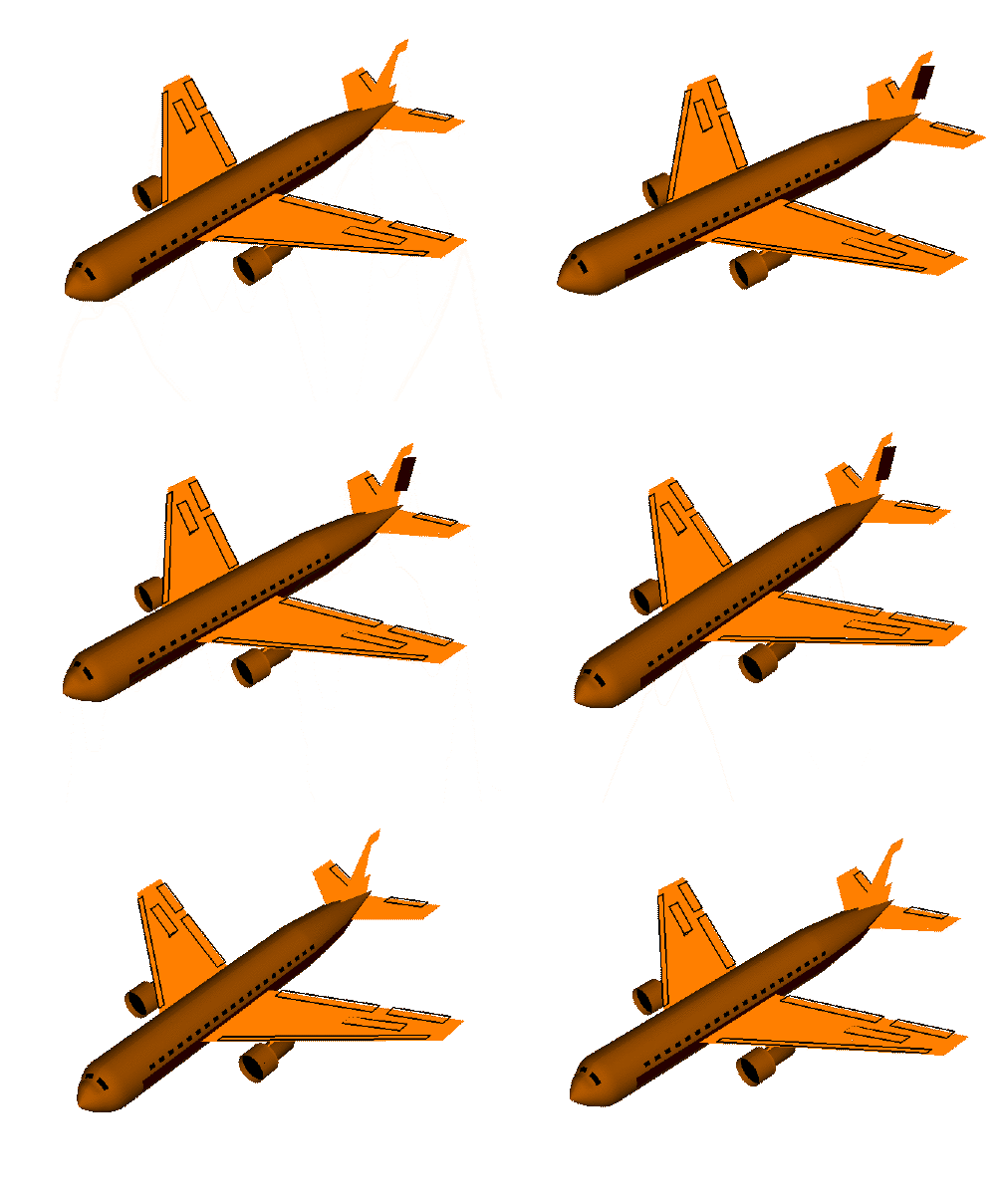
During flight, any aircraft can rotate around a three-dimensional coordinate system passing through its center of gravity. Each axis in this coordinate system is defined perpendicular to the others and is used to determine the aircraft’s orientation in space. One of these axes, the yaw axis, is perpendicular to the wings and lies within the fuselage axis plane. The left-right rotational movement of the aircraft around this axis is called yaw motion.
Yaw motion is achieved through the rudder, a hinged surface located behind the aircraft’s vertical stabilizer. When the rudder deflects to the left, it generates a side force toward the right side of the aircraft; when it deflects to the right, it produces a side force toward the left. This force causes the aircraft to rotate around its center of gravity, allowing the pilot to maintain the aircraft’s nose in the desired flight direction.
The vertical stabilizer and rudder together form a symmetric airfoil. When the rudder is aligned flush with the stabilizer, no side force is generated. However, when the rudder deflects, it can produce a positive or negative side force in the desired direction. This configuration provides the necessary aerodynamic forces for directional control.
In some fighter aircraft, dual vertical stabilizers and dual rudders are used to counteract the torque generated by powerful engines and to enhance maneuverability.
Yaw is one of the three primary axes used for aircraft attitude control; the other two are the pitch and roll axes. Movements around these three axes together define the aircraft’s full orientation and flight control.
Airplane control - Roll, Pitch, Yaw (SoftwarePole)
ITÜ. *Aerodinamik Kuvvet ve Momentler*. ITÜ. Accessed July 19, 2025. https://web.itu.edu.tr/~yukselen/Uck351/02-%20Aerodinamik%20kuvvet%20ve%20momentler.pdf
NASA Glenn Research Center. "Aircraft Yaw Motion." NASA. Accessed July 19, 2025. https://www.grc.nasa.gov/www/k-12/VirtualAero/BottleRocket/airplane/yaw.html
SoftwarePole. "Airplane control - Roll, Pitch, Yaw." YouTube. Accessed July 19, 2015. https://www.youtube.com/watch?v=pQ24NtnaLl8

Flight Axis Triple | Roll (Yalpa): Up-and-down wing tilt Pitch (Yunuslama): Up-and-down nose movement Yaw (Sapma): Side-to-side nose movement | ||||||||
|---|---|---|---|---|---|---|---|---|---|
Yaw Axis | roll). pitch Extends along the fuselage perpendicular to the wings. It is part of the three-dimensional coordinate system (yaw | ||||||||
No Discussion Added Yet
Start discussion for "Deviation (Aviation)" article
Formation of Yaw Motion