

This article was automatically translated from the original Turkish version.
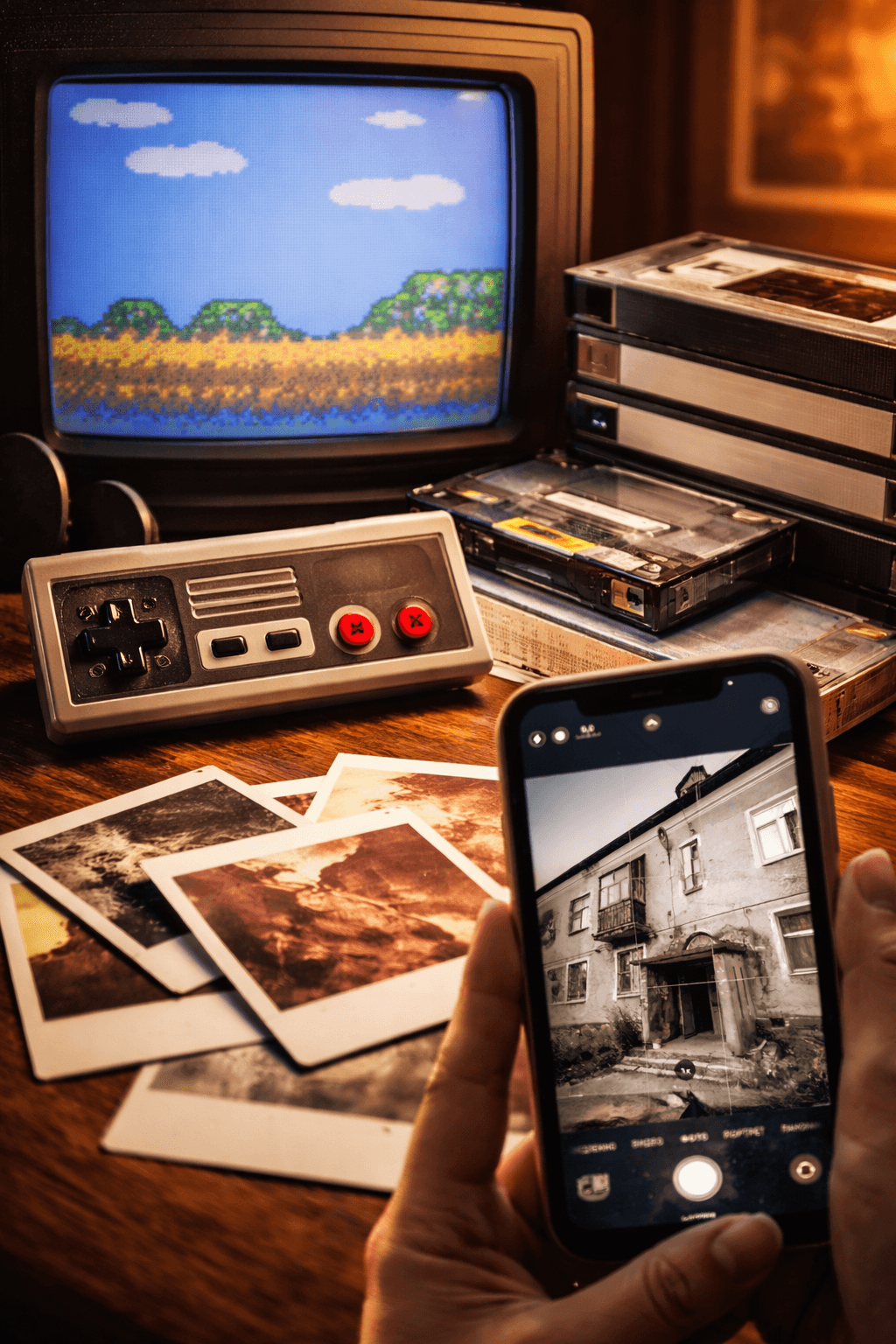
Digital Nostalgia (Generated with Artificial Intelligence.)
Related People | L. Y. İnce (Game) Svetlana Boym (Theory) | ||||||||
|---|---|---|---|---|---|---|---|---|---|
Basic Type(s) | Restorative Reflective | ||||||||
Focus Channels | Social Media (Instagram), Digital Archives, Games | ||||||||
Applications | #tbt, Retro Marketing, Impression Management | ||||||||
English | Digital Nostalgia | ||||||||
Digital Nostalgia is a concept referring to the process through which individual and social experiences of the past are recalled, shared, and reinterpreted via digital media environments. The term nostalgia derives from the Greek words nostos, meaning “return home,” and algos, meaning “pain” or longing; initially, it was associated with an individual’s yearning for their homeland.【1】 Over time, this meaning expanded to encompass not only a physical desire to return but also a broader emotional orientation toward the past. With the impact of digitization, this emotion has gained visibility through social media and online platforms; personal memories, when shared within digital communities, have become part of collective memory. In this process, the digital environment functions not merely as a space for recalling the past but also as a “memory space” where memories are regenerated and circulated.
Visual content, particularly photographs, plays a decisive role in the formation of digital nostalgia. Photography establishes a direct link with memory by concretizing past experiences and creating a bridge between the past and the present. Similarly, photographs, as material traces of the past, are said to play a vital role in the construction of memory. In this context, digital nostalgia is regarded as a multilayered phenomenon that enables the reconstruction of the past through technological tools and influences both individual and social memory processes.
The concept of nostalgia has undergone significant semantic change throughout history. Initially defined in the 17th century as a medical condition linked to an individual’s longing for their homeland, nostalgia gradually expanded beyond this narrow framework to express a broader emotional orientation toward the past. Originally associated with physiological symptoms, the concept was reinterpreted in the modern era by psychology and the social sciences as a way in which individuals form connections with the past.【2】
Processes of modernization, urbanization, and rapid social change have played a decisive role in the transformation of nostalgia. The dissolution of traditional community structures and the distancing of individuals from their roots are among the key factors intensifying longing for the past. In this context, nostalgia for the modern individual is not merely a sentiment directed toward the past but also an orientation toward the search for meaning.【3】 The frequent selective and idealized reconstruction of the past demonstrates that nostalgia is not merely an act of remembering but also a process of re-creation.【4】

Representative Visual of the Digital Recording of Memories (Pexels)
Philosophically, nostalgia is understood as a reflection of the human relationship with time. In this framework, nostalgia is part of the effort to comprehend the relationship between past, present, and future. Particularly within the Heideggerian approach, the individual’s relationship with the past, interpreted through the concepts of “being-in-the-world” and temporality, plays a crucial role in shaping one’s existential understanding. Orientation toward the past is not merely an emotional longing but is also connected to the process through which individuals grasp their own existential position.【5】
On the other hand, nostalgia is also considered not only as an individual experience but as a social and cultural phenomenon. Nostalgic imagery, reproduced through media and popular culture, contributes to the reinterpretation of the past in the present. In this process, nostalgia functions as a significant element in the formation of both individual memory and collective memory.【6】 Thus, nostalgia has evolved from a historical medical diagnosis into a multilayered concept encompassing philosophical, cultural, and social dimensions.
Social media stands out as a digital environment where past experiences are not merely stored but are re-circulated and reinterpreted within contemporary contexts. Platforms such as Facebook and Instagram enable users not only to make current posts but also to revive and share memories from the past. In this sense, social media fulfills the function of a “memory space” that shapes collective memory.【7】
The “Throwback” culture is one of the most visible forms of this remembering practice on social media. Known as Throwback Thursday and commonly abbreviated as TBT, this practice involves users sharing photographs from the past, particularly on Thursdays. TBT is defined as a usage pattern that allows users to share memories with others by adding the #tbt hashtag to their posts and generating nostalgia.【8】 Within Instagram, TBT is viewed as a hashtag used to share photos from a past day or era and is considered one of the most prominent manifestations of nostalgia on social media.

Digital Communication in Daily Life (Pexels)
In this culture, the photograph serves as the primary medium. In the digital age, the photograph has moved beyond being a mere document of the past to become a form of communication within social networks. Users sometimes transfer their fleeting experiences or nostalgic memories into digital spaces through throwback posts. This transforms the relationship between photography and memory, leading to the reconstruction of past visual images within the meaning frameworks of the present.【9】 Therefore, throwback posts are understood not as direct transfers of the past but as its re-presentation in the present.
Another characteristic of throwback culture is the selective visibility of the past. Users do not share every old photograph but rather those that hold personal significance or align with their current identity presentations. Indeed, it is noted that photos shared under TBT typically depict “important” or “special” moments, with users using these posts to revive feelings of happiness, closeness, and longing from the past.【10】 In this sense, TBT serves not only to commemorate the past but also to reorganize it within the framework of the present self.
Throwback culture also generates interaction. A post about the past can facilitate the re-establishment of connections among users, the recollection of shared memories, and the continuation of digital engagement. The increased visibility of posts tagged with #tbt enables other users to access related content and fosters a shared space of remembrance through comments, strengthening the communicative dimension of this practice.【11】 Thus, TBT is not merely an expression of individual memory but also a relational form of communication established within social media.
It is also emphasized that throwback posts carry meaning oriented toward the present. Although nostalgic photographs are from the past, the manner in which they are shared, the accompanying text, and their presentation style construct meaning in the present. Every TBT photograph shared on social media carries a memory element, but as it becomes a form of communication, it functions primarily within the context of today’s identity and impression management. Therefore, throwback culture constitutes a dimension of digital nostalgia shaped not merely by remembrance but by practices of selection, organization, and re-presentation.
Digital games establish a relationship between memory and nostalgia not only through content that recalls the past but also through their interactive structures that provide users with experiential engagement. In this context, the concept of “topographic nostalgia” indicates that players’ memories are shaped not only by the content of the game but also by the physical environments in which they played and the virtual spaces the games offered.【12】
Topographic nostalgia focuses on the spatial dimension of gaming experiences and reveals that the process of remembering is not only temporal but also place-based. Memories related to games are not limited to characters, tasks, or narrative elements; the room in which the player sat, the device they used, and the surrounding environment during gameplay also become integral parts of this remembering process.【13】 This indicates that nostalgia for digital games is directed not toward a specific game but toward the holistic experience surrounding it.
In digital games, space functions not as a passive background but as one of the constitutive elements of the experience. The paths, cities, rooms, and various environmental elements presented to the player allow them to navigate and explore these spaces. It is argued that such navigable and meaningful spaces strengthen the player’s bond with the game and directly influence the process of memory.【14】 Therefore, nostalgia for games often focuses not on a specific narrative but on the spatial experience itself.

Retro Game (Pexels)
The emotional and social dimensions of gaming experiences also play a significant role in the formation of topographic nostalgia. It is noted that gaming spaces and practices contribute to the formation of individual identity and that these experiences are reconstructed through memory.【15】 In particular, gaming experiences from childhood and adolescence create a broader field of remembrance that includes not only the game itself but also the social relationships and daily life of that period.
Over time, these experiences are said to form a unique memory space for the individual, one to which the person can mentally return.【16】 In this sense, digital games are regarded as digital environments that do not merely recall past experiences but also reconstruct and make them accessible in spatial terms.
Nostalgia is used as a key strategy in marketing to establish emotional connections with consumers. This approach aims to provide consumers with emotional satisfaction by reviving past experiences and memories. Nostalgia-themed products or marketing messages are attractive to consumers because they facilitate access to positive memories from the past.【17】
The effects of nostalgia marketing on consumers are analyzed through individual and social dimensions. Such marketing practices not only evoke a sense of longing for the past but also strengthen feelings of belonging, social connection, and emotional closeness. Therefore, nostalgia is regarded as a multidimensional factor influencing consumption behavior.【18】
Generation Z, despite having grown up in a digital environment, stands out as a consumer group showing significant interest in nostalgia-themed content. The study indicates that this interest is driven by distinct motivations—individual, social, and design-related. Individual motivations include self-expression and the pursuit of uniqueness, while social motivations are linked to interpersonal relationships and societal needs. In addition, the design features of products also influence Generation Z’s orientation toward nostalgic goods.
The methods used in nostalgia marketing vary. These include the re-release of previously popular products, the revival of old brands, and the incorporation of nostalgic elements into product and packaging designs. Additionally, the use of themes referencing the past in advertising and communication campaigns is a common practice.
Within this framework, nostalgia marketing is not merely a practice of recalling the past but is also regarded as a functional tool within contemporary consumer culture. Particularly from the perspective of Generation Z, nostalgia has become a multidimensional consumption practice intertwined with aesthetic preference, identity presentation, and social interaction.
Collective memory is understood as a dynamic, continuously reconstructed structure formed through individuals’ practices of recalling and sharing past experiences. This structure is not merely the sum of individual memories but a process shaped by the narratives and interactions of diverse individuals. With digitization, this process has transcended physical boundaries and acquired a new form within online environments.【19】
Digital environments function as new memory spaces where content from the past is stored and circulated. Through social media platforms and various digital archives, individuals make their past experiences visible and share them with others. This not only preserves collective memory but also ensures its continuous reproduction. Thus, memory has transformed from a fixed structure into a process shaped by contemporary interactions.
One of the fundamental components of digital archives is visual materials, which occupy a central position in this process. Particularly photographs stand out as tools that concretize moments from the past, facilitate remembrance, and activate memory. Photographs, carrying traces of their era, contribute to the formation of both individual and collective memory. In this sense, visual materials in digital archives are not merely records but have become part of the process of meaning production.
Another important feature of digital archives is their openness to user participation. Individuals directly contribute to the formation of collective memory by sharing their own photographs, narratives, and experiences on digital platforms. This participatory structure enables collective memory to be reconstructed in a multilayered and interactive manner.【20】 Simultaneously, this process enables the past to transform from a static data repository into a reinterpreted experience within the contemporary context.
In this context, digital archives are regarded as structures that sustain continuity between the past and the present and keep collective memory alive. Particularly, the opportunities provided by digital environments for identity, belonging, and cultural transmission create a foundation for the joint reproduction of memory’s individual and social dimensions.
Bozkuş, Şeyda Barlas. “Dijital Medya Ekseninde Nostalji ve Toplumsal Bellek.” 2023. Accessed March 7, 2026. https://www.academia.edu/download/107036977/makale.pdf
Cottonbro Studio. “Kişi Eller Kadın Akıllı Telefon.” Photograph. Pexels. Accessed March 7, 2026. https://www.pexels.com/tr-tr/fotograf/kisi-eller-kadin-akilli-telefon-6555026/
GODMODE INTRUST. “Festival Bilgisayar Televizyon TV.” Photograph. Pexels. Accessed March 7, 2026. https://www.pexels.com/tr-tr/fotograf/festival-bilgisayar-televizyon-tv-14852171/
Kaplan, İsmail, and Hayyam Celilzade. “Sosyal Medyadaki Nostalji İçerikli Paylaşımlar Üzerine Felsefi Bir Okuma.” *İnsan ve Toplum Bilimleri Araştırmaları Dergisi* 14, no. 5 (2025): 2925–2943. Accessed March 7, 2026. https://dergipark.org.tr/en/download/article-file/5264857
Köse, Hüseyin, and Helin Aydın. “Medyatik Popüler Kültürde Nostalji: Kültürel Doyum Üzerine Bir İnceleme.” *Folklor/Edebiyat* 26, no. 104 (2020): 757–779. Accessed March 7, 2026. https://dergipark.org.tr/en/download/article-file/1368277
Levi, Eser, Ayşe Bengi Özçelik, and Birce Sarıgül. “Z Kuşağının Nostalji Pazarlamasına Yaklaşımı.” *İstanbul Aydın Üniversitesi Sosyal Bilimler Dergisi* 15, no. 4 (2023): 499–525. Accessed March 7, 2026. https://dergipark.org.tr/tr/download/article-file/3409009
Pires, Rafael. “Dijital Video Kamera Tutan Siyah Gömlek Giyen Adam.” Photograph. Pexels. Accessed March 7, 2026. https://www.pexels.com/tr-tr/fotograf/dijital-video-kamera-tutan-siyah-gomlek-giyen-adam-1128230/
Saltık, Rabiya, and Fatma Esra Öztürk. “Göçmen Belleğinin Dijital Mekânı: ‘DiasporaTürk’.” *Uluslararası Medya ve İletişim Araştırmaları Hakemli Dergisi* 6, no. 2 (2023): 251–279. Accessed March 7, 2026. https://dergipark.org.tr/en/download/article-file/3258307
Saltık, Rabiya. “Sosyal Medyada Nostaljik Hafıza Deneyimleri Olarak Throwback Paylaşımlar.” *Kocaeli Üniversitesi İletişim Fakültesi Araştırma Dergisi*, no. 19 (2022): 8–37. Accessed March 7, 2026. https://dergipark.org.tr/tr/download/article-file/1973105
Satır, Mehmet Emin. “Yeni Medya ve Nostalji: TRT Arşiv Üzerine Bir Değerlendirme.” *Karadeniz Sosyal Bilimler Dergisi* 13, no. 24 (2021): 116–129. Accessed March 7, 2026. https://dergipark.org.tr/tr/download/article-file/1380562
Tansel, Betül, and Serhat Kaya. “Instagram’da Zamana Yolculuklar: Nostalji Algısının Yeniden Üretimi ve TBT’nin Kullanım Pratikleri Üzerine.” *Etkileşim*, no. 4 (2019): 236–253. Accessed March 7, 2026. https://dergipark.org.tr/en/download/article-file/825320
İnce, Levent Y. “Dijital Oyun Oynama Anıları ve Topografik Nostalji.” *Moment Dergi* 11, no. 2 (2025): 403–421. Accessed March 7, 2026. https://dergipark.org.tr/en/download/article-file/4261240
[1]
Rabiya Saltık ve Fatma Esra Öztürk, “Göçmen Belleğinin Dijital Mekânı: ‘DiasporaTürk’,” Uluslararası Medya ve İletişim Araştırmaları Hakemli Dergisi 6, no. 2 (2023): 254, https://dergipark.org.tr/en/download/article-file/3258307
[2]
İsmail Kaplan ve Hayyam Celilzade, “Sosyal Medyadaki Nostalji İçerikli Paylaşımlar Üzerine Felsefi Bir Okuma,” İnsan ve Toplum Bilimleri Araştırmaları Dergisi 14, no. 5 (2025): 2928, https://dergipark.org.tr/en/download/article-file/5264857.
[3]
İsmail Kaplan ve Hayyam Celilzade, “Sosyal Medyadaki Nostalji İçerikli Paylaşımlar Üzerine Felsefi Bir Okuma,” 2927.
[4]
Rabiya Saltık ve Fatma Esra Öztürk, “Göçmen Belleğinin Dijital Mekânı: ‘DiasporaTürk’,” 254.
[5]
İsmail Kaplan ve Hayyam Celilzade, “Sosyal Medyadaki Nostalji İçerikli Paylaşımlar Üzerine Felsefi Bir Okuma,” 2929.
[6]
Hüseyin Köse ve Helin Aydın, “Medyatik Popüler Kültürde Nostalji: Kültürel Doyum Üzerine Bir İnceleme,” Folklor/Edebiyat 26, no. 104 (2020): 757, https://dergipark.org.tr/en/download/article-file/1368277.
[7]
İsmail Kaplan ve Hayyam Celilzade, “Sosyal Medyadaki Nostalji İçerikli Paylaşımlar Üzerine Felsefi Bir Okuma,” 2927–2928.
[8]
Rabiya Saltık, “Sosyal Medyada Nostaljik Hafıza Deneyimleri Olarak Throwback Paylaşımlar,” 18-19.
[9]
Rabiya Saltık, “Sosyal Medyada Nostaljik Hafıza Deneyimleri Olarak Throwback Paylaşımlar,” 10-11.
[10]
Betül Tansel ve Serhat Kaya, “Instagram’da Zamana Yolculuklar: Nostalji Algısının Yeniden Üretimi ve TBT’nin Kullanım Pratikleri Üzerine,” Etkileşim, no. 4 (2019): 246-247, https://dergipark.org.tr/en/download/article-file/825320.
[11]
Betül Tansel ve Serhat Kaya, “Instagram’da Zamana Yolculuklar: Nostalji Algısının Yeniden Üretimi ve TBT’nin Kullanım Pratikleri Üzerine,” 247.
[12]
Levent Y. İnce, “Dijital Oyun Oynama Anıları ve Topografik Nostalji,” Moment Dergi 11, no. 2 (2025): 406, https://dergipark.org.tr/en/download/article-file/4261240.
[13]
Levent Y. İnce, “Dijital Oyun Oynama Anıları ve Topografik Nostalji,” 406.
[14]
Levent Y. İnce, “Dijital Oyun Oynama Anıları ve Topografik Nostalji,” 407.
[15]
Levent Y. İnce, “Dijital Oyun Oynama Anıları ve Topografik Nostalji,” 410.
[16]
Levent Y. İnce, “Dijital Oyun Oynama Anıları ve Topografik Nostalji,” 414.
[17]
Eser Levi, Ayşe Bengi Özçelik ve Birce Sarıgül, “Z Kuşağının Nostalji Pazarlamasına Yaklaşımı,” İstanbul Aydın Üniversitesi Sosyal Bilimler Dergisi 15, no. 4 (2023): 502, erişim 7 Mart 2026, https://dergipark.org.tr/tr/download/article-file/3409009.
[18]
Eser Levi, Ayşe Bengi Özçelik ve Birce Sarıgül, “Z Kuşağının Nostalji Pazarlamasına Yaklaşımı,” 504.
[19]
Rabiya Saltık ve Fatma Esra Öztürk, “Göçmen Belleğinin Dijital Mekânı: ‘DiasporaTürk’,” 253.
[20]
Rabiya Saltık ve Fatma Esra Öztürk, “Göçmen Belleğinin Dijital Mekânı: ‘DiasporaTürk’,” 253.


Digital Nostalgia (Generated with Artificial Intelligence.)
Related People | L. Y. İnce (Game) Svetlana Boym (Theory) | ||||||||
|---|---|---|---|---|---|---|---|---|---|
Basic Type(s) | Restorative Reflective | ||||||||
Focus Channels | Social Media (Instagram), Digital Archives, Games | ||||||||
Applications | #tbt, Retro Marketing, Impression Management | ||||||||
English | Digital Nostalgia | ||||||||
The Transformation of Nostalgia and Its Philosophical Background
Social Media and the “Throwback” Culture
Digital Games and Topographic Nostalgia
Marketing Strategies and Generation Z
Collective Memory and Digital Archives